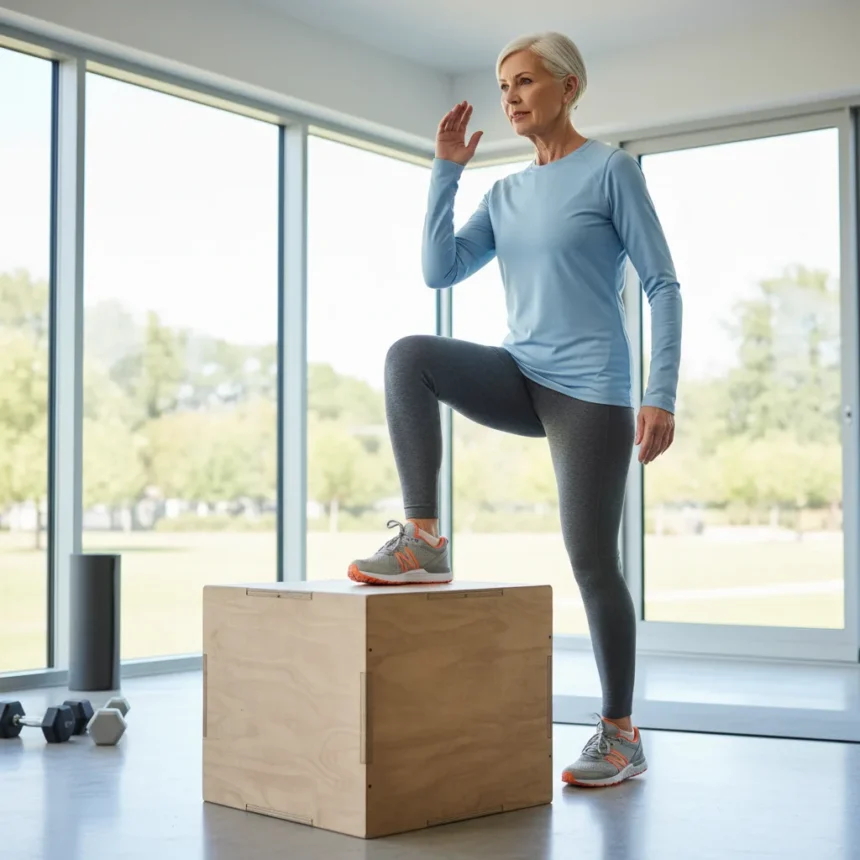
Step-ups after 60 are a direct measure of functional leg strength that correlates with your ability to perform everyday tasks like climbing stairs and maintaining balance. This simple bodyweight exercise has become a benchmark for assessing whether your lower-body power exceeds that of your peers, offering older adults a concrete way to test fitness without equipment or a gym.
Key Takeaways
- Step-ups after 60 directly mimic daily movements like stair climbing and support functional independence.
- The step-up test provides a population-based benchmark for comparing leg strength across the 60+ age group.
- Step-ups build lower-body power, improve balance, and support longevity when performed consistently.
- Squats and chair stands offer comparable alternatives for testing leg strength in older adults.
- No equipment is required—step-ups are accessible for most fitness levels and home settings.
Why Step-ups After 60 Matter for Functional Fitness
Step-ups after 60 measure more than raw leg strength—they assess your ability to perform the movements your body relies on daily. Climbing stairs, rising from a chair, and walking uphill all depend on the same muscles and movement patterns that step-ups target. This functional relevance makes step-ups a more meaningful fitness test than isolated strength metrics that do not translate to real-world capability.
The exercise works your quadriceps, glutes, hamstrings, and calves while demanding balance and stability. For adults over 60, maintaining this functional capacity is directly linked to independence, fall prevention, and quality of life. Strength training at this age has been shown to support longevity and healthier aging, making step-ups a practical tool for self-assessment and motivation.
Understanding the Step-ups After 60 Benchmark
The step-ups after 60 benchmark establishes a population-based standard: if you can complete a certain number of repetitions, your leg strength exceeds that of approximately 50 percent of adults in your age group. This percentile approach removes the guesswork from fitness assessment—you are not comparing yourself to elite athletes or 30-year-olds, but to your actual peer group.


The beauty of this benchmark is its simplicity. Unlike complex gym equipment or expensive testing protocols, step-ups require only a sturdy step or low platform and your body weight. The test is accessible in most home environments, making it practical for older adults who may not have gym access or prefer exercising at home. Knowing where you stand relative to your peers can be motivating—whether it reveals room for improvement or confirms that your training is paying off.
How Step-ups Compare to Other Leg Strength Tests
Squats are the most direct alternative to step-ups for assessing leg strength in adults over 60. Tom’s Guide has published benchmarks for squats in the same age group, positioning them as another measure of lower-body power. Both exercises target similar muscle groups, but they differ in movement mechanics: step-ups emphasize single-leg stability and hip drive, while squats demand bilateral coordination and core engagement.



Chair stands—rising from a chair without using your hands—offer a gentler entry point for those with mobility limitations or joint concerns. Power walking and resistance band work provide low-impact alternatives that build strength while protecting joints, making them valuable options if step-ups cause discomfort. The choice between these exercises depends on your current fitness level, any existing injuries, and your access to equipment or space.
Building Leg Strength Safely After 60
Before starting any new exercise program, consult a qualified healthcare provider or physical therapist, especially if you are returning from injury, have joint concerns, or are new to strength training. Form matters more than speed or volume when performing step-ups after 60. Keep your chest upright, drive through your front heel, and avoid letting your knee collapse inward as you step up. Control the descent on the way down—do not drop or jump off the step, as this increases injury risk.
Start with a lower step height if you are new to the movement, and progress gradually. Your body adapts to strength training over weeks and months, not days. Consistency beats intensity at this stage of life. Perform step-ups two to three times per week with at least one rest day between sessions to allow recovery. Pair them with other strength work—bodyweight squats, resistance band exercises, or light weights—to build balanced fitness and prevent overuse injuries.
Frequently Asked Questions
What is the exact number of step-ups that indicates above-average leg strength after 60?
The research brief does not specify the exact repetition count that defines the 50th percentile for step-ups after 60. The benchmark exists but the specific threshold varies based on the testing protocol used (step height, cadence, number of repetitions per leg). To establish your personal baseline, perform as many controlled step-ups as possible on each leg and track the number over time.



Are step-ups safe for people with knee pain or arthritis?
Step-ups can aggravate existing knee pain if performed with poor form or excessive volume. If you have knee concerns, start with a lower step height, reduce the range of motion, or try gentler alternatives like chair stands or resistance band work. Always consult a physical therapist before beginning a new strength program if you have joint issues.
How often should I do step-ups after 60 to improve leg strength?
Two to three sessions per week with adequate recovery between workouts is a sustainable approach for building strength in older adults. Allow at least one rest day between sessions. Consistency over months and years matters more than high-frequency training that risks burnout or injury.
Step-ups after 60 are a simple, equipment-free way to measure and build the leg strength that keeps you independent and mobile. The benchmark provides clarity—a concrete standard against which to measure your progress—while the movement itself trains the exact capabilities you use every day. Start where you are, focus on form, and progress gradually. Your future self will thank you for the investment.
Edited by the All Things Geek team.
Source: Tom's Guide