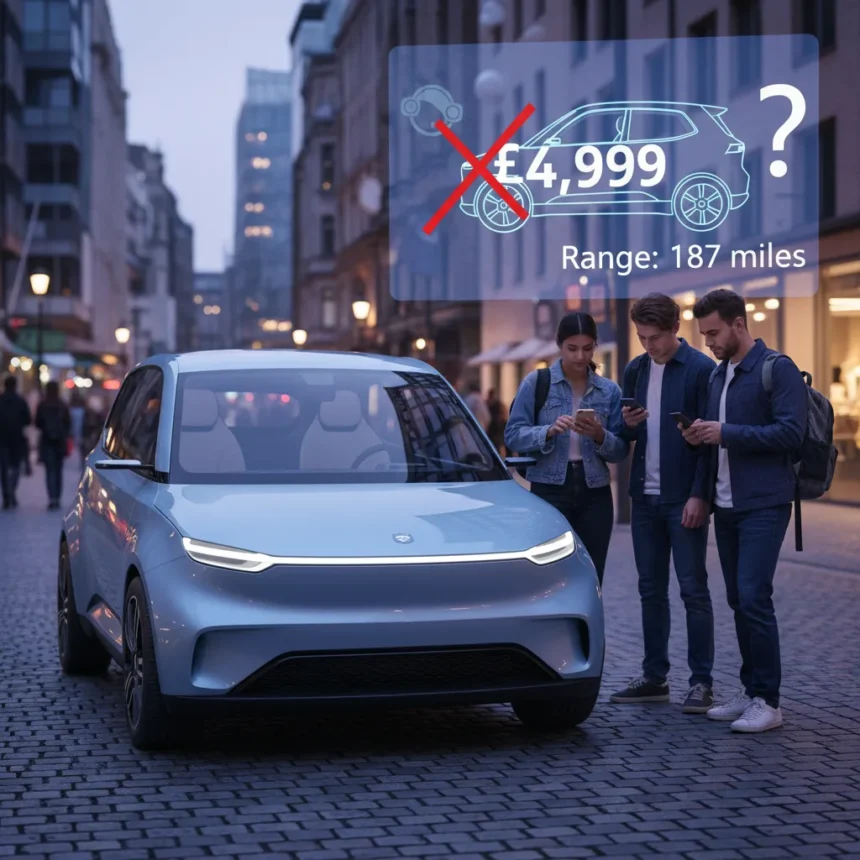
Affordable small electric cars have become the holy grail for young buyers priced out of the EV market, yet the gap between promise and reality remains stubbornly wide. The title of an ideal sub-£5,000 compact EV with 187-mile range sounds perfect on paper, but no such vehicle exists in today’s market.
Key Takeaways
- No new small EV matches a sub-£5,000 price point with 187-mile range capability
- Mini Aceman starts at £31,800, positioning it as the affordable compact EV alternative
- Young buyers face a pricing reality far above the promised sub-£5k benchmark
- Fast charging specs for ultra-affordable EVs remain largely unspecified across the market
- The affordability gap for compact electric vehicles continues to widen
The Sub-£5k Promise That Does Not Exist
The premise of an affordable small electric car under £5,000 with 187-mile range represents a market fantasy rather than current reality. No manufacturer has delivered a new vehicle matching these specifications at this price point. The closest genuine alternative in the compact EV space is the Mini Aceman, which starts at £31,800 and is available to order now. This represents a £26,800 gap between the promised price and what young buyers actually encounter when shopping for compact electric vehicles.
The marketing narrative around affordable EVs often conflates aspirational pricing with actual market conditions. Young people searching for entry-level electric cars discover that the sub-£5,000 threshold applies to used vehicles or vehicles in markets outside the UK, not new compact models with modern range capabilities. The Mini Aceman, while positioned as an affordable stepping stone between the Mini Cooper and Countryman, still exceeds the promised price by more than five times.
What Affordable Small Electric Cars Actually Cost
The Mini Aceman demonstrates the true pricing landscape for compact EVs aimed at younger buyers. Starting at £31,800 and scaling up to £41,350, the Aceman occupies a middle ground in the compact EV market. This pricing reflects the reality that battery technology, electric powertrains, and modern safety systems carry genuine costs that manufacturers cannot eliminate through clever engineering alone.

The gap between promised affordability and delivered pricing reveals a fundamental tension in the EV market. Young buyers entering the electric vehicle space face a choice: purchase an older used EV with unknown battery health, wait for prices to decline further, or stretch their budget significantly beyond the mythical £5,000 threshold. The Aceman’s £31,800 entry point, while lower than many competitors, still represents a substantial investment for first-time car buyers or young professionals.
The Missing Technical Specifications
Claims about fast charging capability for ultra-affordable small electric cars typically lack supporting technical details. Specifications such as charging rate in kilowatts, battery capacity, or real-world charging time from empty to full remain unverified across these hypothetical vehicles. Without concrete charging data, claims of “fast charging” become marketing language rather than measurable performance.



The Mini Aceman, as a real product available in the market, provides the kind of transparent specifications that young buyers need to make informed decisions. Any genuine affordable small electric car would need to publish similar technical details: battery size, charging curve, real-world range under various conditions, and charging infrastructure compatibility. The absence of these specifications in discussions of sub-£5,000 EVs suggests the products themselves remain purely theoretical.
Why the Affordability Gap Persists
The distance between the promised sub-£5,000 small electric car and actual market offerings reflects hard engineering and economic realities. Battery cells remain the largest cost component in any EV, and manufacturers cannot achieve meaningful range at ultra-low price points without accepting serious compromises in durability, performance, or safety. A 187-mile range requires a battery pack with sufficient capacity to store meaningful energy, which costs money.
Young buyers deserve honesty about what affordable electric vehicles actually cost in 2025. The Mini Aceman represents a genuine attempt to create a more accessible compact EV, yet it still demands a commitment far beyond the mythical £5,000 figure. Marketing narratives that promise sub-£5,000 compact EVs with modern range do a disservice to young people saving for their first electric vehicle, setting expectations that the market cannot meet.
Can young people actually afford small electric cars?
Young people can afford small electric cars, but not at the sub-£5,000 price point often promised. The Mini Aceman at £31,800 represents the most accessible new compact EV in the current market, though this still exceeds many first-time buyers’ budgets. Used electric vehicles offer another path, though battery condition becomes a critical concern.



What makes the Mini Aceman different from other compact EVs?
The Mini Aceman positions itself as an exclusive electric-only compact model, distinct from the Mini Cooper by offering a dedicated EV platform rather than adapting an internal combustion design. It sits between the Cooper and Countryman in Mini’s lineup, targeting buyers who want a new compact EV without paying full premium prices.
Are fast-charging specifications available for affordable small electric cars?
Technical fast-charging specifications—including kilowatt rates, battery capacity, and real-world charging times—remain largely unspecified for vehicles marketed as ultra-affordable small electric cars. Without these concrete details, charging claims remain unverifiable and should be treated with skepticism.
The ideal affordable small electric car for young people remains a work in progress. Until manufacturers deliver genuine compact EVs at prices young buyers can actually afford, the sub-£5,000 narrative will continue to mislead. The Mini Aceman proves that compact electric vehicles are possible, but affordability—true affordability—still requires either waiting for battery costs to fall further or accepting the reality that entry-level EVs today cost substantially more than the mythical promises suggest.
Where to Buy
Edited by the All Things Geek team.
Source: T3