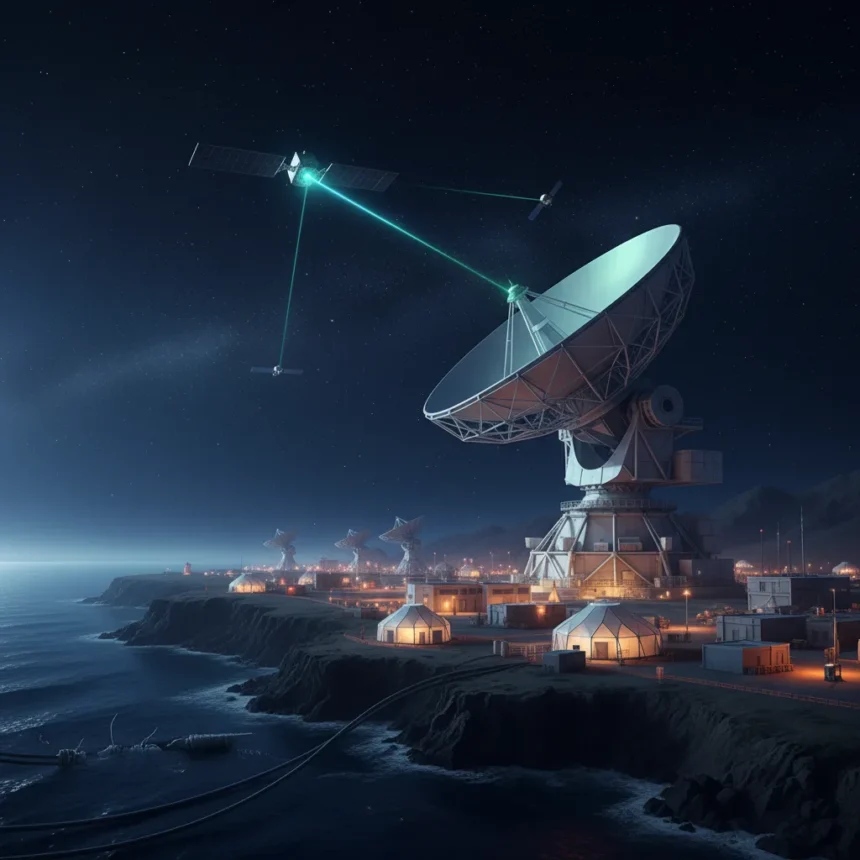
Subsea cable vulnerabilities are reshaping how the world thinks about intercontinental connectivity. More than 95% of global voice and data traffic travels through underwater cables, yet these systems face repeated damage from accidental human activity, sabotage, and environmental disruption. A new generation of deployable optical ground stations now offers a practical way to route communications around this critical infrastructure weakness, providing resilience when cables fail.
Key Takeaways
- Subsea cables carry more than 95% of intercontinental data traffic but suffer 150–200 faults annually.
- 70–80% of submarine cable damage results from accidental human activity like ship anchoring and fishing.
- Deployable optical ground stations create space-based backup routes, avoiding cable infrastructure entirely.
- NATO-backed satellite resilience projects are already exploring rerouting during cable sabotage or disasters.
- Space-based optical links complement rather than replace cables, forming a redundant network architecture.
Why Subsea Cable Vulnerabilities Matter Now
The global internet depends on a fragile foundation. Submarine cables transmit nearly all intercontinental data, making them a single point of failure for critical communications. The International Cable Protection Committee reports 150 to 200 faults on undersea cables each year, with 70 to 80% caused by accidental human activities such as ship anchoring and fishing. This is not a theoretical risk—it is a recurring operational reality that affects financial markets, emergency services, and government communications.
Beyond accidents, geopolitical tensions have elevated subsea cable sabotage from fringe concern to strategic worry. NATO-backed research now explores rerouting traffic from compromised cables to satellite systems during attacks or natural disasters, treating space-based connectivity as essential resilience infrastructure. A small, deployable optical ground station offers the same principle: a backup route that exists outside the physical vulnerabilities of buried or submerged fiber.
How Optical Ground Stations Address Subsea Cable Vulnerabilities
Optical ground stations communicate with satellites using laser links, creating a completely separate network path from terrestrial and subsea cables. When an undersea cable fails—whether from a ship anchor, fishing trawl, or deliberate damage—traffic can be rerouted through space-based optical links without waiting for repair crews to locate and splice the damaged fiber. This redundancy is especially valuable for island nations, remote regions, and critical infrastructure that cannot tolerate connectivity loss.

The advantage of a deployable station lies in its flexibility. Unlike fixed ground infrastructure, a mobile optical station can be positioned where it is needed most, whether that is a disaster zone, a remote facility, or a region where cable routes are concentrated and therefore vulnerable. The system works as a complement to cables, not a replacement—the vast majority of traffic still flows through fiber because it offers higher capacity and lower latency. But when cables fail, space-based optical links become the difference between service continuity and outage.
Subsea Cable Vulnerabilities and the Satellite Backup Strategy
The shift toward space-based redundancy reflects a hard lesson: submarine cables are critical but fragile. NATO-backed initiatives are already funding satellite backup systems, with some projects receiving up to €400,000 in NATO contributions as part of broader $2.5 million resilience efforts. These programs treat satellite connectivity not as a luxury but as essential infrastructure for national security and economic continuity.



Optical ground stations fit into this strategy by offering a practical, scalable way to add redundancy without massive capital investment in additional submarine cables. Building new undersea fiber is expensive, time-consuming, and still vulnerable to the same risks. A deployable optical station sidesteps these constraints, creating instant backup capacity wherever it is positioned. For countries dependent on a small number of cable landing points, this flexibility is transformative.
What This Means for Global Connectivity
The emergence of deployable optical ground stations signals a shift in how critical infrastructure is designed. Rather than assuming cables will never fail, networks are now built with the assumption that they will—and with backup systems ready to take over. This resilience mindset is spreading across telecommunications operators, governments, and international organizations.
For end users, the impact is indirect but significant. Redundant connectivity means fewer outages, faster recovery from cable damage, and more stable service during geopolitical tensions. For businesses relying on intercontinental data flows, it means less dependency on a handful of submarine cable routes. The technology does not eliminate subsea cable vulnerabilities—fiber will remain the backbone of global communications for decades. But it ensures that when cables fail, the internet does not.
Can space-based optical links fully replace submarine cables?
No. Submarine cables carry nearly 99% of intercontinental data traffic because they offer far higher capacity and lower latency than satellite systems. Space-based optical links serve as backup and redundancy, not replacement. They become critical when cables are damaged or compromised, but they cannot handle the volume of everyday traffic.



How often do subsea cables actually fail?
The International Cable Protection Committee reports 150 to 200 faults annually on undersea cables, with the majority caused by accidental human activity. Most faults are repaired within days, but major breaks can cause significant outages. Redundant connectivity through optical ground stations reduces the impact of these failures.
Is this technology being deployed now?
NATO and allied governments are actively funding satellite resilience projects, including optical ground station research. However, widespread commercial deployment is still emerging. The technology is proven, but adoption depends on telecommunications operators and governments prioritizing resilience over cost.
Subsea cable vulnerabilities are not going away—they are inherent to the physics and geography of underwater fiber. But the rise of deployable optical ground stations shows that the industry is finally taking redundancy seriously. When your internet depends on cables buried under thousands of meters of water, a backup route in space is not a luxury. It is insurance.
Edited by the All Things Geek team.
Source: TechRadar