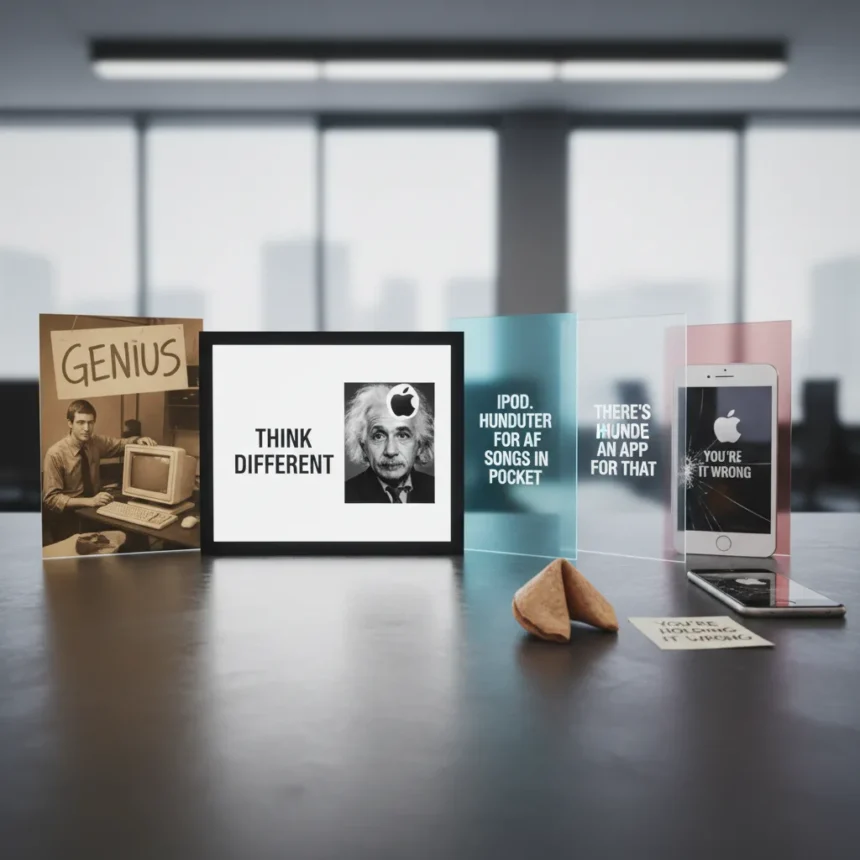
Apple iconic slogans have shaped not just the company’s identity but the entire tech industry’s marketing vocabulary over five decades. From the 1976 founding to today, Apple’s catchphrases reveal a company oscillating between visionary messaging and spectacular public relations disasters. The slogans tell a story: a scrappy startup that learned to sell dreams, then occasionally sold them so hard it forgot to test the product first.
Key Takeaways
- Apple’s most famous slogan, ‘Think Different,’ rescued the company from near-bankruptcy in 1997 and became a cultural phenomenon.
- ‘1000 songs in your pocket’ turned the iPod into a lifestyle product during the 2001-2004 era.
- The ‘Hello, I’m a Mac’ campaign (2006-2009) dominated comparative advertising but couldn’t prevent the iPhone’s eventual dominance over Mac sales.
- ‘You’re holding it wrong’ became a symbol of corporate arrogance during the 2010 iPhone 4 antenna controversy.
- Apple’s early taglines like ‘The Computer for the Rest of Us’ (1984) established the company’s core mission: making technology accessible.
The Slogan That Saved Apple: Think Different
When Steve Jobs returned to Apple in 1997, the company was hemorrhaging money and relevance. ‘Think Different’ arrived not as a product pitch but as a philosophical statement. The campaign featured black-and-white imagery of cultural rebels—Einstein, Gandhi, Miles Davis—with a whispered voiceover: ‘Here’s to the crazy ones. The misfits. The rebels’. It was genius precisely because it didn’t mention computers. Instead, it positioned Apple as a brand for people who rejected conformity, and in doing so, it rescued the company from the brink of bankruptcy.
The slogan became more than marketing. It infiltrated popular culture, inspired countless imitations, and fundamentally changed how tech companies speak to consumers. Every startup that claims to ‘disrupt’ or ‘reshape’ is borrowing from Apple’s playbook. What made ‘Think Different’ work was its emotional core: it told people that buying an Apple product meant joining a tribe of innovators, not just purchasing a computer.
Apple Iconic Slogans That Defined Product Eras
Before ‘Think Different,’ Apple had already established itself with ‘The Computer for the Rest of Us’ in 1984, a slogan targeting everyday users rather than tech professionals. This phrase embodied Apple’s original mission: making technology accessible to people who weren’t engineers or hobbyists. It positioned the Macintosh against IBM’s intimidating corporate computers and suggested that ease of use, not raw power, was the real innovation.

The iPod era brought ‘1000 songs in your pocket’ (2001-2004), a slogan so simple and powerful that it immediately communicated the device’s revolutionary appeal. It didn’t describe technical specs; it described freedom. Similarly, ‘There’s an App for That’ (2009-2011) became so ubiquitous it spawned a Sesame Street parody and entered the lexicon as shorthand for the App Store’s seemingly unlimited ecosystem. These slogans worked because they focused on what the product did for your life, not what it contained.
When Apple’s Messaging Became a Liability
Not every Apple slogan aged well. ‘You’re holding it wrong’ emerged during the 2010 iPhone 4 antenna crisis, when users reported dropped calls if they held the device a certain way. Rather than acknowledging a design flaw, Apple’s response was essentially to blame the customer. The phrase became shorthand for corporate dismissiveness and remains one of the most infamous examples of a company prioritizing optics over user experience. It demonstrated that even Apple, despite its marketing prowess, could catastrophically misread a situation.



The ‘Hello, I’m a Mac / And I’m a PC’ campaign (2006-2009) was clever comparative advertising that dominated the airwaves, but it couldn’t overcome a fundamental market reality. Macs remained a niche product, and the ads’ smugness eventually felt tone-deaf as Windows improved. Apple’s marketing brilliance couldn’t force consumers to abandon the PC ecosystem, and the campaign quietly ended as iPhone sales dwarfed Mac revenue.
Apple’s Earliest Slogans: Scrappy and Imperfect
Apple’s first slogans reveal a company still finding its voice. ‘Byte into an Apple’ (1976-1980) was straightforward wordplay, and early ads contained typos and barely readable logos. The Apple I was priced at $666.66 not for marketing symbolism but because Steve Wozniak liked repeating numbers. These early missteps and quirks now feel charming in retrospect, but they show that Apple’s polish came later—the company’s early messaging was functional, not visionary.
The 1984 Super Bowl ad, directed by Ridley Scott and inspired by George Orwell’s novel, announced the Macintosh with dystopian imagery that positioned Apple against corporate conformity. It aired once and became legendary, proving that a single powerful advertisement could define a brand more effectively than a year of traditional campaigns. This approach—bold, risky, culturally resonant—became Apple’s template.
Why Apple’s Slogans Matter Beyond Marketing
Apple’s iconic slogans matter because they reveal how a tech company communicates its values and priorities to the world. ‘Think Different’ wasn’t just selling Macs; it was selling a worldview. ‘You’re holding it wrong’ wasn’t just a product defense; it was a window into how the company viewed its relationship with customers. The progression from ‘The Computer for the Rest of Us’ to ‘There’s an App for That’ tracks Apple’s evolution from hardware pioneer to software and services powerhouse.



The slogans also show that marketing brilliance doesn’t guarantee business success. Apple’s comparative ads against PCs were witty and culturally dominant, yet they didn’t prevent the iPhone from eventually making Macs a secondary product line. Sometimes the best slogan can’t overcome market forces, and sometimes the worst slogan can’t destroy a product that genuinely solves a problem. Apple’s 50-year messaging history is ultimately a reminder that authentic product value outlasts clever copy.
What made ‘Think Different’ more successful than other Apple slogans?
‘Think Different’ succeeded because it transcended product marketing and became a cultural statement. Unlike slogans that described features or benefits, it described a philosophy. The campaign arrived at precisely the moment Apple needed philosophical rescue—when the company’s survival depended not on selling more computers but on reminding people why Apple mattered. Its competitors were selling faster processors; Apple was selling identity.
Did Apple’s ‘Hello, I’m a Mac’ ads actually help Mac sales?
The ‘Hello, I’m a Mac’ campaign was culturally dominant from 2006 to 2009, but it couldn’t reverse the fundamental market shift toward Windows and, later, toward mobile devices. The ads were clever and won awards, but Macs remained a niche product even as the campaign ran. By the time the iPhone launched in 2007, the future of Apple’s business was already shifting away from the Mac as the company’s primary focus.
Why is ‘You’re holding it wrong’ still remembered as a marketing failure?
‘You’re holding it wrong’ became infamous because it exemplified corporate arrogance during a genuine product crisis. When the iPhone 4 had antenna issues, Apple’s response was to blame users rather than acknowledge the flaw. The phrase became a meme and a symbol of how even the world’s best marketing department can catastrophically misread a situation. It remains a cautionary tale about the limits of spin when the underlying product has a real problem.
Apple’s 50-year slogan history proves that marketing genius and product missteps are not mutually exclusive. The company that created ‘Think Different’ also created ‘You’re holding it wrong.’ The gap between those two phrases—one visionary, one dismissive—captures the entire range of Apple’s corporate personality. The best slogans endure because they reflect genuine truths about the product and the company. The worst ones are remembered precisely because they expose the gap between what Apple wanted to believe about itself and what customers actually experienced.
Edited by the All Things Geek team.
Source: TechRadar