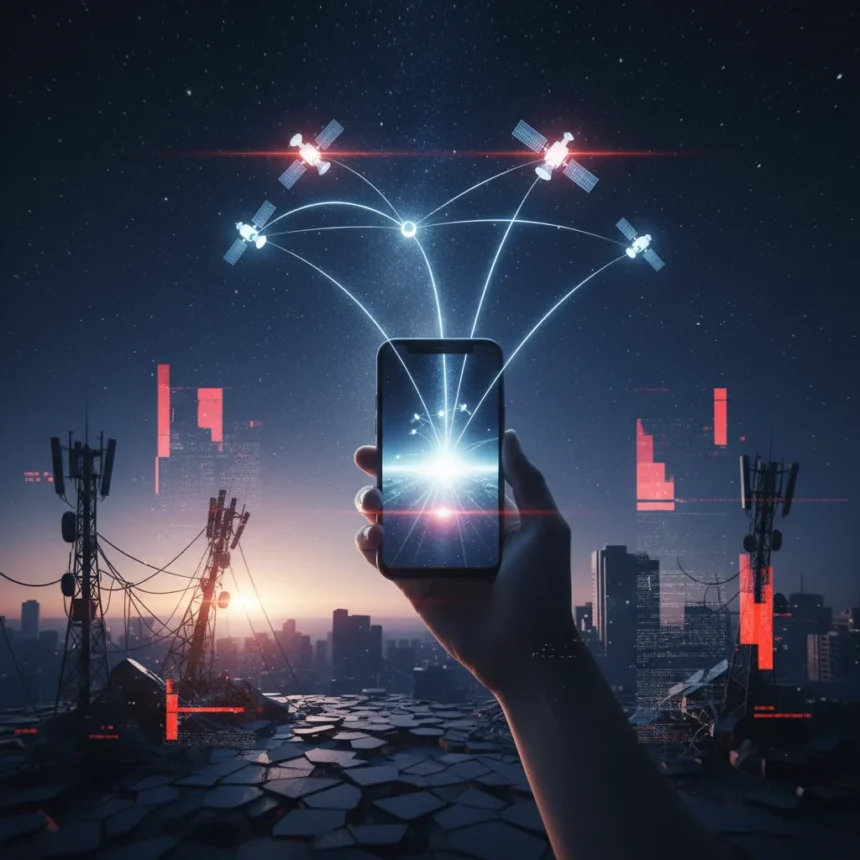
Direct-to-Cell satellite technology represents a fundamental shift in how connectivity reaches people during government-imposed internet shutdowns, offering what traditional Starlink dishes and VPNs simply cannot deliver. Iran’s recent internet blackout exposed a critical vulnerability: Starlink requires physical hardware that governments can block, while VPNs depend on ground infrastructure that can be switched off entirely. A new class of satellite service sidesteps both problems by turning orbiting spacecraft into cellular towers.
Key Takeaways
- Direct-to-Cell uses LEO satellites with built-in modems to connect standard LTE phones without extra hardware or apps.
- Starlink’s D2C partnership with T-Mobile enables texting in early 2025, with voice and data arriving mid-2025.
- AST SpaceMobile’s BlueWalker 3 achieved 21 Mbps in testing, outpacing SpaceX’s 17 Mbps.
- Digital rights groups Access Now and WITNESS are pushing developers and lawmakers to prioritize D2C for censorship resistance.
- Over 500,000 square miles in the U.S. lack cellular coverage, a gap D2C could fill without new towers.
How Direct-to-Cell Satellite Technology Works
Direct-to-Cell satellite technology bypasses the need for ground-based cell towers by deploying low Earth orbit (LEO) satellites equipped with built-in modems that function as orbiting cell towers. When you send a text or voice call from an unmodified LTE phone, the signal travels directly to a Starlink satellite overhead. The satellite uses laser interlinks to route data globally with minimal latency, then forwards the signal to a ground station. From there, it connects to a carrier’s existing network—say, T-Mobile—completing the call or message. This architecture matters: your phone never needs special apps, extra hardware, or knowledge that a satellite is involved. It simply works like a regular cell tower, except that tower is 550 kilometers above Earth.
The difference from traditional Starlink is stark. A Starlink dish provides direct internet access by bypassing carriers entirely, but the dish itself is a physical target governments can confiscate or jam. Direct-to-Cell satellite technology, by contrast, requires only a standard smartphone. During Iran’s shutdown, such a system would have allowed citizens to send texts and make calls even after the government disabled ground infrastructure, because the satellite connection exists independently of any national network.
Why Starlink and VPNs Fall Short During Shutdowns
Starlink’s traditional dish-based service offers impressive speeds and global coverage, but it has a fatal flaw in censorship scenarios: the hardware is visible and blockable. A government that wants to prevent access can confiscate dishes, jam signals targeting ground stations, or simply arrest anyone caught using one. VPNs face a different but equally severe problem. They work by routing traffic through servers in other countries, but they depend entirely on the underlying internet connection. Once a government cuts off internet access at the backbone level—as Iran did—no VPN can function because there is no connection to tunnel through. Both technologies assume a functioning network layer; neither survives when that layer is destroyed.

Direct-to-Cell satellite technology sidesteps both vulnerabilities. It does not require a dish, so there is nothing to confiscate. It does not depend on ground infrastructure, so cutting off the internet backbone does not disable it. A phone receives a signal directly from orbit, making the service extraordinarily difficult for any single nation to block without jamming satellite frequencies across its entire airspace—a technically complex and economically costly measure.
Direct-to-Cell Satellite Technology and Digital Rights
Access Now and WITNESS, two prominent digital rights organizations, have begun pushing operators and lawmakers to tailor Direct-to-Cell satellite technology specifically for censorship resistance. Their argument is straightforward: the technology exists, carriers are deploying it, and the moment to shape its development for resilience is now. These groups urge software developers and lawmakers to prioritize features that make D2C harder to suppress during shutdowns, such as built-in encryption, offline messaging capabilities, and carrier-agnostic routing.



The policy window is narrow. Starlink has deployed over 650 LEO satellites and is rolling out texting capabilities in early 2025, with voice and data services expected mid-2025. AST SpaceMobile’s competing BlueWalker 3 test satellite achieved 21 Mbps download speeds in testing, demonstrating that higher throughput is achievable. If digital rights advocates wait for the technology to mature, carrier partnerships will already be locked in, potentially with built-in censorship compliance mechanisms. Acting now means shaping the ecosystem from the ground up.
Real-World Gaps and Practical Limitations
Direct-to-Cell satellite technology is not a universal solution to censorship. The service will likely carry an additional fee—potentially around $20 per month—making it inaccessible to the poorest populations in shuttered regions. Compatibility is also limited: the service works only with LTE-capable phones, excluding older devices and some regional variants. Most critically, Direct-to-Cell relies on carrier partnerships. Starlink’s D2C service works through T-Mobile in the United States, meaning the carrier retains the ability to disable the service if pressured by governments or regulators. A truly censorship-resistant version would require carriers to agree to operate independently of national pressure—a significant ask in countries where telecom companies are state-owned or heavily regulated.
The technology also does not provide the raw bandwidth of traditional Starlink. SpaceX’s D2C tests achieved 17 Mbps, while AST SpaceMobile hit 21 Mbps—both far below what a fiber connection or even a good 4G signal offers. For texting and emergency voice calls, this is sufficient. For streaming video or large file transfers, it is not.
Why This Matters Now
Internet shutdowns are accelerating globally. Iran, Sudan, Myanmar, and Venezuela have all imposed blackouts in recent years. Each shutdown reveals the same pattern: traditional connectivity solutions fail because they depend on infrastructure governments can control. Direct-to-Cell satellite technology represents the first genuinely difficult-to-suppress alternative, provided it is deployed with censorship resistance in mind from day one. The moment to influence that deployment is now, while the technology is still in beta and partnerships are forming. In two years, when D2C is mature and ubiquitous, the opportunity to shape it for resilience will have passed.



Will Direct-to-Cell satellite technology replace traditional internet?
No. Direct-to-Cell is a supplement designed for areas without coverage and for resilience during emergencies or shutdowns. It will coexist with fiber, 4G, and traditional Starlink, not replace them. The service excels at providing basic connectivity when ground infrastructure fails, not at delivering the speeds modern applications demand.
Can governments block Direct-to-Cell satellite technology?
Theoretically, yes—by jamming satellite frequencies across their entire territory. Practically, this is expensive and difficult to implement without affecting neighboring countries. More likely, governments will attempt to pressure carriers to disable the service within their borders, which is why digital rights groups are pushing for carrier-independent implementations now.
When will Direct-to-Cell satellite technology be available?
Starlink is rolling out texting in early 2025, with voice and data services expected mid-2025. AST SpaceMobile is pursuing similar timelines. Availability will initially be limited to countries with carrier partnerships and regulatory approval, meaning much of the world will not have access immediately.
Direct-to-Cell satellite technology is not a panacea for censorship, but it is the first connectivity option that makes shutdowns genuinely hard to enforce. The question is whether it will be deployed as a tool for resilience or as another service locked behind carrier agreements and government pressure. The answer depends on whether digital rights advocates can influence the technology now, before the carriers do.
Edited by the All Things Geek team.
Source: TechRadar