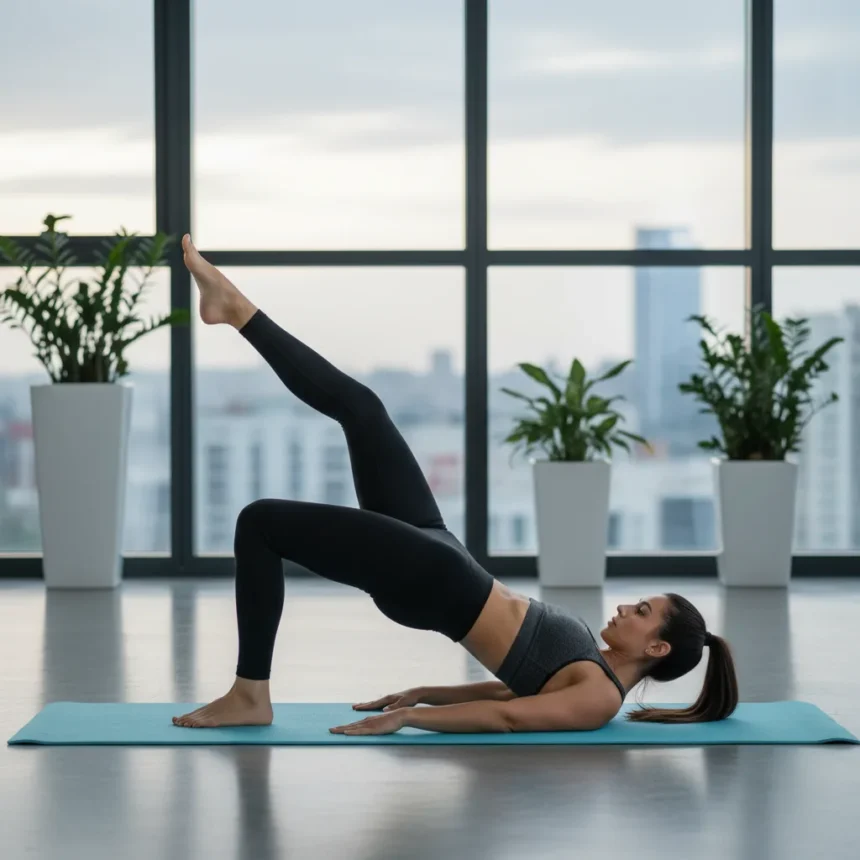
The glute bridge march is a Pilates exercise that targets your glutes—especially the gluteus maximus and medius—and your deep abdominal muscles without requiring squats, lunges, or any equipment. Performed on a mat using only your bodyweight, this move emphasizes controlled movement and functional strength, making it ideal for people seeking glute activation and core stability without joint stress.
Key Takeaways
- The glute bridge march targets glutes and transverse abdominis (deep core) using only bodyweight on a mat.
- No equipment needed; accessible anytime for functional strength and glute sculpting.
- Controlled leg lifts from a bridge position engage glutes while maintaining core stability.
- Progressions include extending legs fully or adding pulses for increased difficulty.
- Lower-impact alternative to squats and lunges for busy people and those avoiding joint stress.
How to Perform the Glute Bridge March
Start by lying on your back on a mat with your knees bent and feet flat, positioned hip-width apart. Your arms rest by your sides, palms down. This is your foundation—get comfortable here before moving forward.
Engage your core by drawing your belly button toward your spine, then squeeze your glutes to lift your hips off the mat into a bridge position. Your body should form a straight line from your knees to your shoulders. Hold this position steady; this is where the work happens. Inhale to prepare, then exhale as you lift one foot off the mat, extending your leg to tabletop position with your knee bent at 90 degrees and your shin parallel to the floor. Hold for 2-3 seconds, feeling the engagement in your glutes and deep core, then lower your foot with control. Alternate legs for 8-12 repetitions per side, or work for 30-60 seconds total, keeping your hips stable without letting them drop.
The key to success is control. Move slowly and deliberately. Rushing through reps wastes the benefit and increases injury risk. Your glutes should feel activated, not your lower back. If your lower back dominates the sensation, reduce your range of motion or consult a qualified fitness professional before continuing, especially if you have existing lower back issues.

Why the Glute Bridge March Works Better Than Squats and Lunges
Squats and lunges are effective, but they demand significant joint stress and coordination—especially for people with knee issues or those returning from injury. The glute bridge march isolates glute activation without the complexity. You are lying down, so balance is not a factor. Your knees stay bent, reducing strain on the joint. Your spine stays neutral throughout, eliminating the compression that comes with loaded squats.
This exercise also forces you to engage your deep abdominal muscles, the transverse abdominis, which squats and lunges do not emphasize as directly. A strong transverse abdominis stabilizes your pelvis and protects your lower back during daily activities—bending, lifting, walking. That functional benefit extends far beyond aesthetics.



Compared to traditional glute bridges, the marching variation adds dynamic movement while maintaining stability, creating higher glute activation without explosive loading. You are not bouncing or pulsing; you are lifting and lowering with intention. This makes it safer for beginners and more effective for anyone seeking targeted glute work.
Progressions to Increase Difficulty
Once the standard glute bridge march feels manageable, progress by extending your leg fully straight toward the ceiling instead of keeping it bent at 90 degrees. This increases the lever arm and demands more glute strength. Alternatively, add pulses at the top of the movement—small, controlled lifts of the extended leg—to boost time under tension.
You can also increase the hold time at the top of each rep, working up to 5 seconds per leg. Or perform 3 sets instead of one, resting 30-60 seconds between sets. Build progression gradually. Adding all modifications at once risks form breakdown and injury.
Common Mistakes to Avoid
The most frequent error is dropping your hips between reps. Your hips must stay elevated throughout the entire set. Dropping them resets the tension and wastes reps. Another mistake is using momentum to lift your leg instead of glute strength. If you are swinging or jerking your leg up, slow down. Slow, controlled movement is always superior to fast, sloppy reps.



Avoid arching your lower back excessively. Your core should be engaged—belly button drawn in—throughout the exercise. If your lower back arches and takes over, you have lost the glute and core connection. Finally, do not hold your breath. Breathe steadily: exhale as you lift the leg, inhale as you lower it. Holding your breath increases intra-abdominal pressure and reduces oxygen to your muscles.
Frequently Asked Questions
Is the glute bridge march suitable for beginners?
Yes. The glute bridge march requires no equipment and minimal coordination. Beginners should start with 1 set of 8 reps per leg and focus on form over volume. If you have never done Pilates, consider consulting a qualified instructor to ensure proper technique before progressing.
How often should I perform the glute bridge march?
Perform this exercise 3-4 times per week as part of a balanced fitness routine. Your glutes need recovery time between sessions to adapt and grow. Spacing sessions 48 hours apart is ideal. If you are doing other glute-focused work (like side-lying leg lifts or other Pilates moves), reduce frequency to avoid overuse.
Can the glute bridge march help with lower back pain?
The glute bridge march can support lower back health by strengthening the glutes and deep core muscles that stabilize your pelvis. However, if you have existing lower back pain or injury, consult a healthcare professional or physical therapist before starting. They may recommend modifications or a different approach suited to your specific condition.
The glute bridge march proves that effective strength training does not require heavy weights, complex equipment, or high-impact movements. It is a straightforward, accessible exercise that delivers real results for glute activation and core stability. If you are tired of squats and lunges or looking for a lower-impact option, this Pilates move deserves a place in your routine.
Edited by the All Things Geek team.
Source: Tom's Guide