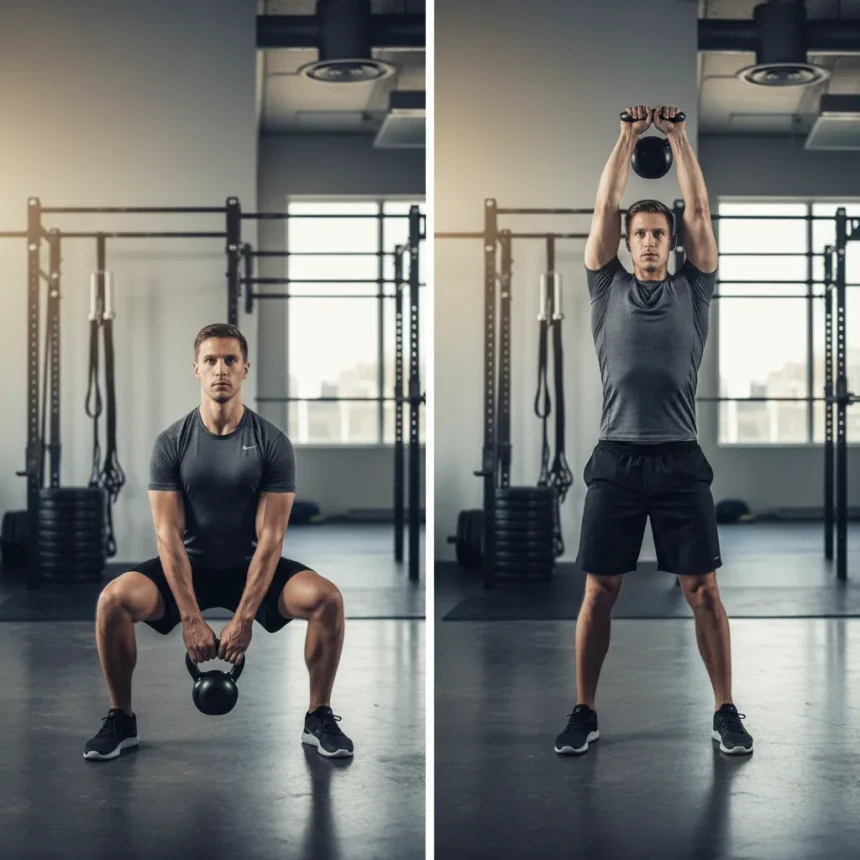
The split squat kettlebell swing is a kettlebell variation that combines explosive hip power with unilateral strength, balance, and core stability. This single tweak to traditional kettlebell swings transforms how your body generates force and maintains control under load, addressing three critical fitness qualities in one movement.
Key Takeaways
- The split squat kettlebell swing adds unilateral loading to traditional hip-hinge power work
- This variation demands greater core stability than standard two-footed kettlebell swings
- Balance improvements come from the staggered stance requiring constant micro-adjustments
- Explosive hip power remains the foundation while unilateral strength becomes a new demand
- The movement combines dynamic power generation with single-leg stability control
What Makes the Split Squat Kettlebell Swing Different
Standard kettlebell swings rely on bilateral power—both legs working symmetrically to drive the bell upward. The split squat kettlebell swing strips away that symmetry. By positioning one leg forward and one back, you immediately demand something the traditional swing does not: unilateral strength and stability. One leg drives the movement while the other stabilizes your base, forcing your core to work harder to prevent rotation and collapse.
This asymmetrical stance is not just a minor adjustment. It fundamentally changes how your body recruits muscle fibers and coordinates force generation. Your glutes, hamstrings, and hip flexors must work in different patterns than they do in a bilateral swing. The forward leg drives extension while the rear leg braces against the floor, creating a staggered power structure that mirrors real-world movement patterns more closely than a symmetrical stance.
Building Balance Through Unilateral Loading
Balance improvements in the split squat kettlebell swing come from constant micro-adjustments your stabilizer muscles make throughout the movement. Unlike standing on two feet, a staggered stance narrows your base of support and shifts your center of gravity. Every swing demands your proprioceptive system—your body’s awareness of position in space—to fire continuously. Your ankles, knees, hips, and core engage to prevent the forward leg from caving inward or the rear leg from drifting sideways.

This is not balance in the static sense of holding a yoga pose. It is dynamic balance under load, where your body must stabilize while simultaneously generating explosive power. The kettlebell’s momentum adds instability that your muscles must counteract, forcing adaptation that carries over to everyday activities like stepping over obstacles, navigating uneven terrain, or catching yourself during a stumble.
Core Stability and Rotational Control
The split squat kettlebell swing demands core stability in ways bilateral swings cannot replicate. Because your weight is distributed unevenly across your legs, your core must prevent rotation around your spine. The kettlebell swinging in front of you creates a rotational force that your obliques and deep abdominal muscles resist. Your anterior core keeps you from folding forward, while your posterior chain—your back, glutes, and hamstrings—maintains extension and power transfer from your hips to the bell.



This rotational demand is the hidden benefit. Many lifters chase core strength through planks or crunches, but the split squat kettlebell swing builds functional core stability under dynamic conditions. Your core is not just resisting movement; it is stabilizing while your legs generate force and your arms swing a heavy object. That integration is what translates to real-world strength and injury resilience.
How This Compares to Standard Kettlebell Swings
Standard kettlebell swings excel at building explosive hip power and cardiovascular capacity. They allow heavier loads and faster tempos because both legs share the burden equally. The split squat kettlebell swing trades some of that pure power output for specificity. You cannot swing as heavy or as fast because one leg is always in a weaker position. That limitation is intentional. The movement prioritizes movement quality, stability, and single-leg strength development over maximum power output.
Think of it this way: the bilateral swing is your power tool. The split squat swing is your precision tool. Both belong in a complete training program, but they serve different purposes. If you want to build explosive hip extension in a stable position, use the bilateral swing. If you want to build single-leg stability, rotational control, and balanced strength development across both sides of your body, the split squat variation is superior.
Integrating the Split Squat Kettlebell Swing Into Your Training
The split squat kettlebell swing works best as a supplemental movement rather than your primary kettlebell exercise. Its lower load capacity and technical demands make it ideal for higher-rep sets or as a finisher after your main power work. The movement also requires more attention to form than a standard swing, so fatigue and poor coaching will degrade results quickly.



The unilateral nature means you must perform equal reps on both sides. If you swing five times with your right leg forward, you must swing five times with your left leg forward. This symmetrical training prevents the common problem of developing one side stronger than the other, a pattern that often goes unnoticed in bilateral movements until it shows up as injury or asymmetrical movement.
Why Athletes and Lifters Should Care
For athletes, the split squat kettlebell swing addresses a training gap. Most strength programs focus on bilateral movements—squats, deadlifts, bilateral swings—because they allow heavier loading and faster strength gains. But real sports demand unilateral stability. A sprinter drives off one leg. A soccer player cuts on one leg. A boxer stands in a staggered stance. The split squat kettlebell swing trains the stability and power patterns that sports actually require, making it a more sport-specific tool than a standard swing.
For general fitness enthusiasts, the movement offers a straightforward way to build balanced strength and stability without adding complexity to your routine. One kettlebell, one variation, three benefits: explosive power, unilateral strength, and dynamic balance. That efficiency is why a small tweak to a familiar movement can deliver outsized results.
Can the split squat kettlebell swing replace traditional swings?
No. The split squat kettlebell swing is a supplemental variation, not a replacement. Traditional bilateral swings allow heavier loading and faster power development. Use the split squat variation to address stability, balance, and unilateral strength gaps, then return to bilateral swings for your primary power work.
How many reps should you perform per side?
Start with 5-8 reps per leg and focus on movement quality over volume. Because the split squat kettlebell swing demands greater stability and coordination than a bilateral swing, lower rep ranges with strict form deliver better results than high-rep sets where form degrades.
What weight kettlebell should you use?
Use a lighter bell than you would for bilateral swings. The unilateral loading and stability demands mean you cannot safely handle your typical swing weight. Start 8-12 pounds lighter and increase load only after movement quality remains consistent across all reps and both sides.
The split squat kettlebell swing is not a revolutionary movement—it is a simple tweak that addresses real training needs. By adding unilateral loading to kettlebell swings, you build balance, stability, and power in patterns that matter beyond the gym. That combination of simplicity and effectiveness is why small adjustments to familiar exercises often deliver the biggest long-term results.
Edited by the All Things Geek team.
Source: T3