





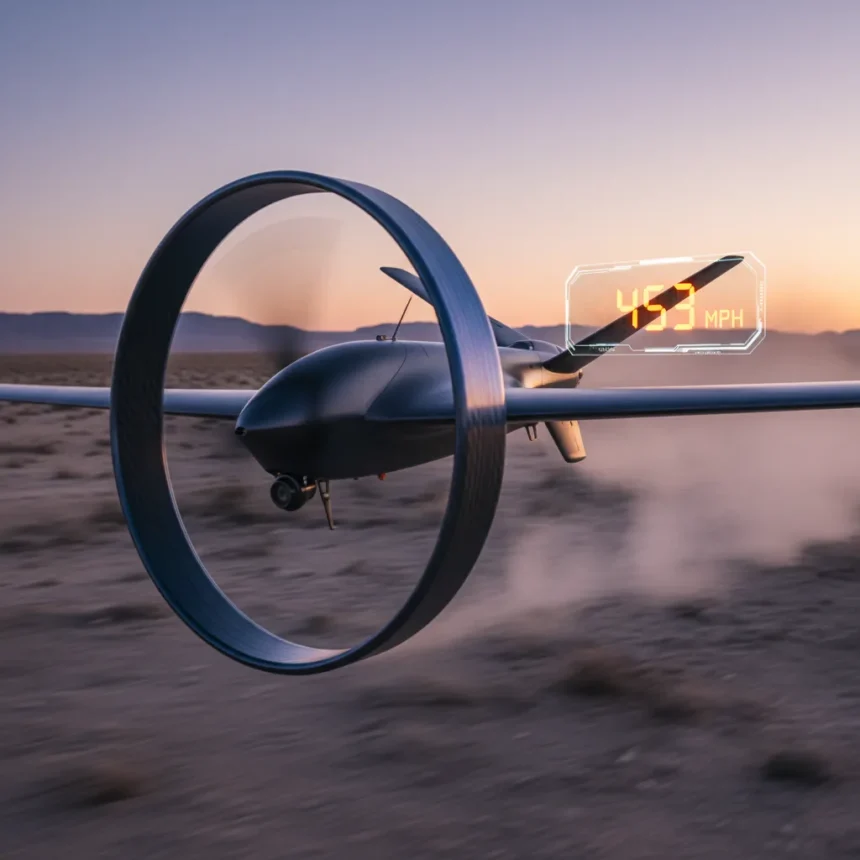
The Blackbird drone speed record attempt represents one of the most audacious engineering pushes in RC aviation. A YouTuber duo flew the custom-built Blackbird to 453 mph during a test run, unofficially shattering previous speed benchmarks for unmanned aircraft. The breakthrough came not from raw power alone, but from a fundamental redesign of the drone’s propeller blades using exotic sawtooth carbon fiber leading edges that fundamentally altered aerodynamic efficiency at extreme velocities.
Key Takeaways
- The Blackbird drone reached 453 mph in a test-run attempt, unofficially breaking the world speed record for drones.
- Sawtooth carbon fiber propeller blades were a critical design innovation that enabled the record speed.
- An earlier test ended in a crash at 393 mph when the drone lost contact mid-flight.
- The Blackbird drone represents a competitive push in the custom drone speed-record space.
- The sawtooth propeller design reduces turbulence and improves aerodynamic stability at extreme speeds.
What Makes the Blackbird Drone Speed Record Significant
The Blackbird drone speed record of 453 mph matters because it pushes the boundaries of what small unmanned aircraft can achieve. For years, drone speed competitions have been dominated by specialized racing platforms, but the Blackbird drone’s approach focused on precision engineering rather than brute-force motor power. The 453 mph speed is remarkable not just as a number, but as validation that thoughtful propeller design can unlock performance gains that seem impossible on paper.
The unofficial nature of the record is worth noting. Unlike Guinness-verified records, the Blackbird drone’s 453 mph run exists in the gray zone of experimental aviation—impressive to the drone community, but lacking the institutional stamp of approval that makes a record truly undeniable. That distinction matters for credibility, though it does not diminish the engineering achievement itself.
The Sawtooth Carbon Fiber Propeller Innovation
The exotic sawtooth carbon fiber propeller blades are the Blackbird drone’s secret weapon. Rather than using traditional smooth propeller surfaces, the designers incorporated sawtooth leading edges—tiny, controlled irregularities along the blade’s front edge. This design reduces turbulent airflow separation at extreme speeds, allowing the propeller to maintain efficiency even as the drone approaches transonic flight regimes where conventional blade designs fail catastrophically.

Custom-made carbon fiber construction gave the blades the strength-to-weight ratio necessary for high-speed flight without shattering under aerodynamic stress. The sawtooth pattern itself is not new in aerospace—birds use similar tubercles on their wings, and aircraft engineers have studied the phenomenon for decades—but applying it to a small drone propeller required precision manufacturing that few teams can execute. The Blackbird drone’s team clearly invested in that capability, and the 453 mph result suggests the investment paid off.
The Crash That Nearly Ended the Project
Before the Blackbird drone reached 453 mph, disaster nearly stopped the entire program. An earlier test run saw the drone accelerate to 393 mph before losing radio contact and crashing. That failure could have been catastrophic—a total loss of the custom airframe, the exotic propellers, and potentially months of debugging work. Instead, the team treated it as a data point. The crash at 393 mph revealed that the drone’s control systems struggled at near-transonic speeds, a problem the team addressed in subsequent iterations.



The 393 mph crash underscores the risk inherent in pushing speed records. These are not consumer drones with safety margins built in. They are experimental platforms operating at the edge of what materials and control systems can handle. One miscalibration, one unexpected gust of wind, and tens of thousands of dollars of custom engineering becomes wreckage.
How Blackbird Drone Speed Record Compares to Competitors
The Blackbird drone speed record exists within a competitive landscape that includes other custom racing drones and speed-record attempts by specialized teams. While the research brief does not provide detailed specifications for competing platforms, the 453 mph figure places the Blackbird drone in the upper echelon of drone speed achievements. Competitive drone racing typically involves speeds under 200 mph in organized events, making the Blackbird drone’s 453 mph claim exceptional by comparison.
The difference between the Blackbird drone and conventional racing platforms is architectural. Racing drones prioritize maneuverability and control response; the Blackbird drone prioritizes raw speed at the expense of agility. That trade-off is fundamental—you cannot optimize a platform for both tight turns and maximum velocity. The Blackbird drone’s designers chose speed, and the 453 mph result validates that choice.
Why Sawtooth Propeller Design Matters for Future Drones
The sawtooth carbon fiber propeller innovation could influence drone design beyond speed-record attempts. As commercial drones push for longer range and faster transit times, propeller efficiency becomes critical. A more efficient propeller means longer flight times, faster delivery speeds, and reduced power consumption—all valuable in commercial applications. The Blackbird drone’s 453 mph test run proves the concept works at extreme scales, but the principles could trickle down to practical platforms.



That said, applying sawtooth propeller designs to consumer drones presents manufacturing challenges. Custom carbon fiber work with sawtooth precision is expensive and labor-intensive. Mass production would require entirely new manufacturing processes, tooling investments, and quality-control protocols. The Blackbird drone’s approach works for a one-off experimental platform; scaling it requires different engineering decisions.
Is the Blackbird drone speed record verified?
The Blackbird drone’s 453 mph record is unofficial, meaning it has not been independently verified by Guinness World Records or another recognized authority. The YouTuber duo’s test run produced the speed claim, but without third-party adjudication, the record exists in the enthusiast community rather than in official record books. That does not make the achievement less impressive, but it does mean the claim carries less institutional weight than a Guinness-verified record would.
What makes the sawtooth propeller design so effective?
Sawtooth propeller blades reduce turbulent airflow separation at extreme speeds by controlling how air flows around the blade surface. Traditional smooth propellers create vortices and pressure drops that waste energy; sawtooth edges guide that airflow more efficiently, allowing the propeller to maintain thrust and control even as speed approaches transonic regimes. The design is particularly effective on the Blackbird drone because the entire platform was engineered around it, rather than retrofitted.
Could the Blackbird drone design be used in commercial drones?
The principles behind the Blackbird drone could influence commercial platforms, but the custom engineering that enabled 453 mph is not practical for mass production. The sawtooth carbon fiber propellers are hand-crafted for the specific speed regime the Blackbird drone targets. Commercial drones need propellers that balance efficiency, durability, cost, and manufacturability across millions of units. The Blackbird drone proves the concept; turning it into a product requires completely different engineering trade-offs.
The Blackbird drone’s 453 mph achievement stands as a testament to what happens when engineering teams obsess over a single metric: speed. By redesigning every component around that goal—especially the exotic sawtooth carbon fiber propellers—the team unlocked performance that seemed impossible just years ago. Whether the record holds up under independent verification remains to be seen, but the engineering behind it is undeniably bold.
Edited by the All Things Geek team.
Source: Tom's Hardware




