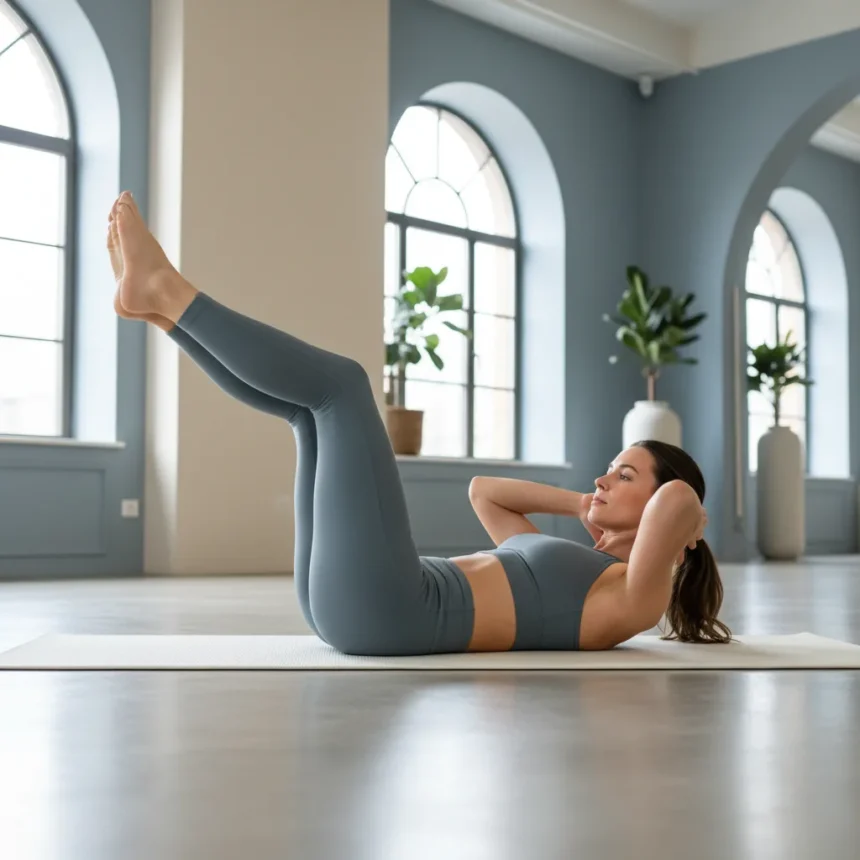
Butterfly kicks Pilates exercise is a dynamic, bodyweight-only movement that activates your deep core, lower abs, and hip flexors far more effectively than traditional sit-ups or crunches. Unlike isolation exercises that target surface abs, this Pilates move engages your transverse abdominis—the deepest core muscle responsible for spine stability and injury prevention. It requires no equipment, takes minutes to master, and delivers measurable functional strength gains.
Key Takeaways
- Butterfly kicks target deep core (transverse abdominis), lower abs, and hip flexors simultaneously using only bodyweight.
- Slow, controlled movement with constant core engagement is the foundation of proper form.
- Key cue: suck belly button to spine, brace abs as if expecting a punch, or imagine zipping jeans a size too small.
- Progressions include double-leg lifts, resistance bands above knees, and Pilates ball placement under tailbone.
- Builds functional spine stability and injury prevention, not aesthetic six-pack development.
Why Butterfly Kicks Pilates Exercise Outperforms Traditional Ab Work
Sit-ups and crunches target the rectus abdominis—the visible six-pack muscle—but leave your deep core largely untouched. Butterfly kicks Pilates exercise reverses this entirely. By forcing your transverse abdominis to stabilize your spine against resistance, you build the kind of core strength that prevents lower back pain and improves posture in daily life. This is functional core training, not aesthetic core training. The difference matters because deep core activation translates to real-world spine protection, whether you’re lifting groceries, playing sports, or sitting at a desk for eight hours.
The butterfly kicks Pilates exercise also engages your hip flexors—muscles that tighten from prolonged sitting and weaken from neglect. Traditional leg raises and planks touch these muscles but do not isolate them the way butterfly kicks do. By focusing on controlled opening and closing motions against your own body weight, you strengthen hip flexors while simultaneously teaching your core to stabilize. This dual activation is why the movement has gained traction among fitness professionals and postpartum recovery specialists.
How to Perform Butterfly Kicks Pilates Exercise: Step-by-Step Form
Start by lying flat on your back on an exercise mat. Bend both knees and lift them into tabletop position—a 90-degree angle with knees directly above hips. Keep your feet together. From here, let both knees fall open to the sides, as if your thighs were pages of a book opening. This is the butterfly position. Press your lower back firmly into the mat; this engagement is non-negotiable. Inhale as you open your knees wider against the resistance of your own muscles. Exhale as you squeeze your knees back together using your deep core and hip flexors. Move slowly and deliberately. Speed kills the effectiveness of butterfly kicks Pilates exercise—control is everything.

The core engagement cue is critical. Think about sucking your belly button into your spine, or bracing your abs as if someone were about to punch you in the stomach. If you are postpartum or dealing with pelvic floor concerns, imagine zipping your abs up and in, as if squeezing into a pair of jeans a size too small—this simultaneous engagement of deep core and pelvic floor muscles is especially valuable for recovery. Perform butterfly kicks for 30 to 45 seconds, focusing on slow, controlled tempo rather than speed. Rest and repeat for 2 to 3 sets.
Progressions to Intensify Butterfly Kicks Pilates Exercise
Once you master the basic butterfly kicks Pilates exercise, three progressions will challenge your core further. The first is the double-leg lift: instead of keeping your feet on the mat in tabletop, lift both legs higher, forcing your core to do all of the stabilizing work. This removes the stability anchor and demands far greater deep core activation. The second progression is adding external resistance. Place a resistance band just above your knees and perform the opening phase against the band’s tension. This increases the challenge during the most demanding part of the movement. The third progression is placing a Pilates ball under your tailbone. This introduces instability, forcing your abs and hip flexors to work harder to maintain control and pelvic stability.



Do not jump to progressions until you can perform 45 seconds of basic butterfly kicks Pilates exercise with perfect form and no lower back strain. Form breakdown is the fastest way to lose the benefits and invite injury. If you are new to Pilates or returning from injury, spend at least one week on the basic version before attempting progressions.
Butterfly Kicks Pilates Exercise vs. Other Core Movements
Planks demand shoulder and core endurance but neglect hip flexor strength. Leg raises blast hip flexors but often compromise lower back alignment. Bird dog and dead bug variations spread activation across multiple planes but lack the focused deep core intensity of butterfly kicks Pilates exercise. Sit-ups and crunches are efficient at building surface abs but do almost nothing for spine stability or hip mobility. Butterfly kicks Pilates exercise threads the needle: it targets deep core, lower abs, and hip flexors simultaneously in a single, efficient movement. This is why fitness professionals are increasingly recommending it as a daily core staple instead of traditional ab circuits.
Safety Considerations Before Starting
Before performing butterfly kicks Pilates exercise, consult a qualified fitness professional or physical therapist if you are a beginner, returning from lower back injury, or pregnant or postpartum. Improper form—particularly failing to maintain lower back contact with the mat—can strain your lumbar spine. Never rush the movement or sacrifice control for repetitions. If you feel sharp pain (not muscle fatigue) in your lower back, stop immediately and reassess your form or seek professional guidance. Muscle fatigue in your deep core and hip flexors is the goal; pain is a warning sign.
Is butterfly kicks Pilates exercise suitable for daily practice?
Yes. Many fitness professionals perform butterfly kicks Pilates exercise daily as their primary core work, replacing sit-ups, crunches, planks, or leg raises entirely. Because the movement is low-impact and bodyweight-only, it poses minimal injury risk when form is correct. Daily practice builds consistent deep core activation and hip flexor strength without overtraining.



What equipment do I need for butterfly kicks Pilates exercise?
None for the basic version—only an exercise mat. Progressions may benefit from a resistance band, ankle weights, Pilates ball, or Pilates ring, all widely available online and at fitness retailers, but these are optional. The butterfly kicks Pilates exercise is fundamentally a bodyweight movement.
How long until I see results from butterfly kicks Pilates exercise?
Functional improvements—better posture, reduced lower back discomfort, improved hip mobility—typically appear within 2 to 3 weeks of consistent daily practice. Deep core strength gains accumulate over 4 to 8 weeks. Aesthetic changes (visible abs) depend on diet and overall training volume, not the butterfly kicks Pilates exercise alone.
Butterfly kicks Pilates exercise is not a shortcut to six-pack abs, and that is precisely why it works. By prioritizing deep core activation and functional strength over surface aesthetics, you build a spine that stays healthy, hips that move freely, and a core that actually does its job. In a fitness landscape cluttered with crunches and planks, a simple, slow, controlled movement that targets what your body actually needs is refreshingly rare.
Edited by the All Things Geek team.
Source: Tom's Guide