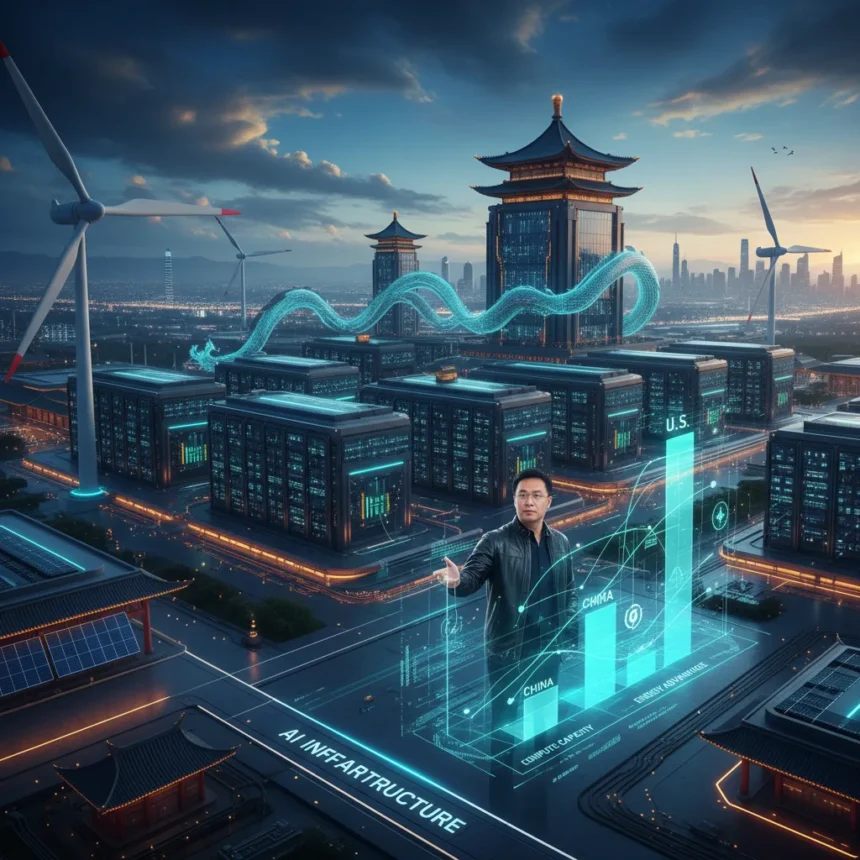
China AI infrastructure is expanding at a pace that leaves American competitors scrambling. Nvidia CEO Jensen Huang warned at the Center for Strategic and International Studies that China’s compute capacity rivals entire U.S. regions, with data centers built in months rather than years. His message was blunt: without dramatic reforms to energy policy, permitting, and industrial capacity, the U.S. risks ceding AI leadership to Beijing.
Key Takeaways
- China builds AI data centers in months; U.S. faces years of regulatory delays and higher costs
- China generates twice the electricity of the U.S., offering 50% discounts on power
- Nvidia banned from selling to China; Beijing now building its own AI stack with domestic researchers
- AI demand growth (10,000 to 1 million times) outpaces chip efficiency gains of 5-10x annually
- U.S. energy costs are 4-8x higher than China’s, slowing hyperscale data center expansion
China’s Infrastructure Velocity Creates a Staggering Gap
The speed differential between Chinese and American data center construction is not a minor inconvenience—it is a structural disadvantage. Huang described China’s approval, land allocation, and full buildout processes as happening at speeds U.S. firms “cannot match”. Where American projects face environmental reviews, grid interconnection delays, and zoning battles stretching across years, China completes equivalent infrastructure in months. This velocity advantage compounds when multiplied across dozens of simultaneous projects.
China generates twice the electricity of the United States, a fundamental advantage that translates directly into compute capacity. The nation’s energy sector offers subsidies and discounts reaching 50%, making power costs 4-8x cheaper than in America. For hyperscale data centers consuming megawatts continuously, this cost difference determines profitability and expansion pace. Huang’s metaphor—calling China’s underutilized facilities “ghost data centers”—suggests excess capacity built speculatively, yet even idle infrastructure represents future compute power ready to activate [title]. The U.S. has no comparable reserve.
The Nvidia Exodus and China’s Domestic AI Stack
Huang revealed that Nvidia has been banned from selling to China and China banned from buying Nvidia products, making the company “the first in history that has been banned on both sides”. Rather than cripple Beijing’s AI ambitions, the export restrictions accelerated China’s development of domestic alternatives. Nvidia has “evacuated” the Chinese market, leaving room for local competitors leveraging China’s researchers and software talent to build an independent AI stack. This is not theoretical—it is happening now, with China claiming 70% of global AI patents and leading in open-source AI downloads that shape the developer ecosystem globally.

The irony cuts deep: U.S. export controls intended to slow China’s AI progress instead forced Beijing to invest in self-sufficiency. Sovereign AI nations are rising worldwide, many still relying on Nvidia hardware where available, but China’s path toward independence is already underway. This shift fundamentally changes the competitive landscape. The U.S. cannot assume dominance through hardware advantage alone if software, talent, and infrastructure tilt toward Beijing.
Why U.S. AI Leadership Hangs on Energy and Permitting Reform
Huang’s warning centered on a single urgent point: “The best of days are ahead of us, but only if we build the infrastructure to support them”. The U.S. faces a workload explosion—AI demand is growing by 10,000 to 1 million times, far outpacing Nvidia’s annual 5-10x chip efficiency gains. This mismatch means raw compute capacity matters as much as chip performance. Without it, the U.S. cannot absorb the coming wave of AI applications.



The bottleneck is not innovation—American firms excel at that. It is permitting, energy policy, and industrial velocity. Huang called for urgent reforms in three areas: faster data-center construction permitting, energy reforms to lower power costs and increase supply, and industrial rebuilds for chip fabs, robotics, and hyperscale infrastructure. These are not technical challenges but political ones. China has already solved them through centralized decision-making and state backing. The U.S. must now decide whether to match that pace through policy change or accept a secondary position in AI infrastructure.
What “Ghost Data Centers” Really Means
Huang’s comparison of China’s excess capacity to ghost cities was not dismissive—it was a warning. Ghost cities in China are often built ahead of demand, sitting empty until population or economic activity catches up. Ghost data centers follow the same logic: built speculatively, they represent dormant compute power. When demand spikes, they activate instantly. The U.S. has no equivalent reserves. American data centers are built to demand, not ahead of it, because permitting and financing take years. By the time approval arrives, the market has moved on. China builds first, fills later, and always has capacity ready.
This structural difference means China can respond to AI workload surges faster than the U.S. can even begin construction on new facilities. The gap widens with every quarter of regulatory delay.
Can the U.S. Still Win?
Huang’s statement—”We want the United States to win” [title]—was not sentiment but a call to action. He did not say the U.S. would win, or that it was winning. He said it should. The conditional matters. Huang believes American victory is possible, but only if policymakers act decisively on energy, permitting, and industrial capacity. The window is open, but it is closing. AI demand growth of up to 1 million times will not wait for regulatory consensus.



The U.S. retains advantages in chip design, software talent, and venture capital. But those edges erode if infrastructure cannot support them. Huang’s warning is not about Nvidia’s future—the company will thrive regardless. It is about American technological sovereignty and the economic power that flows from it. Without urgent action, that sovereignty shifts east.
Is China’s AI infrastructure truly unbeatable?
Not unbeatable, but currently ahead. China’s 2x electricity advantage, faster permitting, and lower energy costs create a structural lead in compute capacity expansion. The U.S. can close this gap through policy reform—faster environmental approvals, energy deregulation, and industrial investment—but it requires political will that has not yet materialized.
Why did Nvidia get banned from selling to China?
U.S. export controls on advanced semiconductors targeted China’s AI development. Nvidia, as the leading supplier of AI chips, was restricted from selling to Chinese entities. China reciprocated with its own ban, making Nvidia the rare company sanctioned from both sides. The restrictions accelerated China’s push for domestic AI alternatives.
How much faster does China build data centers than the U.S.?
China completes approvals, land allocation, and full data center buildouts within months. U.S. projects face years of permitting, environmental review, and grid interconnection delays. The exact time gap varies by project, but the velocity difference is stark enough that Huang cited it as a decisive competitive disadvantage.
Huang’s message to policymakers was clear: the U.S. still has time to act, but the clock is running. Without energy reforms, faster permitting, and industrial capacity rebuilds, American AI leadership will not survive the next decade. China is not waiting for the U.S. to catch up—it is building ahead of demand, stocking ghost data centers with compute power, and training researchers to reduce dependence on American chips. The infrastructure race is underway, and the U.S. is behind.
Edited by the All Things Geek team.
Source: TechRadar