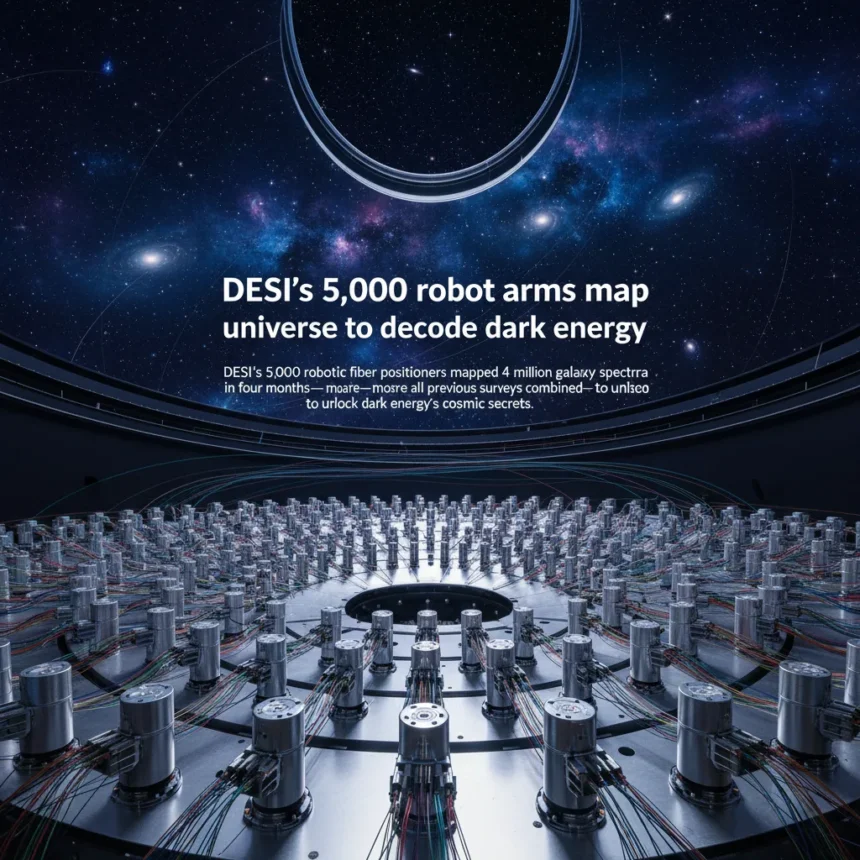
DESI’s 5,000 robot arms represent the most ambitious spectroscopic survey ever built, mounted on the Nicholas U. Mayall 4-meter Telescope at Kitt Peak National Observatory in Arizona. The Dark Energy Spectroscopic Instrument uses these tiny robotic fiber positioners—each about the width of a human hair—to map the largest 3D universe catalog in history, targeting 47 million galaxies and quasars to unlock the mysteries of dark energy, which comprises roughly 68% of the universe and drives its accelerating expansion.
Key Takeaways
- DESI’s 5,000 robot arms cycle through new galaxy targets every 20 minutes, with each positioner swiveling into position in about 10 seconds.
- A four-month trial run captured 4 million spectra—exceeding the combined output of all previous spectroscopic surveys.
- The focal plane contains nearly half a million individual parts and was completed under budget by $1.9 million and 17 months ahead of schedule.
- The instrument maps over 20 times more objects than any predecessor experiment to study dark energy’s role in cosmic expansion.
- Total robotic positioners built: 7,300 units (including spares), assembled by the University of Michigan physics team.
How DESI’s 5,000 robot arms actually work
Each of the 5,000 robotic fiber positioners in DESI’s focal plane holds a fiber-optic cable and automatically pivots to point at a preselected galaxy or quasar. The 5,000 positioners are arranged in 10 wedge-shaped petals, with 500 positioners per petal, supported by guide, focus, and alignment sensors. In ideal observing conditions, the entire array cycles through a new set of 5,000 targets every 20 minutes, with individual positioners reaching their targets in roughly 10 seconds. Once positioned, each fiber collects light from its assigned galaxy. That light travels down the fiber to DESI’s spectrograph, which splits it into color bands—a technique called spectroscopy. By analyzing these color bands, astronomers measure how far each galaxy is and how fast it is moving away from us, revealing the universe’s expansion history and dark energy’s influence.
DESI’s 5,000 robot arms vs. previous universe surveys
DESI’s scale dwarfs all prior spectroscopic surveys. In its first four-month trial run, DESI captured 4 million spectra—more than the combined total of all previous spectroscopic surveys in history. The instrument maps over 20 times more objects than any predecessor experiment, fundamentally changing how cosmologists study the universe. Previous surveys mapped fewer than 20 times the number of objects that DESI targets in its full 47 million galaxy catalog. To identify which galaxies to observe, the University of Arizona conducted an imaging survey on the Bok Telescope—positioned next to the Mayall—over 360 nights or more. This pre-selection process ensures DESI’s robot arms point at the most scientifically valuable targets.
Engineering a half-million-part focal plane
Building DESI’s focal plane was a feat of precision engineering. The University of Michigan physics team, led by professor Gregory Tarlé, assembled 7,300 total robotic positioners—the 5,000 active units plus 2,300 spares. The focal plane itself contains nearly half a million individual parts, all coordinated to point simultaneously at distant galaxies. The project finished under budget by $1.9 million and 17 months ahead of schedule. DESI captured its first test images on October 22, 2019, with nearly all components operational. After a pandemic pause, survey operations resumed in December 2020, and the formal five-year survey began following the four-month trial.

Why dark energy matters to cosmology
Dark energy remains one of physics’ deepest mysteries. It makes up approximately 68% of the universe’s total mass-energy content and is responsible for accelerating the universe’s expansion—a discovery that earned the 1998 Nobel Prize in Physics. Yet scientists still do not understand what dark energy is or how it works. DESI’s 47 million galaxy map will provide unprecedented data on how dark energy has influenced cosmic expansion over billions of years. By measuring the distances and velocities of millions of galaxies, DESI reveals the universe’s expansion history with far greater precision than previous surveys. This data will constrain dark energy’s properties and potentially point toward new physics beyond current cosmological models.
Is DESI still collecting data today?
Yes. DESI’s formal five-year survey began after its successful four-month trial run in 2020 and continues mapping the universe. The instrument operates continuously, with its 5,000 robot arms cycling through new galaxy targets every 20 minutes in ideal conditions. The ongoing data collection feeds directly into cosmological analyses aimed at understanding dark energy’s role in the universe’s past, present, and future.



How long does it take DESI to map one galaxy?
DESI’s robotic positioners reach their target galaxies in approximately 10 seconds, and light collection continues for about 15-20 minutes per exposure cycle. The entire array then reconfigures to a new set of 5,000 targets in the next cycle, which repeats every 20 minutes under optimal observing conditions.
DESI’s 5,000 robot arms represent a watershed moment in observational cosmology. By combining precision robotics, fiber optics, and spectroscopy at an unprecedented scale, the instrument is delivering the largest 3D map of the universe ever created. The data already exceeds all previous spectroscopic surveys combined, and with five years of planned observations ahead, DESI is poised to transform our understanding of dark energy and the universe’s ultimate fate.
Edited by the All Things Geek team.
Source: TechRadar