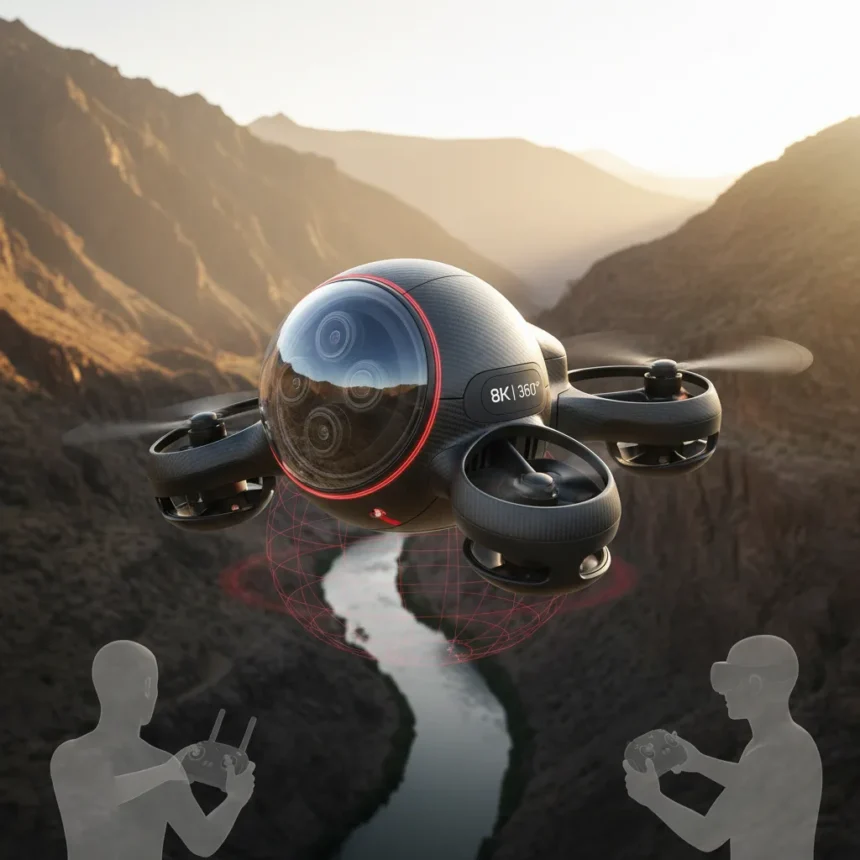
The DJI Avata 360 is DJI’s first-ever 360-degree FPV drone, launching after months of speculation with specs that challenge the entire category. This isn’t just another FPV quadcopter with a wider lens—it’s a fundamentally different approach to aerial capture, pairing two 1/1.1-inch CMOS sensors with 8K/60fps HDR video, 120MP stills, and dual flight control systems that let you fly like a racer or film like a cinematographer. The drone weighs 455g, fits in a backpack, and costs $719 to $979 depending on your bundle choice. After testing, the claim that “there’s no better drone on the planet” stops sounding like hyperbole and starts sounding like a reasonable take.
Key Takeaways
- DJI Avata 360 captures 8K/60fps 360° video with dual 64MP sensors and seamless stitching
- Dual control modes: RC 2 for precision, Goggles 3/N3 + RC Motion 3 for immersive FPV flight
- 23-minute flight time per battery; real-world performance ranges 15-22 minutes depending on conditions
- Omnidirectional obstacle avoidance with LiDAR, Nightscape vision, and infrared sensors
- Fly More Combo starts at $719 USD; available globally from DJI Store and authorized retailers
What Makes the DJI Avata 360 Different
The DJI Avata 360 solves a problem that traditional FPV drones ignore: you can only capture what the camera sees in a single direction. Fly a perfect line through a canyon, nail the speed, hit the lighting—and you miss the dramatic moment happening 90 degrees to your left. The Avata 360’s dual-sensor design (each with a 200° field of view and 20° overlap for seamless stitching) captures everything simultaneously. This is not a gimmick. It’s a workflow revolution. One flight yields multiple reframed angles in post-production, transforming FPV’s traditional “one flight, one angle” limitation into a multi-angle asset.
The camera specs back this up. Each sensor is 64MP effective, delivering 120MP stills in 16K resolution (14,420 x 7,760 pixels) or 8K/60fps video in HDR with 10-bit color and D-Log M profile for grading flexibility. Compare this to the Avata 2, which used 1/1.3-inch sensors—the Avata 360’s larger 1/1.1-inch sensors mean more light, better detail, and cleaner shadows. For traditional FPV pilots who want single-lens mode, it shoots 4K/60fps in that configuration too.
Flight Experience and Control Systems
Here’s where the Avata 360 diverges from every other FPV drone on the market: you get two completely different ways to fly it. The RC 2 controller offers precision stick control, letting you frame shots methodically, execute smooth orbits, and use ActiveTrack 360° to lock onto a subject automatically. This is how cinematographers will use it. But plug in the Goggles 3 or Goggles N3 with the RC Motion 3 controller, and you’re in full immersive FPV mode—head tracking, low-latency video, pure racing feel, all the adrenaline. The DJI O4+ transmission reaches 10km CE-certified range, with some reporting 20km in optimal conditions.

Flight time is rated at 23 minutes per battery under ideal conditions, though real-world numbers hover between 15 and 22 minutes depending on wind, speed, and payload. The 2700mAh battery is user-replaceable, and the Fly More Combo gives you three batteries for roughly 69 minutes of total flight time. Max speed is 18 m/s, and it handles Level 5 wind resistance (10.7 m/s) without losing stability. Operating temperature ranges from -10° to 40°C, which matters if you’re flying at altitude or in winter.
Safety and Obstacle Avoidance
DJI equipped the Avata 360 with omnidirectional obstacle sensing—forward-facing LiDAR, down-facing infrared, and Nightscape vision technology. For an FPV drone, this is serious. Traditional FPV pilots fly with tunnel vision, trusting reflexes and muscle memory. The Avata 360 adds a safety net without removing the thrill. Return-to-home is automatic, propeller guards are integrated, and the gimbal cover is easier to swap than on previous models. If you crash and damage a lens, DJI sells user-replaceable lens kits, reducing repair costs and downtime.



Storage, Battery, and Accessories
The Avata 360 packs 42GB of internal storage plus microSD expansion. DJI recommends Lexar SILVER PLUS A2 V30 or Kingston CANVAS GO! Plus A2 V30 cards for sustained 8K recording. USB-C transfer is quick, and you can offload footage without powering on the drone—a small feature that saves battery during field shoots. The single-axis mechanical gimbal handles tilt, while a 360° virtual gimbal in software stabilizes the image. This keeps weight down and simplifies the design without sacrificing stabilization quality.
Pricing and Value Proposition
The Fly More Combo options start at $719 USD and climb to $979, depending on which bundle you choose. For that price, you’re getting 1-inch flagship imaging (matching DJI’s Air 3S and Mini 4 Pro in sensor class), 8K/60fps 360° video, and dual control ecosystems. Competitors offering 360° capture at this price point don’t exist—you’re either buying a budget 360° action camera with mediocre low-light performance, or spending thousands on professional cinema rigs. The Avata 360 slots into the middle ground: accessible to prosumers, capable enough for professionals, and flexible enough for both racing pilots and filmmakers.
Is the DJI Avata 360 Worth Buying?
Yes, if you fly FPV or shoot aerial video. The 360° capture removes the biggest constraint of traditional FPV drones—the inability to reframe after the flight is done. You get one flight, multiple angles, multiple stories. The dual control modes mean you’re not locked into a single flying style. The safety systems are genuinely useful without infantilizing the experience. The only hesitation: if you’re a pure speed-racing pilot who never touches a camera, the Avata 2 is cheaper and lighter. But if you care about what the footage looks like, the Avata 360 is the obvious choice.
How does the DJI Avata 360 compare to traditional FPV drones?
Traditional FPV drones like the Avata 2 capture a single forward-facing perspective, forcing you to plan every angle before takeoff. The Avata 360’s dual-sensor design captures 360° simultaneously, letting you reframe in post-production and extract multiple angles from one flight. This changes the creative workflow entirely—you’re no longer locked into a single composition.



What’s the real-world flight time on a single battery?
DJI rates the Avata 360 at 23 minutes per battery, but real-world performance ranges from 15 to 22 minutes depending on wind conditions, flying style, and temperature. The Fly More Combo includes three batteries, giving you roughly 69 minutes of total flight time per charge cycle.
Can you fly the DJI Avata 360 with a traditional RC controller?
Yes. The RC 2 controller provides traditional stick-based flight with precision camera control, making it ideal for smooth cinematography and automated tracking modes like ActiveTrack 360°. The Goggles 3 or N3 with RC Motion 3 are for immersive FPV racing, but the RC 2 is the default for most users.
The DJI Avata 360 doesn’t just add a second sensor to an existing drone—it redefines what an FPV camera should capture. For filmmakers tired of single-angle constraints and FPV pilots hungry for better image quality, it’s the most compelling option on the market right now.
Where to Buy
DJI Avata 360: | No price information
Edited by the All Things Geek team.
Source: Tom's Guide