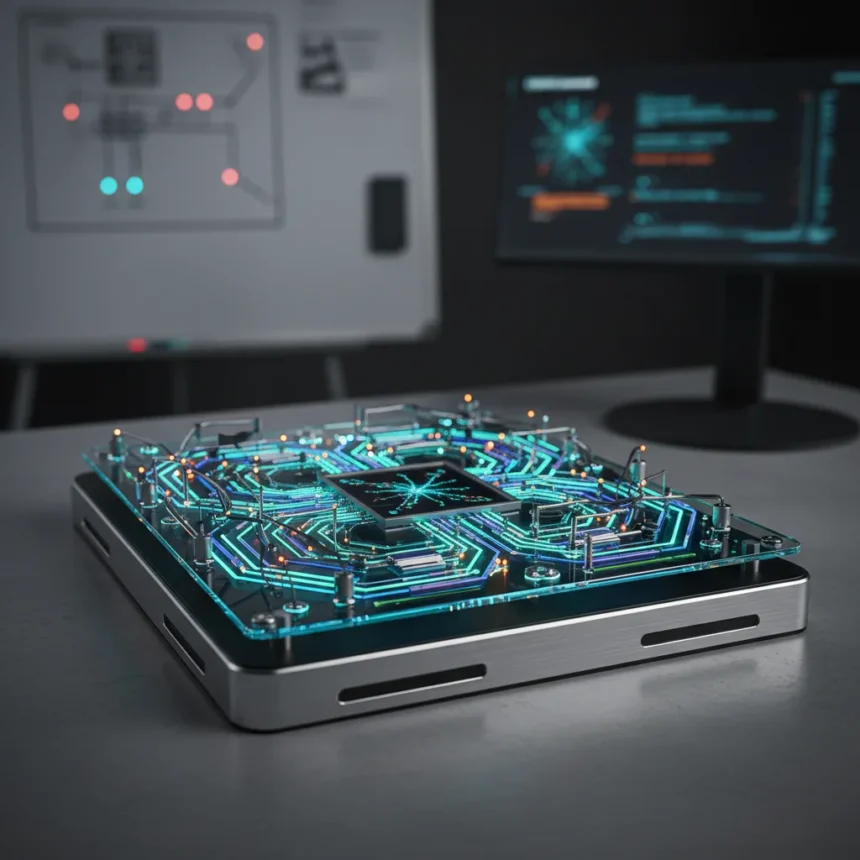
A fluid circuit board is a rewirable prototype board that can be physically reconfigured in less than a minute, according to a startup that recently emerged from stealth with claims of fundamentally disrupting hardware iteration workflows. The startup asserts that this fluid circuit board could accelerate the design cycle by up to 1,000 times compared to traditional printed circuit boards, addressing a persistent bottleneck in electronics development where even minor design changes require physical reconstruction.
Key Takeaways
- Fluid circuit board can be physically rewired in under a minute without soldering or chemical etching.
- Startup claims 1,000x faster hardware iteration versus traditional PCBs.
- Prototype represents alternative to conventional copper-trace circuit boards.
- Company recently emerged from stealth with working prototype.
- Designed to eliminate time-consuming PCB redesign cycles.
What Makes the Fluid Circuit Board Different
Traditional printed circuit boards rely on copper foil traces chemically etched into an insulating substrate, a manufacturing process that locks components into fixed positions. Any design change requires fabricating an entirely new board, often taking days or weeks depending on the manufacturer’s turnaround time. The fluid circuit board concept bypasses this constraint by allowing physical rewiring without chemical processes or permanent connections. This architectural shift matters because hardware developers spend enormous time waiting for revised prototypes rather than iterating on ideas.
Conventional prototype boards use perforations, copper strips, or wire jumpers to connect components, offering some flexibility but still requiring manual rewiring and remaining bound by the board’s fixed layout. The fluid circuit board approach claims to eliminate these limitations entirely, enabling designers to reconfigure connections in under a minute without breaking the physical board or losing component placement. If the claim holds, the time savings alone would reshape how teams approach hardware development, particularly for startups and research labs operating under tight iteration schedules.
The Speed Advantage in Hardware Development
The 1,000x faster iteration claim hinges on comparing the fluid circuit board’s sub-minute reconfiguration time against the multi-day turnaround typical for ordering and receiving revised traditional PCBs. In conventional workflows, a designer identifies a circuit flaw, submits a new PCB design to a manufacturer, waits for fabrication, receives the board, solders components, and tests the result. This cycle repeats for each design iteration, consuming weeks on projects that might require five or ten revisions. The fluid circuit board would compress that entire loop into a single day or even hours, assuming the prototype performs as advertised.

Hardware prototyping today remains surprisingly manual and time-intensive despite advances in software simulation and design tools. Designers cannot fully validate circuit behavior until physical components interact in real conditions, making prototype testing unavoidable. A technology that cuts prototype turnaround from days to minutes would address a genuine pain point in the industry, particularly for teams developing IoT devices, embedded systems, or experimental hardware where design changes are frequent and unpredictable. The startup’s emergence from stealth suggests they believe the prototype has reached a stage worth demonstrating publicly, though third-party validation of the 1,000x claim remains absent from the available information.
Comparing Fluid Boards to Traditional PCB Workflows
Traditional PCB manufacturing involves designing circuits in software, sending designs to fabrication facilities, waiting for chemical etching and assembly, and finally receiving boards weeks later. Each iteration of this process costs money and time, creating a strong incentive to minimize design changes and get the initial layout right. Designers compensate by over-simulating, over-testing, and over-designing before committing to a board, a defensive approach that slows innovation. The fluid circuit board eliminates this friction point by making physical changes instantaneous and reversible, theoretically allowing designers to test ideas more freely and discover flaws faster.



Prototype boards and perfboards exist as alternatives to full PCB manufacturing, using standardized hole patterns and wire jumpers to assemble circuits quickly. These tools provide flexibility but require manual wiring, are prone to connection errors, and occupy significant physical space. They also lack the signal integrity and miniaturization advantages of professionally manufactured PCBs, making them unsuitable for many applications. A fluid circuit board that combines the reconfigurability of a prototype board with the performance characteristics of a manufactured PCB would represent a genuine step forward, assuming the prototype’s electrical properties match its convenience claims.
What Remains Unproven
The startup’s claims about the fluid circuit board are compelling, but key details remain undisclosed. The available information does not specify how the board handles signal integrity, component density, power delivery, or thermal management—all critical factors in real-world circuit design. The prototype may excel at simple educational circuits or low-frequency designs while struggling with high-speed digital or RF applications where trace routing and impedance control matter enormously. Without independent testing or published specifications, the 1,000x claim cannot be verified independently, and skepticism is warranted until third-party engineers can examine the prototype’s actual performance under realistic conditions.
Commercial viability also remains uncertain. Even if the fluid circuit board works perfectly for prototyping, the startup must demonstrate that it can be manufactured at scale, priced competitively, and integrated into existing design workflows. Designers accustomed to traditional PCB tools may resist adopting unfamiliar hardware, and the startup would need to prove that the speed advantage justifies any learning curve or compatibility challenges. The company’s emergence from stealth is a milestone, but the gap between a working prototype and a market-ready product remains substantial.
Could this replace traditional PCBs entirely?
No. The fluid circuit board is positioned as a prototyping tool that accelerates iteration, not a replacement for manufactured PCBs. Once a design is finalized, traditional PCBs remain superior for production because they offer miniaturization, cost efficiency at scale, and reliability that a fluid board cannot match. The fluid circuit board’s value proposition targets the development phase, not the manufacturing phase.



What types of circuits can the fluid circuit board handle?
The available information does not specify which circuit types, frequency ranges, or power levels the prototype supports. Signal integrity, component density, and thermal handling capabilities remain undisclosed, so claims about its suitability for specific applications cannot be verified without additional technical documentation from the startup.
When will the fluid circuit board be commercially available?
The startup has emerged from stealth with a working prototype, but no launch date, pricing, or availability timeline is provided in the available sources. Reaching commercial production from a prototype stage typically requires months or years of additional development, testing, and manufacturing setup.
The fluid circuit board prototype represents an intriguing challenge to the status quo of hardware iteration, but hype must be separated from reality. If the startup’s claims survive independent scrutiny, the technology could genuinely accelerate hardware development for teams that prototype frequently. Until then, the 1,000x claim remains a compelling promise rather than a proven achievement, and potential users should await third-party validation before restructuring their design workflows around this unproven technology.
Edited by the All Things Geek team.
Source: Tom's Hardware