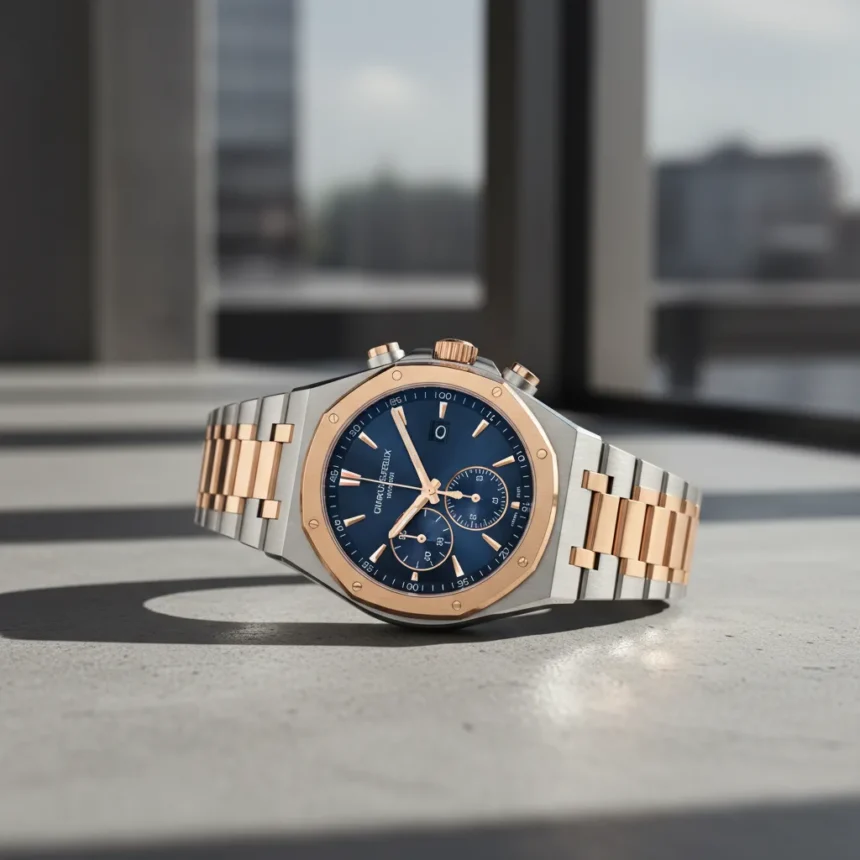
The two-tone chronograph watches market has long been dominated by safe choices and predictable metal combinations. Girard-Perregaux’s latest release shatters that conservatism with a design that feels both unexpected and inevitable once you see it.
Key Takeaways
- Girard-Perregaux launches a striking two-tone chronograph that breaks conventional luxury watch design rules.
- Two-tone metal combinations are emerging as a defining trend in haute horlogerie for 2025–2026.
- The watch balances technical sophistication with aesthetic boldness, challenging the industry’s risk-averse approach.
- Luxury watchmakers are increasingly experimenting with metal mixing to appeal to collectors seeking individuality.
- This release signals a shift away from monochromatic precious metal watches toward hybrid designs.
Why Two-Tone Chronograph Watches Matter Right Now
Two-tone chronograph watches represent a fundamental shift in how luxury watchmakers approach design. For decades, the industry operated under an unwritten rule: stick to one metal, one story. Yellow gold told one narrative. Stainless steel told another. Platinum was reserved for the ultra-wealthy. Girard-Perregaux’s new two-tone chronograph obliterates that hierarchy by proving that mixing metals is not a compromise—it is a statement.
The timing is crucial. Collectors in 2025 are tired of predictability. They want watches that reflect their own complexity: professional yet creative, traditional yet forward-thinking, valuable yet wearable. A two-tone chronograph delivers on all fronts. It signals confidence. It avoids the sterility of monochromatic design without sacrificing the gravitas that precious metals command.
This design philosophy represents a broader industry awakening. Watchmakers from independent horologists to established maisons are experimenting with metal combinations that would have been dismissed as gimmicky a decade ago. The two-tone chronograph watch has evolved from a niche preference into a legitimate design language.

The Girard-Perregaux Two-Tone Chronograph: Design That Defies Convention
What makes Girard-Perregaux’s approach to two-tone chronograph watches compelling is its refusal to hide the join. The watch does not apologize for mixing metals; it celebrates it. The contrast between the warm and cool tones creates visual rhythm—your eye moves across the dial with purpose, discovering details rather than scanning a uniform surface.
The two-tone chronograph design elevates the traditional chronograph complication beyond mere function. Chronographs have always been about precision and performance, but Girard-Perregaux’s execution proves that a two-tone chronograph can be equally about personality. The metal combination does not distract from the chronograph’s purpose; it enhances it by adding visual interest without sacrificing legibility.



For collectors evaluating two-tone chronograph watches, the question has always been whether the aesthetic payoff justifies the technical complexity of working with multiple metals. Girard-Perregaux answers affirmatively. The watch demonstrates that two-tone chronograph construction, when executed with care, creates an object that feels more substantial, more considered, and ultimately more desirable than its monochromatic alternatives.
How Two-Tone Chronograph Watches Reshape Luxury Watch Collecting
The emergence of two-tone chronograph watches as a category signals a democratization of luxury watchmaking. Historically, collectors could choose between established categories: sports watches in steel, dress watches in gold, technical instruments in titanium. A two-tone chronograph sits across these boundaries. It is sporty enough for daily wear, precious enough for formal occasions, and distinctive enough to stand out in any collection.
This flexibility has profound implications for the market. Collectors no longer need to own multiple watches to cover different occasions—a well-executed two-tone chronograph can do the work of three. For watchmakers, this means two-tone chronograph watches appeal to a broader audience: not just the ultra-wealthy who can afford a watch for every occasion, but the discerning collector who wants one exceptional piece.
Girard-Perregaux’s willingness to lead with a two-tone chronograph also reflects confidence in the house’s technical mastery. Mixing metals demands precision in manufacturing, careful attention to thermal expansion rates, and meticulous finishing. A poorly executed two-tone chronograph watch becomes a lesson in why monochromatic design exists. Girard-Perregaux’s execution suggests the brand has solved these technical challenges—and is ready to prove it to the world.



Two-Tone Chronograph Watches vs. Traditional Metal Choices
Comparing a two-tone chronograph to a traditional steel or gold chronograph reveals the advantages of hybrid design. A steel chronograph is practical and accessible, but it lacks the prestige and warmth that precious metals convey. A gold chronograph is undeniably luxurious, but it can feel heavy-handed—all signal, no subtlety. A two-tone chronograph splits the difference. It retains the technical credibility of steel while borrowing the visual richness of gold. The result is a watch that feels more sophisticated than either alternative alone.
The two-tone chronograph approach also solves a problem that has plagued luxury watchmaking: the gap between aspiration and wearability. A full gold chronograph can feel ostentatious for everyday use. A steel chronograph, while practical, can feel like a compromise. A two-tone chronograph is neither. It is bold enough to be noticed, refined enough to be worn anywhere, and distinctive enough to feel like a personal choice rather than a default selection.
What Collectors Should Know About Two-Tone Chronograph Watches
For anyone considering a two-tone chronograph watch, several factors matter. First, proportions: how much of each metal, and where? Girard-Perregaux’s design choices here are worth studying. Second, finishing: does the brand treat both metals with equal care, or does one feel neglected? Third, purpose: will you wear this daily, or is it a special occasion piece? A well-designed two-tone chronograph works in either role, but your own habits should inform the decision.
The two-tone chronograph category is still young enough that not all examples are equal. Some feel gimmicky. Some feel unfinished. Girard-Perregaux’s entry into the space carries weight precisely because the brand has the technical heritage and design confidence to make the concept work. This is not a trend-chasing exercise. It is a statement about the future of luxury watchmaking.
Is the Girard-Perregaux two-tone chronograph worth buying?
If you value distinctive design, technical sophistication, and a watch that works across multiple occasions, yes. The two-tone chronograph represents the evolution of luxury watchmaking—away from safe choices and toward designs that reflect the complexity of modern collecting. Girard-Perregaux has executed this vision with confidence and skill.
Are two-tone chronograph watches a passing trend?
No. The two-tone chronograph fills a genuine need in the market: a watch that is sporty and dressy, precious and wearable, bold and refined. As more collectors seek alternatives to monochromatic designs, two-tone chronograph watches will only become more central to luxury watchmaking.
How do two-tone chronograph watches compare to vintage examples?
Vintage two-tone chronographs often feel accidental—mixed metals as a result of repair or availability rather than deliberate design. Modern two-tone chronograph watches like Girard-Perregaux’s are intentional. The difference is profound. Contemporary two-tone chronograph design treats the metal combination as a core aesthetic choice, not a compromise.
Girard-Perregaux’s two-tone chronograph is not just a watch—it is a statement about where luxury watchmaking is headed. It proves that the future belongs to brands willing to challenge convention, and to collectors willing to embrace complexity. In a market saturated with safe choices, a watch that dares to be different is exactly what the industry needed.
Where to Buy
Edited by the All Things Geek team.
Source: T3