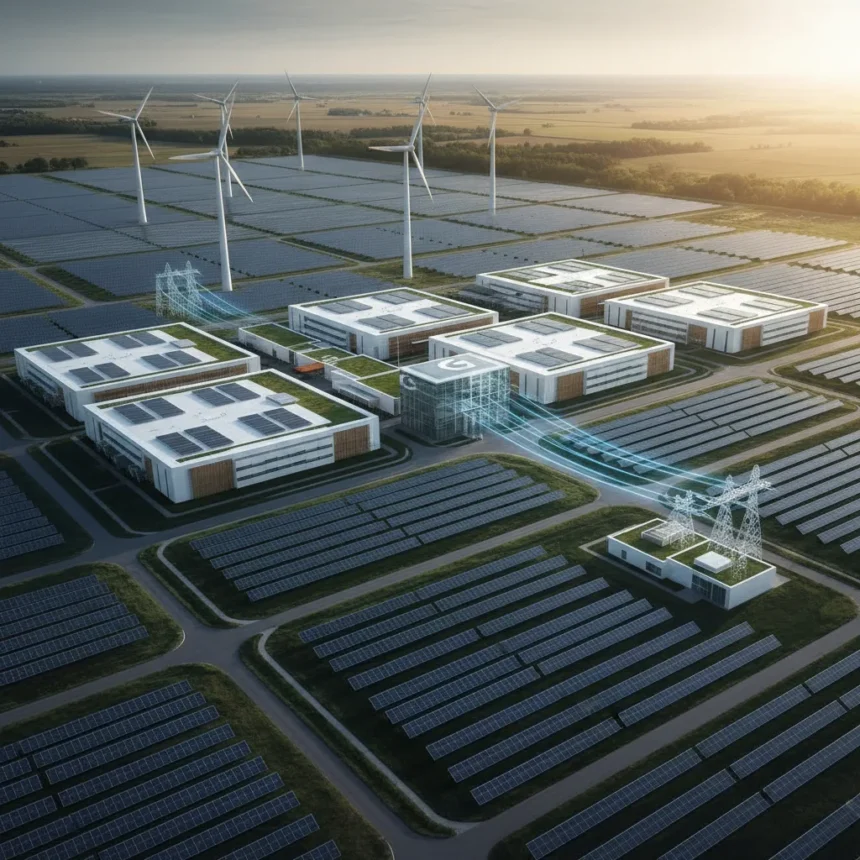
Google Michigan data center announced on March 17, 2026, represents a watershed moment for how hyperscalers fund renewable energy without shifting costs to everyday ratepayers. The partnership with DTE Energy in Michigan’s Van Buren Township—locally known as Project Cannoli—pairs a 1-gigawatt data center with a 2.7-gigawatt clean energy commitment spanning two decades. This is not just another corporate sustainability pledge. It is a structural shift in how AI infrastructure gets powered.
Key Takeaways
- Google’s Michigan data center deal commits 2.7 GW of new clean resources over 20 years via a Clean Capacity Acceleration Agreement
- The 1 GW data center will draw power equivalent to 2 million homes’ electricity demand when paired with grid support
- Clean energy sources include 1.6 GW solar, 400 MW energy storage, 350 MW demand response, and 300 MW bilateral deals
- Google contributes $10 million Energy Impact Fund for Michigan communities covering workforce development and home weatherization
- First deal to include demand response as a grid-stabilizing tool, positioning Michigan as a sustainable digital infrastructure hub
Why This Deal Matters Beyond the Gigawatts
The Google Michigan data center agreement breaks the usual pattern where tech companies demand power and local utilities scramble to build infrastructure on the company’s timeline. Instead, Google covers all electricity costs and infrastructure needs, protecting ratepayers from bearing the financial risk. The 20-year contract structure—filed by DTE with Michigan’s Public Service Commission—transforms data center expansion from a ratepayer burden into a clean energy accelerator. This matters because Michigan still relies heavily on coal-fired generation, and the deal explicitly supports the state’s transition away from that legacy infrastructure.
The clean energy breakdown reveals sophisticated grid thinking. Solar provides the bulk (1.6 GW), but the inclusion of 400 MW of advanced and long-duration energy storage addresses the intermittency problem that sinks most renewable-only pledges. The 350 MW demand response component—the first of its kind in a clean transition tariff—lets the data center flex its power consumption to match grid conditions rather than forcing the grid to match the data center’s rigid demand. This is the difference between a data center that destabilizes the grid and one that stabilizes it.
How Google Michigan Data Center Compares to Other Hyperscaler Deals
Google is not alone in pursuing clean power for AI infrastructure. In February 2026, Google signed power purchase agreements with TotalEnergies for 1 GW of solar capacity over 15 years serving Texas data centers, and with Xcel Energy for 1.9 GW (1.4 GW wind, 200 MW solar, 300 MW long-duration storage) for a Minnesota facility. The Michigan deal differs in one critical way: it uses a clean transition tariff structure that bundles ratepayer protection into the contract itself, rather than relying on separate PPAs. The Xcel and TotalEnergies deals are traditional power purchase agreements—Google buys renewable energy at fixed rates. The Michigan model makes the utility a partner in managing grid stability, not just a power supplier.

This distinction matters for scaling. Other tech giants—Meta, Amazon, Microsoft—are pursuing similar clean transition tariff structures for their own data center expansion. Michigan’s deal becomes a template. If successful, it proves that hyperscalers can fund massive renewable buildouts without destabilizing local grids or forcing residents to subsidize corporate infrastructure.
The $10 Million Community Fund and Political Context
Beyond the power commitment, Google pledges $10 million to an Energy Impact Fund supporting Michigan communities. The fund targets energy affordability, workforce development, home weatherization, and energy efficiency programs—investments that directly address the communities most vulnerable to rising energy costs. This is not philanthropy masquerading as strategy. It is recognition that data center projects trigger political backlash if locals see no tangible benefit.



Michigan’s political landscape has shifted toward embracing data center investment as an economic engine, but skepticism remains. The Google Michigan data center deal attempts to flip the narrative: instead of a corporate grab for cheap power, it positions the facility as a catalyst for grid modernization and local job creation. Whether that framing holds depends on execution—on whether DTE actually builds the promised clean resources on schedule, and whether the Energy Impact Fund delivers measurable community benefit.
What Happens Next for the Michigan Project
The site in Van Buren Township remains under evaluation, with no construction start date confirmed. DTE’s filing with Michigan’s Public Service Commission on or around March 17, 2026, triggers a regulatory review process that could take months. Approval is not guaranteed, though the deal’s ratepayer-protection structure makes it politically harder to reject than traditional data center proposals.
If approved, the Google Michigan data center becomes operational sometime in the mid-to-late 2020s. The 20-year clean energy commitment extends well beyond that initial buildout, locking in grid benefits for decades. This is why the timeline matters: hyperscalers are not thinking in quarterly earnings cycles. They are building infrastructure for an AI-driven future that demands constant, reliable, clean power.
Does the deal actually protect Michigan ratepayers?
Yes. Google covers all electricity costs and infrastructure expenses needed to support the data center, preventing the utility from passing those costs to residential and business customers. The clean transition tariff structure embeds ratepayer protection into the contract itself, rather than leaving it to regulatory goodwill. This is a meaningful distinction from older data center deals where utilities absorbed financial risk.



Why include demand response in a data center power deal?
Demand response—the ability to reduce power consumption when the grid is stressed—transforms the data center from a fixed load into a flexible resource. The 350 MW demand response component lets Google’s facility absorb excess solar generation during peak production hours and reduce consumption during grid emergencies, stabilizing the overall system. It is a tool borrowed from utility grid management that rarely appears in corporate power agreements.
How does this compare to traditional power purchase agreements?
Traditional PPAs, like Google’s TotalEnergies and Xcel deals, lock in renewable energy supply at fixed rates over 15–20 years. Clean transition tariffs go further by bundling grid stability, ratepayer protection, and community investment into a single regulatory structure. The Michigan model is more complex to negotiate but creates stronger alignment between corporate and public interests.
Google’s Michigan data center deal is not revolutionary in isolation—it is one data center, one utility, one state. But it signals that hyperscalers have learned an uncomfortable truth: if you want to build massive AI infrastructure, you cannot do it on the backs of local ratepayers. The future belongs to companies that solve the power problem by building clean energy, stabilizing grids, and investing in communities. Google is betting that this approach scales.
Edited by the All Things Geek team.
Source: TechRadar