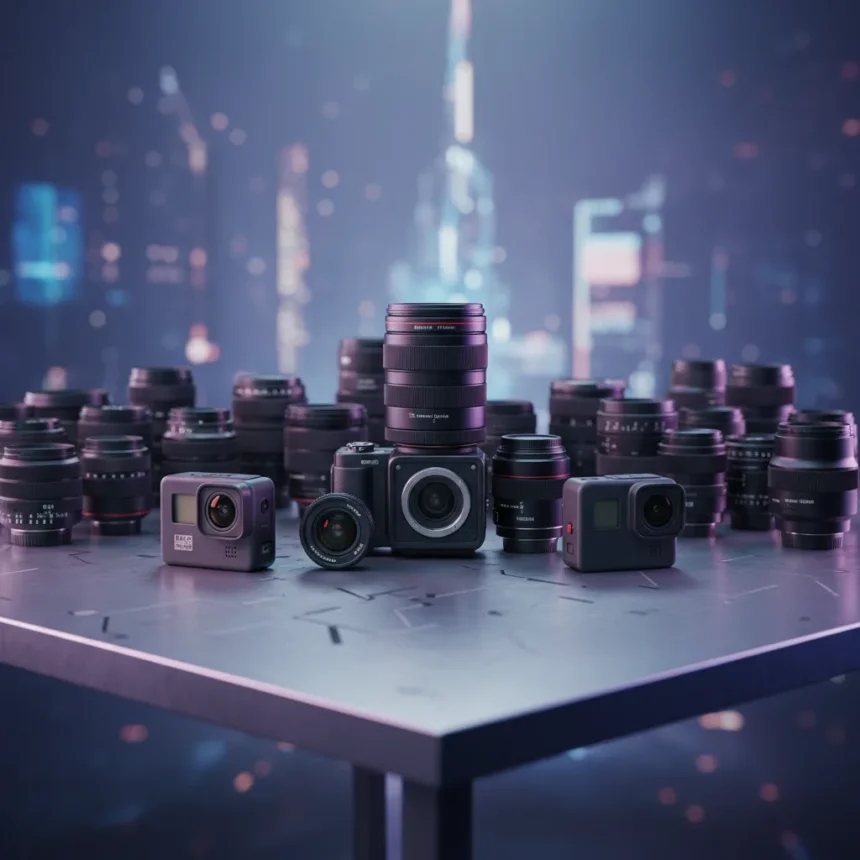
GoPro Mission 1 8K cameras represent the company’s most significant product overhaul in 20 years, marking a decisive shift from consumer action cams toward professional-grade filmmaking tools. The trio of new cameras brings 8K resolution to GoPro’s lineup, with one model supporting hundreds of professional camera lenses—a feature that fundamentally changes what creators can accomplish with GoPro hardware.
Key Takeaways
- GoPro Mission 1 is the company’s biggest upgrade in 20 years, introducing 8K resolution across three models.
- One Mission 1 model supports hundreds of professional camera lenses, enabling compatibility with existing pro gear.
- The launch signals GoPro’s pivot from casual POV footage toward professional production workflows.
- Previous HERO13 Black features 5.3K video, HyperSmooth 6.0 stabilization, and interchangeable HB-Series Lenses.
- Mission 1 cameras follow the success of GoPro hardware used on NASA’s Artemis II mission in 2026.
What Makes GoPro Mission 1 8K Cameras Different
GoPro Mission 1 8K cameras break from the company’s traditional formula of compact, rugged action cams designed for extreme sports and casual vlogging. Instead, these three new models target professional cinematographers and filmmakers who need broadcast-quality resolution without abandoning GoPro’s durability and ease of use. The 8K resolution alone represents a generational leap—previous flagships like the HERO13 Black maxed out at 5.3K60 video.
The lens compatibility feature on one Mission 1 model is the real significant shift. By supporting hundreds of professional camera lenses, GoPro is essentially saying: bring your existing RF-mount or other pro glass, and we’ll handle the sensor and stabilization. This approach sidesteps the traditional bottleneck where action cam creators had to choose between compact form factor and optical flexibility. Filmmakers can now pair Mission 1 hardware with macro lenses, ultra-wide optics, or neutral density filters without buying entirely new camera systems.
Compared to the HERO13 Black, which introduced interchangeable HB-Series Lenses for the first time, Mission 1 8K cameras open the ecosystem dramatically wider. The HERO13’s lens system was clever but limited to GoPro’s own ecosystem. Mission 1’s pro lens support means a cinematographer who already owns Zeiss, Canon, or Sigma glass can integrate GoPro’s stabilization and sensor directly into their existing kit.

Professional Features and NASA Credibility
GoPro’s professional ambitions are bolstered by real-world validation. In April 2026, GoPro hardware was selected as official mission equipment aboard NASA’s Artemis II spacecraft, where it documented the journey around the Moon. That endorsement—using GoPro cameras in one of humanity’s most demanding environments—carries weight that no marketing claim can match. It proves the cameras can function reliably where failure is not an option.
The Mission 1 series builds on this credibility by targeting workflows where reliability and image quality are non-negotiable. The 8K resolution enables professional color grading, cropping in post-production, and future-proofing for emerging broadcast standards. Stabilization technology, proven across the HERO13 Black’s HyperSmooth 6.0 system, ensures footage remains usable even in chaotic shooting conditions.



How Mission 1 8K Cameras Compare to Existing GoPro Lineup
The gap between Mission 1 and the current HERO13 Black is substantial. The HERO13 remains a versatile consumer camera with 5.3K resolution, magnetic mounting, and auto-detecting HB-Series Lenses that unlock macro, ultra-wide, and neutral density capabilities. It’s an excellent all-in-one for creators who need flexibility without professional overhead.
Mission 1 8K cameras, by contrast, are built for specialists. They assume users either already own professional lenses or are willing to invest in them. The 8K resolution, pro lens support, and professional-grade stabilization indicate these cameras are designed for rental houses, production companies, and elite independent filmmakers—not casual vloggers or adventure enthusiasts. The HERO13 Black remains the more accessible option for most users, but Mission 1 is where GoPro plants its flag in the professional market.
Older models like the HERO10 Black, with its 5.3K and 4K120fps capabilities, feel dated by comparison. Mission 1’s 8K resolution and lens ecosystem represent a full generational leap, not just an incremental spec bump.
What This Means for GoPro’s Future
The Mission 1 launch signals that GoPro is no longer content competing solely in the action camera space. By introducing pro lens support and 8K resolution, the company is directly challenging mirrorless and cinema camera makers. This is a bold move—it expands GoPro’s addressable market but also puts it in direct competition with brands that have decades of professional relationships and ecosystem depth.



The trio of Mission 1 models suggests GoPro is offering choice at different price and capability tiers, though specific models and pricing remain unconfirmed. This tiered approach mirrors how professional camera manufacturers structure their lineups, further reinforcing GoPro’s shift toward the pro market.
Will Mission 1 8K Cameras Replace Traditional Cinema Cameras?
Not entirely. Mission 1 cameras excel at stabilization, ruggedness, and compact form factor—advantages that matter for documentary, action, and run-and-gun work. Traditional cinema cameras offer deeper manual control, larger sensors, and more mature post-production pipelines. Mission 1 is best understood as a complementary tool for professionals, not a replacement. A production might use Mission 1 for POV shots, gimbal-free handheld work, or extreme environments where conventional cameras would fail.
What Happened to GoPro’s Smaller Action Cam Focus?
The HERO13 Black and earlier models remain in GoPro’s lineup, serving the consumer and prosumer markets. Mission 1 doesn’t replace that strategy—it extends it upmarket. GoPro is now a broader company, with products spanning casual users to professionals, much like Canon or Sony. The HERO13 Black’s interchangeable lenses and magnetic mount were the bridge; Mission 1 8K cameras are the destination.
GoPro Mission 1 8K cameras represent a watershed moment for the company. After 20 years as the dominant action camera brand, GoPro is finally stepping into professional production. The 8K resolution, pro lens compatibility, and proven reliability create a compelling proposition for filmmakers tired of choosing between compact form factor and optical flexibility. For casual users, the HERO13 Black remains the smarter buy. For professionals willing to invest in the ecosystem, Mission 1 8K cameras offer capabilities that rival cameras costing several times as much.
Where to Buy
GoPro HERO13 Black | DJI Osmo Action 6
Edited by the All Things Geek team.
Source: TechRadar