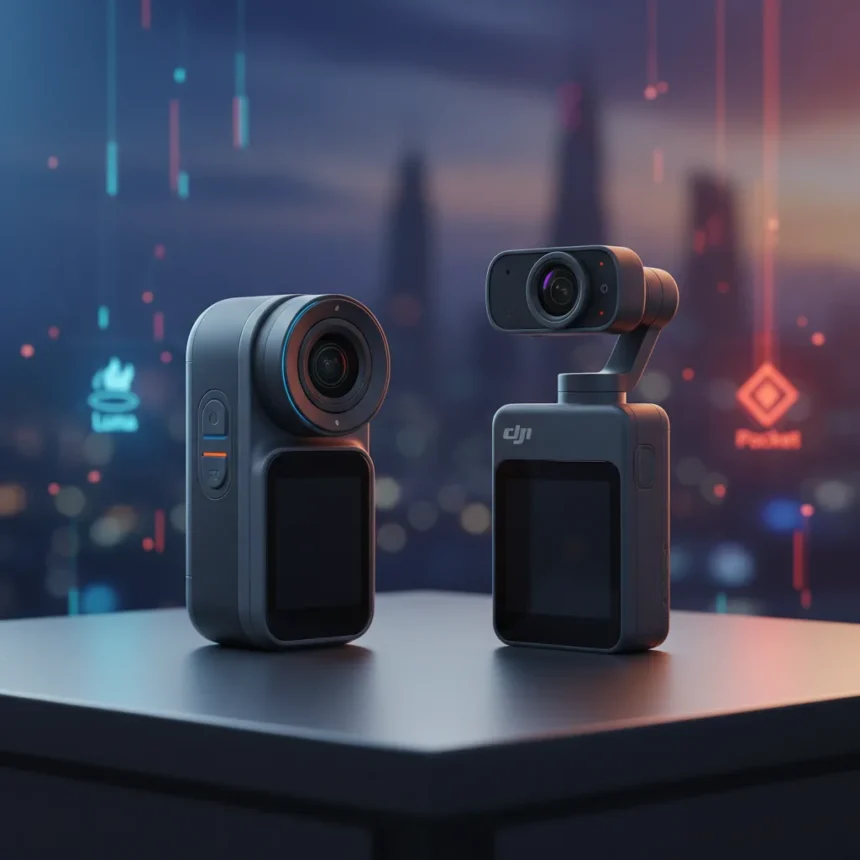
Insta360 Luna vlogging camera represents a major shift for Insta360, moving the company away from its core 360-degree camera business into the competitive compact vlogging space. The Luna is Insta360’s first dedicated vlogging camera, and early hands-on impressions suggest it has the potential to challenge DJI Pocket 4’s grip on the category.
Key Takeaways
- Insta360 Luna is the company’s first vlogging camera, marking a departure from 360-camera focus
- Early hands-on testing indicates Luna could meaningfully compete with the DJI Pocket 4
- Luna targets the compact, stabilized handheld vlogging-camera category
- Insta360 is leveraging its imaging expertise to enter a new product segment
- The camera represents a strategic expansion for a company historically known for 360 content
Why Insta360 Luna vlogging camera matters now
For years, DJI’s Pocket line has owned the compact vlogging-camera space almost entirely. The market has needed genuine competition, and Insta360’s entry changes that equation. Rather than iterating on existing designs, Insta360 is bringing a fresh perspective from its 360-camera heritage into a category where handheld stabilization and video quality are non-negotiable. This is not a me-too product—it is a calculated strategic move by a company with deep imaging credentials.
The timing matters because vlogging hardware has stagnated. DJI’s Pocket 4 remains the default choice for creators who want a pocket-sized gimbal camera, but that dominance has left little room for innovation. Insta360’s entry signals that the market is ready for alternatives, and the company’s hands-on showing suggests the Luna is not arriving as an also-ran competitor.
What sets Insta360 Luna vlogging camera apart
Early hands-on impressions reveal that Luna is designed to compete directly in the compact, stabilized handheld vlogging-camera space where DJI has long reigned. Insta360 is not trying to out-DJI DJI—instead, the company is bringing its own design philosophy and imaging expertise to a category where pocket gimbal cameras have become the standard tool for mobile creators.

The Luna’s positioning as a vlogging-first device suggests Insta360 has studied what creators actually need versus what existing hardware offers. By stepping out of its 360-camera lane, Insta360 is signaling that it understands the vlogging audience and has engineered a product specifically for that use case rather than adapting existing technology.
The key differentiator lies in how Insta360 approaches the problem of compact video stabilization and image quality. While DJI’s Pocket line has set the baseline expectation—small form factor, reliable gimbal performance, solid video output—Luna arrives with the advantage of learning from years of Insta360’s camera development. This is not the first time Insta360 has built imaging hardware; it is simply the first time the company has focused that expertise on the vlogging-camera category.



How Luna compares to the DJI Pocket 4
The DJI Pocket 4 has become the benchmark for what a compact vlogging camera should deliver: portability, three-axis gimbal stabilization, and reliable autofocus. Luna enters a market where those expectations are already set. The question is not whether Luna matches DJI’s feature set—it is whether Luna offers a compelling alternative that justifies the switch for creators currently invested in the Pocket ecosystem.
Insta360’s advantage lies in its outsider perspective. The company is not beholden to the design language or feature priorities that DJI has established. Luna can take risks that DJI might not, experiment with form factors DJI has avoided, and prioritize features that the Pocket line has overlooked. Early hands-on testing suggests Insta360 has identified gaps in DJI’s offering and built Luna to address them.
The competitive landscape also matters. DJI’s Pocket line faces no serious rivals in the compact gimbal-camera space, which means DJI has little pressure to innovate rapidly. Luna’s arrival changes that dynamic. Even if Luna does not immediately outsell the Pocket 4, the presence of a credible competitor forces both companies to accelerate development cycles and take user feedback more seriously.
Should creators switch to Insta360 Luna vlogging camera?
For existing DJI Pocket 4 users, the decision depends on what Luna offers that the Pocket 4 does not. Switching costs are real—creators have invested in DJI’s ecosystem, learned the interface, and built workflows around the Pocket’s capabilities. Luna has to offer a compelling reason to abandon that investment.



For new creators entering the compact vlogging-camera market, Luna represents a genuine choice where none existed before. The decision becomes about which company’s approach to handheld video stabilization and imaging philosophy aligns with individual creative priorities. Insta360’s entry into the vlogging space means creators no longer have a single default option.
What does Luna’s arrival mean for the vlogging-camera market?
Insta360 Luna vlogging camera signals that the compact gimbal-camera category has matured enough to support multiple players. For years, DJI’s dominance seemed unshakeable, but Luna’s credible challenge suggests the market was waiting for an alternative. Competition drives innovation, and both Insta360 and DJI will benefit from having to prove their value propositions to creators.
The broader implication is that Insta360’s willingness to leave its 360-camera comfort zone and enter vlogging opens the door for other companies to challenge DJI as well. The Pocket 4 may no longer be the obvious choice for every creator. That is healthy for the industry and better for users who now have options.
Is Insta360 Luna vlogging camera available now?
Based on the available information, Insta360 Luna vlogging camera was shown in early hands-on form, indicating the product is in development or pre-launch stages rather than available for general purchase. Specific pricing, exact release dates, and regional availability details have not been confirmed in the provided materials.
How does Insta360 Luna vlogging camera compare to other compact gimbal options?
The compact handheld vlogging-camera space is dominated by the DJI Pocket 4. Luna is positioned as the primary competitor in this category. While other companies make action cameras and smartphone gimbals, the Pocket 4 and Luna occupy the same niche: pocket-sized, three-axis stabilized cameras designed specifically for vlogging and mobile content creation.
Why is Insta360 entering the vlogging-camera space now?
Insta360 has built expertise in imaging and stabilization technology through years of 360-camera development. The company recognized that the vlogging-camera market had matured and that its core competencies—camera design, stabilization, and video quality—translate directly to the compact gimbal category. Entering now allows Insta360 to challenge DJI’s unchallenged dominance with a product informed by the company’s unique heritage.
Insta360 Luna vlogging camera represents more than a new product line for Insta360; it signals that the company is confident enough in its imaging expertise to compete outside its traditional 360-camera focus. For creators tired of DJI’s default status, Luna offers a credible alternative built by a company with deep camera-engineering credentials. The vlogging-camera market just became more interesting.
Edited by the All Things Geek team.
Source: TechRadar