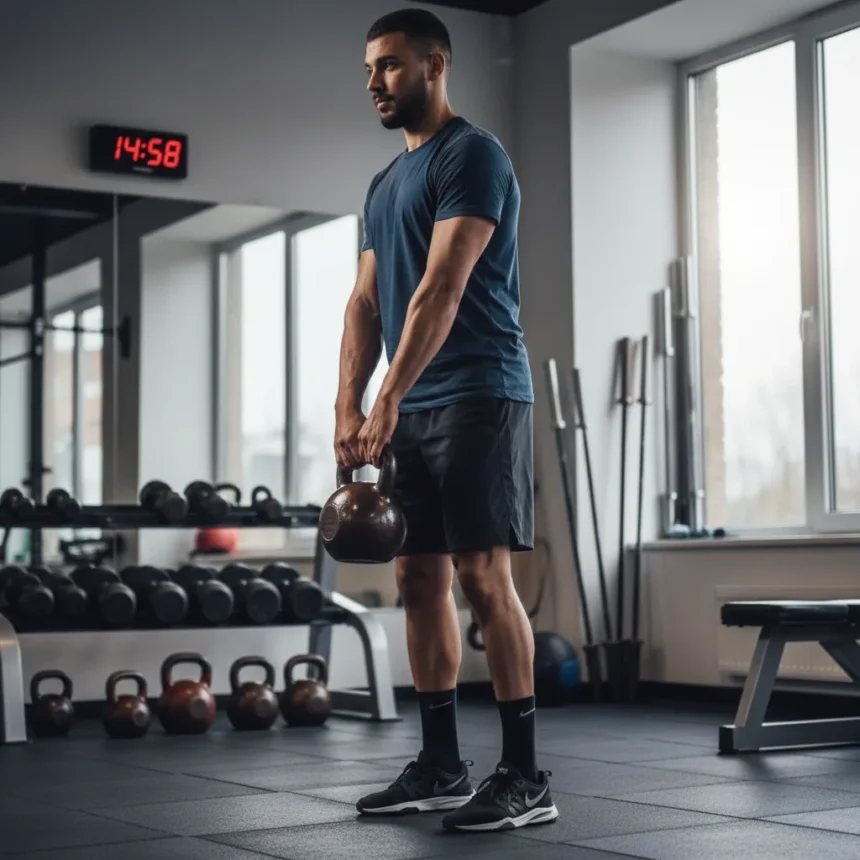
Kettlebell strength training is a form of resistance exercise using cast-iron weights with a handle, designed to build functional strength and power through compound movements. The debate over whether kettlebells truly deliver strength gains—or merely offer a trendy alternative to dumbbells and barbells—has largely been settled by evidence: they work. A focused 15-minute kettlebell routine can produce measurable strength improvements, challenging the assumption that meaningful gains require lengthy gym sessions.
Key Takeaways
- Kettlebell strength training builds functional strength through compound movements in short sessions.
- A 15-minute workout can deliver strength-building results comparable to longer routines.
- Proper form and controlled movement patterns are critical to preventing injury.
- Kettlebell exercises engage multiple muscle groups simultaneously, maximizing efficiency.
- Beginners should consult a qualified fitness professional before starting any new strength program.
Why Kettlebell Strength Training Works
Kettlebell strength training differs fundamentally from traditional dumbbell work because the weight distribution forces stabilizer muscles to engage continuously. When you lift a kettlebell, the offset handle creates an asymmetrical load that your core, shoulders, and grip must constantly stabilize. This demand for stability translates into functional strength—the kind that transfers to real-world movement patterns, not just isolated muscle growth.
The efficiency of kettlebell strength training lies in compound movement patterns. Rather than isolating a single muscle group, kettlebell exercises like swings and cleans engage the posterior chain, core, legs, and upper body simultaneously. A 15-minute session can therefore produce a metabolic stimulus that might take 30 or 40 minutes with traditional strength methods. This is not about rushing through reps—it is about intelligent exercise selection that maximizes work density without sacrificing form.
The Three-Move Kettlebell Strength Training Routine
An effective kettlebell strength training session requires only three carefully chosen movements. The specific exercises depend on your starting point, but the principle remains constant: select movements that challenge multiple movement patterns—a lower body hinge, an upper body pull or press, and a core stability element. This structure ensures balanced strength development across the entire body within a compressed timeframe.

When performing kettlebell strength training movements, form precision matters more than speed. A kettlebell swing should begin with a hip hinge—knees slightly bent, chest upright, weight in your heels—not a squat. The explosive drive comes from your hips and glutes, not your arms. Your arms remain relatively straight throughout the movement, serving as connectors between your torso and the kettlebell. The bell should rise to roughly chest height, controlled by hip extension, then float back down as you return to the hinge position. This distinction separates effective kettlebell training from dangerous, lower-back-straining form.
Safety note: If you are new to kettlebell strength training, returning from an injury, or have any pre-existing conditions, consult a qualified fitness professional before beginning this or any strength program. Proper form prevents injury and ensures you build strength efficiently rather than reinforcing poor movement patterns.



Kettlebell Strength Training vs. Traditional Methods
Kettlebell strength training compares favorably to barbell and dumbbell work in terms of time efficiency and functional carryover, though each tool has distinct advantages. Barbells allow heavier absolute loads, which some strength athletes prioritize for maximal strength development. Dumbbells offer greater freedom of movement and reduce the learning curve for beginners. Kettlebells occupy a middle ground: heavier than most dumbbells, more forgiving than barbells, and uniquely demanding in terms of stabilization requirements.
The 15-minute timeframe is what distinguishes kettlebell strength training from conventional approaches. A barbell strength session typically requires 45 minutes to an hour when you factor in warm-up, strength work, and accessory exercises. A kettlebell routine compresses this timeline by eliminating isolation work and focusing entirely on compound patterns. This efficiency appeals to people with limited training time, but it also suits experienced lifters who value metabolic stimulus alongside strength development.
Progression and Adaptation in Kettlebell Strength Training
Kettlebell strength training progresses through several mechanisms. The most obvious is increasing the weight of the bell itself. A typical progression might move from a 16kg bell to a 20kg, then 24kg, and so on. However, weight progression alone is not sufficient for long-term strength gains. You must also progress movement complexity, increase training density (more work in the same timeframe), or extend the duration of your working sets.
A 15-minute kettlebell strength training session could be structured as five minutes of warm-up followed by ten minutes of work intervals. As you adapt, you might increase work intervals from 40 seconds to 50 seconds while maintaining the same rest periods, or you might decrease rest periods to force greater density. These adjustments provide progression without requiring heavier bells, which matters if you train at home with limited equipment.



Common Mistakes in Kettlebell Strength Training
The most frequent error in kettlebell strength training is treating the bell like a dumbbell. Kettlebell movements are ballistic and explosive—they require momentum and hip drive, not slow, controlled grinding. A kettlebell swing is not a squat; a kettlebell clean is not a bicep curl. Beginners often decelerate the bell at the top of a swing or slow down during a clean, which defeats the purpose and increases injury risk. The bell should move explosively through the drive phase, then decelerate naturally as momentum fades.
Another common mistake is neglecting the eccentric (lowering) phase. Kettlebell strength training gains come from both the explosive drive and the controlled descent. If you drop the bell or let gravity handle the lowering phase, you miss half the stimulus. Control the descent, maintain tension, and prepare for the next rep. This discipline separates effective kettlebell training from sloppy repetition.
How often should I do kettlebell strength training?
For strength development, kettlebell strength training sessions work best performed 3-4 times per week with at least one rest day between sessions. This frequency allows adequate recovery while providing enough stimulus for adaptation. Beginners may start with 2-3 sessions per week to master movement patterns before increasing frequency.
What weight kettlebell should I start with?
Kettlebell strength training beginners should select a weight that allows 8-10 controlled repetitions of the most challenging movement in your routine while maintaining perfect form. For most adults, this means a 12kg or 16kg bell. If you can complete all reps with fresh energy remaining, the weight is too light. If form breaks down before reaching your target reps, the weight is too heavy.
Can kettlebell strength training replace all other exercise?
Kettlebell strength training builds strength and work capacity effectively, but it does not develop all fitness qualities equally. If you want comprehensive fitness—including aerobic capacity, flexibility, and sport-specific skills—kettlebells alone are insufficient. However, as a time-efficient strength tool, kettlebell strength training stands alone. A 15-minute kettlebell session is vastly superior to no training at all, and it provides genuine strength stimulus for people who cannot access a full gym.
Kettlebell strength training has proven itself as a legitimate, efficient path to measurable strength gains. The 15-minute format is not a shortcut or a compromise—it is a deliberately designed structure that maximizes work density through intelligent exercise selection. If you commit to proper form, consistent progression, and adequate recovery, kettlebell strength training will deliver the results that decades of training data confirm. The question is no longer whether kettlebells work, but whether you are willing to train with the focus and precision they demand.
Edited by the All Things Geek team.
Source: Tom's Guide