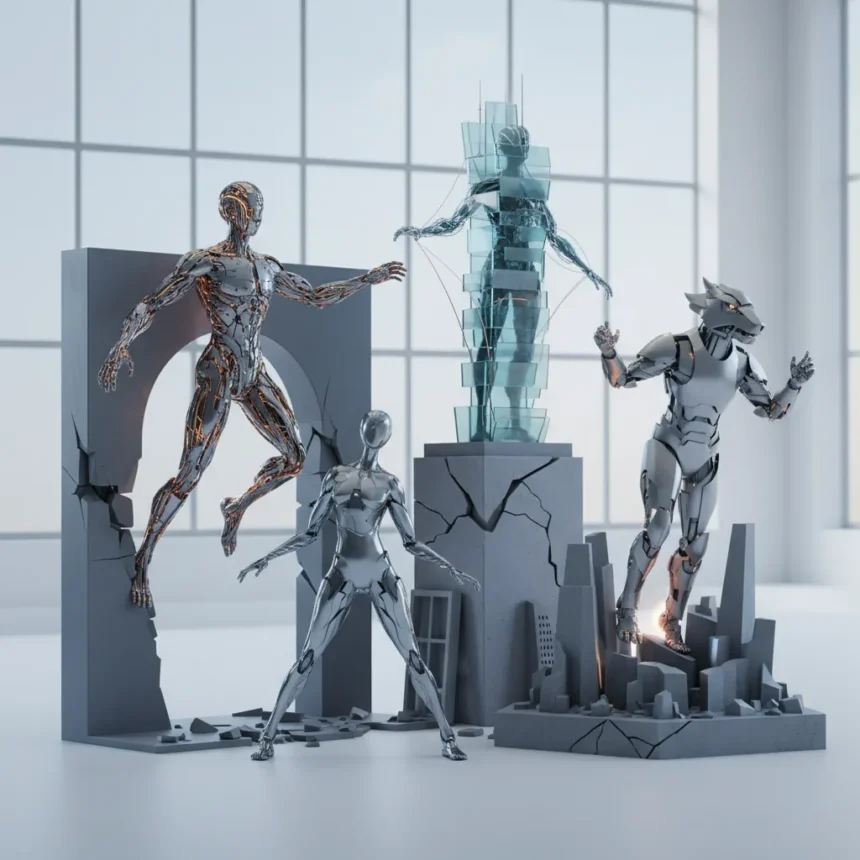
3D character design has become a victim of its own tools. Walk through any portfolio site, and you’ll see the same muscular heroes, identical anime faces, and low-poly generics repeated endlessly. Kevin Beckers, a 3D artist with deep roots in architectural visualization, is proving there’s a better way.
Key Takeaways
- Kevin Beckers applies architectural visualization techniques to 3D character design, creating distinctive non-generic figures.
- His approach leverages arch-viz skills like precise modeling, modular construction, and structural realism.
- 3D character portfolios often suffer from homogenization due to reliance on standard anatomy references and mass-produced assets.
- Beckers’ characters feel like inhabitants of believable worlds rather than isolated digital sculptures.
- His fusion of technical rigor with character work offers a model for breaking industry sameness in 2026.
Why 3D Character Design Feels Stuck in a Loop
The 3D character art world has a sameness problem. Most portfolios showcase variations on identical themes: hyper-muscular fantasy heroes, anime-inspired faces with exaggerated proportions, or generic low-poly figures churned out from Blender and ZBrush. The culprit? Reliance on standard anatomy references, cookie-cutter rigging pipelines, and mass-produced asset libraries that flatten individuality. When every artist starts from the same anatomical baseline, the output inevitably converges.
This homogenization reflects deeper workflow issues. Artists often follow established character pipelines without questioning whether those pipelines serve their unique vision. The result is a portfolio landscape where technical competence is high but creative distinction is scarce. A character model might be flawlessly rendered, but if ten other artists have rendered the same character, does technical perfection matter?
How Architectural Visualization Reshapes Character Work
Kevin Beckers’ breakthrough lies in his willingness to borrow from a completely different discipline. Architectural visualization demands hyper-realistic proportions, precise spatial relationships, and the ability to integrate objects into believable environments. These skills, typically applied to buildings and interiors, translate powerfully to character design when executed with intention.

His approach treats character construction like building design. Rather than starting with a generic humanoid base mesh, Beckers applies modular thinking—building characters the way architects build structures, with repeatable elements and logical structural systems. This methodology produces characters that feel engineered rather than sculpted, grounded in spatial logic rather than stylistic whimsy. The result is figures that inhabit worlds convincingly, not abstractions floating in void.
Architectural visualization also instills a discipline around environmental storytelling. Arch-viz artists spend careers thinking about how objects relate to their surroundings, how light interacts with surfaces, how proportions feel in space. When Beckers brings this sensibility to character design, his figures become inhabitants of believable worlds rather than isolated portfolio pieces.



3D Character Design in a Market Hungry for Distinction
The irony of modern 3D character art is that technical barriers have collapsed. Software like Blender is free and powerful. ZBrush democratized digital sculpting. Substance Painter standardized texture workflows. These tools are so good that technical competence alone no longer differentiates. Everyone can make a technically proficient character. Few can make a memorable one.
Beckers’ portfolio cuts through this noise because it refuses to compete on technical execution alone—it competes on conceptual clarity. By anchoring character design in architectural principles, he sidesteps the aesthetic arms race that defines most 3D portfolios. He’s not trying to out-render other artists; he’s working in a different conceptual framework entirely.
This distinction matters commercially. Studios chasing generic fantasy content can hire any competent character artist. But clients needing characters that feel architecturally grounded, spatially logical, and narratively integrated—those clients need someone like Beckers. His arch-viz background becomes a moat against commoditization.
What Makes a 3D Character Portfolio Actually Stand Out
Standing out in 3D character design requires more than technical skill. It requires a point of view. Beckers’ point of view is simple: characters should feel like they belong to believable worlds, built with the same rigor architects apply to buildings. This philosophy eliminates the need to chase stylistic trends or compete on rendering horsepower. Instead, it creates a consistent, defensible aesthetic.



The lesson extends beyond Beckers’ specific approach. Any 3D character artist can break the sameness by asking: What unique perspective do I bring? What discipline, skill, or life experience informs my work differently than other artists? Beckers answers with architecture. Another artist might answer with industrial design, biology, or engineering. The specific answer matters less than the commitment to a coherent vision.
For studios and art directors, Beckers’ portfolio serves as a reminder that distinctive 3D character design isn’t a matter of rendering power or software version. It’s a matter of conceptual clarity and the willingness to work outside established character pipelines.
Is Kevin Beckers’ approach scalable to other artists?
Yes, but not by copying his exact methods. The value lies in the principle: bring expertise from another discipline into character design. If you have a background in product design, apply that rigor. If you understand fashion or industrial engineering, channel that knowledge. The specific source discipline matters less than the commitment to a coherent, defensible vision that differentiates your work from generic character portfolios.
Why do so many 3D character portfolios look similar?
Standard anatomy references, mass-produced asset libraries, and established character pipelines create convergence. When most artists start from identical baselines and follow similar workflows, their outputs inevitably resemble each other. Breaking this requires either a unique conceptual framework—like Beckers’ architectural approach—or a willingness to abandon conventional character pipelines entirely.
What software does Kevin Beckers use for 3D character design?
The research brief does not specify Beckers’ exact software stack. His work suggests a blend of architectural visualization tools (likely 3ds Max or similar) combined with character-specific software like ZBrush and Substance Painter, but the specific tools remain secondary to his architectural methodology.
Kevin Beckers’ portfolio proves that 3D character design doesn’t have to be samey. By importing architectural rigor into character work, he’s shown that distinction comes not from rendering power or stylistic flourish, but from a coherent vision rooted in a unique perspective. In an industry drowning in generic humanoids, that clarity is rare—and commercially powerful.
Where to Buy
Wacom Cintiq 24 Touch: | HUION Huion Kamvas Pro 19 4K:
Edited by the All Things Geek team.
Source: Creativebloq