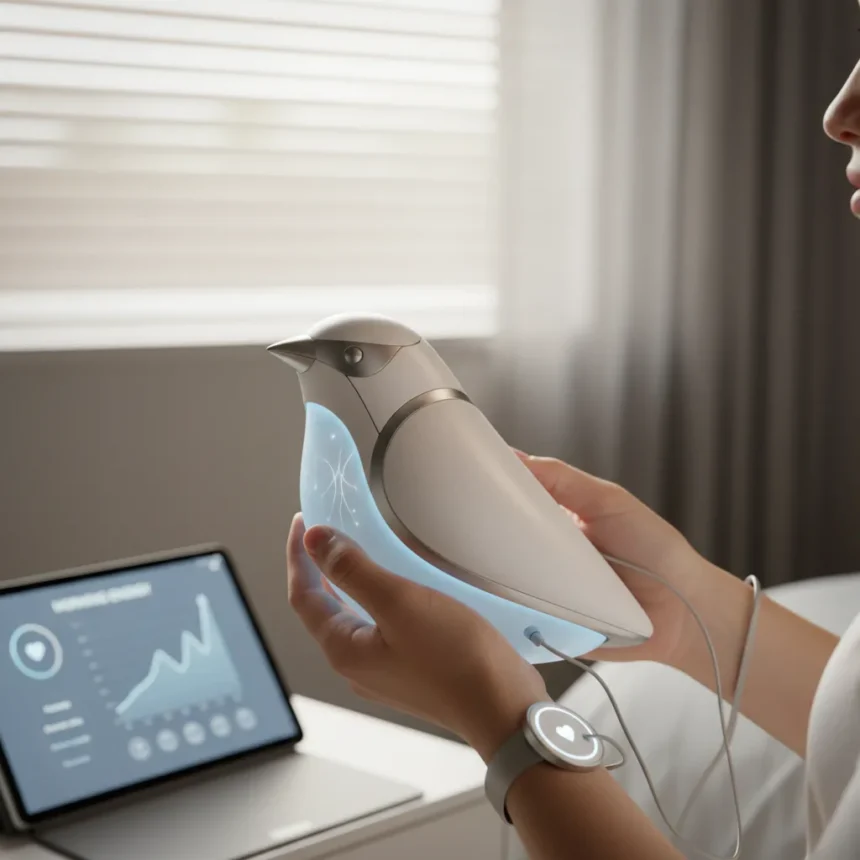
A handheld breathing coach sounds gimmicky until you hold one that actually works. The Moonbird is a palm-sized device that expands and contracts like tiny lungs, guiding slow diaphragmatic breathing without requiring you to count or think. After two weeks of daily use, the results were measurable: faster sleep onset, waking with genuine energy instead of grogginess, and heart rate variability data confirming the stress reduction was real, not placebo.
Key Takeaways
- Moonbird uses tactile expansion and contraction to guide diaphragmatic breathing without app required.
- Built-in PPG sensor tracks heart rate, HRV, and heart coherence in real time.
- Standalone mode activates by shaking; app mode offers guided meditations and custom exercises.
- EEG studies show higher alpha-band connectivity and lower beta-band connectivity, indicating wakeful relaxation.
- 30-day money-back guarantee with free returns; some insurers reimburse the cost.
How the Moonbird handheld breathing coach actually works
The device is deceptively simple. Shake it to wake, and it begins inflating and deflating on a preset rhythm. Your job is to match your breathing to its tempo—inhale as it expands, exhale as it contracts. No app, no screen, no counting. The session ends when the device stops, though you can repeat as many times as needed. For users with phone anxiety or meditation app fatigue, this tactile-only mode is liberating.
The app layer adds depth without complexity. Download the Moonbird app, place your thumb on the built-in photoplethysmogram sensor, and select a preset exercise or custom breathing pattern. The device guides you through the session while measuring your baseline breathing rate and tracking how your heart coherence improves afterward. Real-time biofeedback appears on screen—your heart rate, HRV, and coherence metrics updating as you breathe. It transforms breathing from an invisible act into something you can literally watch improve.
Real results: Sleep and morning energy improved measurably
The first night felt like a placebo. By night three, the pattern was undeniable: falling asleep 10 to 15 minutes faster than usual, and more importantly, waking without that thick-headed fatigue that normally requires two coffees to shake. Heart rate variability data—the time variance between heartbeats, a marker of nervous system resilience—showed consistent improvement after each session. Higher HRV correlates with better stress regulation and sleep quality, and the numbers bore this out.

This aligns with existing research. A 2022 study evaluated the device with 39 participants experiencing sleep problems, finding it acceptable for managing sleep issues and particularly appreciating the standalone function and design. Users in that study noted the tactile guidance helped them focus on breathing without screen distraction. One participant observed: the device has a stress-reducing and calming effect, and the shape and texture are pleasant because they are not too conspicuous.
An EEG study conducted by Moonbird researchers found that users showed higher alpha-band connectivity and lower beta-band connectivity during use—a neurological signature of stepping away from problem-solving and entering a wakeful relaxed state. This is the opposite of what happens during anxiety or racing thoughts, where beta-band activity dominates. The shift is measurable within minutes.



Moonbird versus other breathing and sleep tech
The handheld breathing coach market is small but growing. Moonbuddy, a child-focused variant, uses the same tactile guidance for younger users during bedtime routines. Compared to breathing apps alone—which rely on visual or audio cues—Moonbird’s physical expansion and contraction creates a more embodied experience. You are not watching a screen or listening to an instructor; you are holding something that breathes with you. This removes the cognitive load of following instructions, which is precisely why it works for people who find meditation apps frustrating.
Other tactile breathing devices exist, but the Moonbird’s real advantage is the optional biofeedback layer. Most competitors offer breathing guidance or app connectivity, rarely both with the same polish. The ability to use it standalone or with real-time HRV tracking gives it flexibility that pure app-based solutions cannot match.
Design, durability, and practical use
The device is one size only, which limits customization but simplifies the product line. It connects via Bluetooth Low Energy to the app, ensuring battery longevity—a full charge lasts weeks of daily use. The build feels solid, not cheap, and the silicone exterior is soft enough to hold comfortably but durable. Shake-to-wake is intuitive; you do not need to fumble with buttons or open an app just to start breathing.
Portability is genuine. Slip it into a pocket or bag, and you have a stress-relief tool that does not require WiFi, a full battery, or a working phone. This matters for people who use breathing exercises during stressful moments—meetings, flights, moments before sleep—when pulling out a phone feels counterintuitive.



Pricing and the money-back guarantee
The Moonbird costs approximately €179. A 30-day money-back guarantee covers the full refund, including return shipping, which removes the financial risk. Some insurers reimburse the cost, though coverage varies by region and policy. Global shipping is available, though EU availability appears to be the primary focus based on pricing currency.
Is the Moonbird worth buying for sleep and stress?
The Moonbird works best for people who struggle with meditation apps, find counting-based breathing techniques tedious, or want objective biofeedback on their stress levels. If you are skeptical of wellness gadgets but willing to try something with a money-back guarantee, the 30-day trial is a legitimate way to test it. The device is not a replacement for therapy or medical treatment, but as a complementary tool for stress and sleep, it delivers measurable results without the friction of app-based solutions.
Can you use Moonbird without the app?
Yes. Shake the device to activate standalone mode, and it runs on preset breathing rhythms through vibrations and expansion and contraction alone. The app is optional and adds guided meditations and custom exercises, but the core functionality—guided tactile breathing—works completely offline.
How long does a Moonbird session typically last?
Sessions vary depending on the mode. Standalone sessions end when the device stops inflating and deflating, typically lasting 3 to 5 minutes. App-guided sessions can be customized to your preference, ranging from a quick 2-minute reset to longer 10-minute meditations.
The Moonbird succeeds because it solves a real problem: people want to breathe slower and deeper for stress relief, but they do not want to think about it. A device that does the thinking for you, with optional data to prove it is working, fills a gap between meditation apps and doing nothing at all. The faster sleep onset and genuine morning energy are not revolutionary claims—they are the basic result of better stress regulation, delivered through something you can hold in your hand.
Where to Buy
from $199.99 on Amazon | available on Amazon | View Deal
Edited by the All Things Geek team.
Source: Tom's Guide