







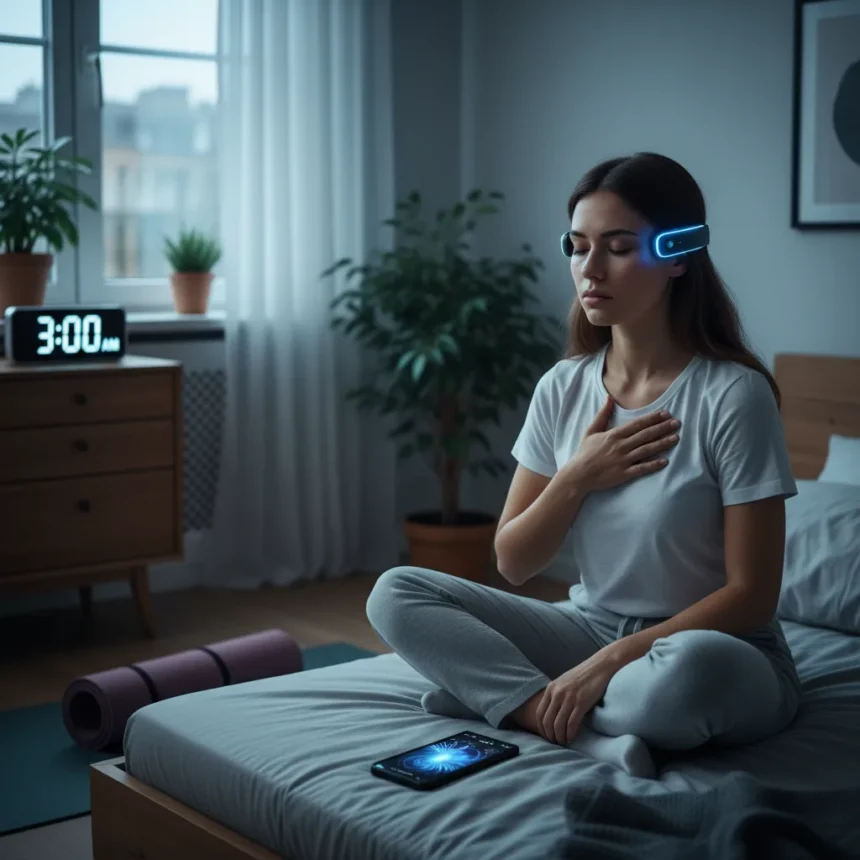
Waking up at 3 a.m. and lying awake for hours is maddening. If this has been your nightly reality for weeks, you are not alone—anxiety-driven 3 a.m. wake-ups are surprisingly common, and they are fixable without pills. Three specific relaxation techniques can help you fall back asleep in minutes: cognitive shuffling, deep breathing, and progressive muscle relaxation.
Key Takeaways
- Cognitive shuffling—thinking of random, neutral words—stops rumination and enables falling back asleep quickly.
- Deep breathing and progressive muscle relaxation are expert-endorsed alternatives when your mind won’t settle.
- Bedroom setup matters: cool temperature, darkness (via sleep mask), and quiet (via earplugs) maximize technique effectiveness.
- If techniques fail, leaving bed for a calming activity like folding laundry resets your sleep drive.
- Consistent sleep schedules and daytime outdoor time reduce the frequency of middle-of-the-night wake-ups.
Why 3 a.m. Wake-Ups Happen—and Why They Feel Unstoppable
The 3 a.m. phenomenon is real. Your brain wakes you, and then rumination takes over. Racing thoughts about work, relationships, or vague anxieties flood your mind, and sleep feels impossible. This cycle repeats night after night, eroding your confidence that you can ever sleep through again. The root causes vary: light pollution from windows, inconsistent sleep schedules, daytime stress without outlet, or simply anxiety that surfaces when your conscious mind quiets down. The good news is that once you understand the mechanism—rumination is the enemy, not insomnia itself—you can interrupt the cycle with targeted techniques.
Why does your bedroom environment matter? A cool room (try opening a window), a blackout sleep mask to block light, and earplugs to muffle noise create conditions where your nervous system can actually relax. Without these basics, even the best breathing technique will struggle to compete with environmental stimulation. Start here before expecting relaxation methods to work.
Cognitive Shuffling: The Fastest Route Back to Sleep
Cognitive shuffling is the most effective technique for stopping the 3 a.m. spiral. Here is how it works: lie comfortably in your optimized bedroom and deliberately think of random, neutral words—cow, leaf, sandwich, doorknob—and shuffle through them without forming narratives or memories around them. The goal is to occupy your thinking brain with meaningless input so that rumination cannot hijack it. Most people fall back asleep in seconds once they master this technique.



Why is this so effective? Rumination requires narrative—your brain spinning stories about what went wrong or what might go wrong. Cognitive shuffling breaks that narrative loop by filling your mental space with random, emotionally neutral content. You are not trying to clear your mind (which often backfires). You are deliberately cluttering it with harmless noise. Sleep experts, including Dr. Lu, endorse this approach as one of the fastest ways to interrupt the 3 a.m. wake-up cycle.
The technique requires no equipment, no app, and no special training. It works anywhere—at home, while traveling, in a noisy hotel room. The only prerequisite is a willingness to think about random objects instead of your anxiety. If you try it once and it does not work, that is normal. Like any skill, cognitive shuffling improves with repetition. By the third or fourth night, most people notice a dramatic difference in how quickly they drift back off.



Deep Breathing and Progressive Muscle Relaxation as Backup Techniques
If cognitive shuffling does not resonate with you, two other expert-backed methods can work just as well: slow, deep breathing and progressive muscle relaxation. Deep breathing is straightforward—keep your bedroom lights low (bright light signals wakefulness) and inhale slowly, then exhale slowly, focusing entirely on the rhythm of your breath. The 4-7-8 breathing method is a structured version: inhale for 4 seconds, hold for 7 seconds, exhale for 8 seconds. This pattern signals your nervous system to downshift and lulls both body and mind toward sleep.
Progressive muscle relaxation works differently. Starting at your toes, deliberately tense each muscle group for a few seconds, then release. Move sequentially up through your calves, thighs, abdomen, chest, arms, shoulders, neck, and face. This technique works because it redirects your attention away from racing thoughts and into physical sensation, and the release of muscle tension signals safety to your nervous system. Both methods take 5 to 15 minutes, depending on how quickly your body responds.
The choice between breathing and muscle relaxation often comes down to personal preference. Some people find breath control meditative and grounding. Others find it frustrating because they become hyperaware of breathing itself. Muscle relaxation suits people who think better through physical sensation than through breath awareness. Experiment with both and stick with whichever quiets your mind fastest.
What to Do If Relaxation Techniques Fail
Sometimes your brain simply refuses to cooperate. You have tried cognitive shuffling, deep breathing, and muscle relaxation, and you are still awake 20 minutes later. Sleep specialists recommend getting out of bed at this point. The bed has become associated with wakefulness and frustration, not sleep. A brief activity that genuinely interests you—folding laundry, gentle journaling to offload racing thoughts, or auricular massage (stimulating the vagus nerve in your ear)—can reset your sleep drive. After 10 to 15 minutes, return to bed and try again. Often, this break is enough to shift your nervous system state.



Avoid screens, bright lights, and stimulating activities during this break. The goal is to calm your mind, not entertain it. Journaling your racing thoughts can be surprisingly effective—the act of externalizing worry onto paper seems to free mental space that was occupied by rumination. If you choose to leave bed, commit to the break being brief and intentionally boring.
Prevention: Stop 3 a.m. Wake-Ups Before They Start
Relaxation techniques are reactive—they help when you are already awake. Prevention is more powerful. Consistent sleep and wake times, even on weekends, train your body to expect sleep at a specific hour and reduce the likelihood of middle-of-the-night arousal. Daytime outdoor exposure, especially in the morning, anchors your circadian rhythm and deepens nighttime sleep. If you struggle with daytime anxiety, scheduling a dedicated “worry time” earlier in the day—say, 3 p.m.—can prevent anxiety from ambushing you at 3 a.m..
Light pollution is a hidden culprit in 3 a.m. wake-ups. Even small amounts of ambient light can disrupt sleep architecture and trigger arousals. A blackout sleep mask is one of the most underrated sleep tools available. Research on Nordic sleep practices found that simply using an eye mask to block light correlates with significantly fewer nighttime awakenings. Pair this with consistent sleep hygiene—cool room, quiet environment via earplugs, no screens 30 minutes before bed—and you are addressing the root causes rather than just treating symptoms.
How long does it take for these techniques to work?
Cognitive shuffling can work the very first night you try it, though most people see consistent results within three to five nights of practice. Deep breathing and muscle relaxation may take longer because they require more conscious effort. The key is consistency. Using the same technique every night trains your brain to recognize it as a sleep cue, which strengthens its effectiveness over time.
Can these techniques work for anxiety-driven insomnia, or just 3 a.m. wake-ups?
These techniques work for any form of racing thoughts that prevent sleep, whether you are trying to fall asleep at 11 p.m. or fall back asleep at 3 a.m.. Cognitive shuffling, in particular, is effective whenever rumination is the barrier. If your insomnia stems from physical discomfort, sleep apnea, or hormonal shifts, these techniques will help less—consult a sleep specialist in those cases.
Should I try all three techniques or pick one?
Start with cognitive shuffling because it is the fastest and requires the least effort. If it does not work after a week, switch to deep breathing or progressive muscle relaxation. Most people find one technique that clicks and stick with it. There is no advantage to rotating techniques unless you get bored or one stops working.
The 3 a.m. wake-up cycle is a habit your brain has learned, but habits can be unlearned. Cognitive shuffling, deep breathing, and progressive muscle relaxation are not miracle cures, but they are evidence-backed, accessible tools that work for most people within days. The real victory is not falling asleep in seconds—it is breaking the anxiety loop that tells you sleep is impossible. Once you prove to yourself that you can fall back asleep reliably, the 3 a.m. panic loses its grip.
Where to Buy
This article was written with AI assistance and editorially reviewed.
Source: Tom's Guide




