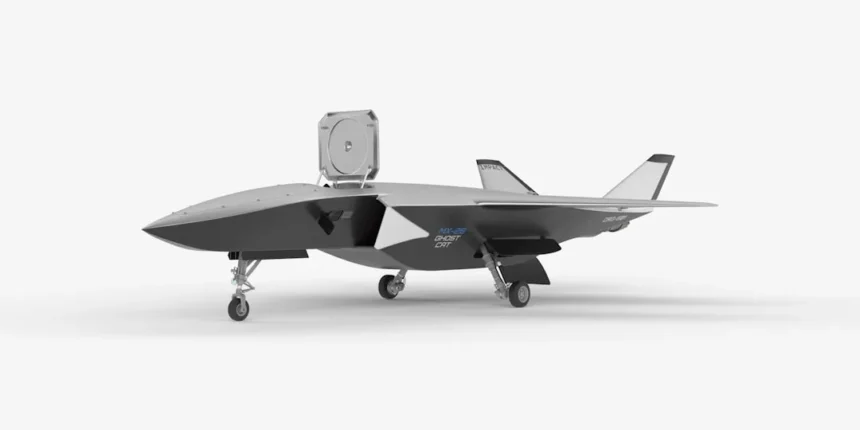
The MQ-25 Stingray drone completed its maiden test flight on April 25, 2026, from MidAmerica St. Louis Airport in Mascoutah, Illinois, marking the first operational flight of the US Navy’s carrier-based unmanned refueling system. The aircraft autonomously taxied, took off, flew for approximately two hours, and landed following a predetermined mission plan, validated by Navy and Boeing pilots monitoring from the ground. This milestone represents a fundamental shift in how naval aviation will operate from carrier decks.
Key Takeaways
- MQ-25 Stingray drone flew autonomously for ~2 hours on April 25, 2026, from Illinois airport
- First operational US Navy carrier-based unmanned refueling system to achieve maiden flight
- Aircraft autonomously taxied, took off, and landed under predetermined mission control
- Frees F/A-18 Super Hornets from tanker duties to focus on combat missions
- Next phase: carrier qualification trials at Naval Air Station Patuxent River, Maryland
What the MQ-25 Stingray Drone Accomplishes
The MQ-25 Stingray drone is the US Navy’s first operational carrier-based unmanned aircraft system, designed primarily as an aerial refueling tanker. Unlike crewed tanker aircraft that consume valuable deck space and pilot resources, the MQ-25 Stingray drone extends carrier strike group range by refueling fighter jets in flight while freeing F/A-18 Super Hornets to focus on strike missions rather than support roles. This architectural advantage means more combat capability per carrier deployment without adding crewed aircraft.
During the maiden flight, the MQ-25 Stingray drone validated basic flight controls, engine performance from its Rolls-Royce AE 3007N powerplant, and handling characteristics critical for carrier operations. Boeing’s Unmanned Carrier Aviation Mission Control System (UCMCS) MD-5 ground control station, which incorporates Lockheed Martin’s MDCX system, managed the flight while Navy and Boeing Air Vehicle Pilots maintained the ability to abort or modify the mission in real time. This human-in-the-loop safety architecture ensures autonomous operations remain under operator control.
Why This Flight Matters for Naval Aviation
Rear Admiral Tony Rossi, Program Executive Officer for Unmanned Aviation and Strike Weapons, stated that the MQ-25 Stingray drone represents more than just an aircraft—it is the first step in integrating unmanned aerial refueling onto the carrier deck, directly enabling manned fighters to fly further and faster. This capability addresses a critical gap in naval operations. Carrier air wings currently depend on bulky, crew-intensive tanker variants of existing fighters, which limits the number of combat sorties possible during a deployment. The MQ-25 Stingray drone removes that constraint.

Dan Gillian, Boeing vice president and general manager of Air Dominance, called the MQ-25 Stingray drone the most complex autonomous system ever developed for the carrier environment. The aircraft must operate in one of the world’s most demanding settings: a pitching flight deck in open ocean, surrounded by other aircraft, with zero margin for error. Autonomy at this scale and complexity has never been deployed in carrier operations before.
The Road to Carrier Operations
The MQ-25 Stingray drone’s April 2026 flight represents a production-representative aircraft, distinct from Boeing’s T1 prototype that first flew in September 2019 and accumulated approximately 125 flight hours. The program evolved from the Carrier-Based Aerial-Refueling System (CBARS) initiative, which itself descended from the earlier Unmanned Carrier-Launched Airborne Surveillance and Strike (UCLASS) program. Boeing was selected as the winner in August 2018, and the MQ-25 Stingray drone has since undergone extensive ground testing and simulation before this maiden flight.



The next phase involves additional tests at MidAmerica St. Louis Airport, followed by transition to Naval Air Station Patuxent River, Maryland, where the MQ-25 Stingray drone will undergo aircraft carrier qualification trials. These trials will test the system’s ability to operate from an actual carrier deck, including catapult launches, arrested landings, and full integration with carrier air traffic control. Only after successful carrier qualification will the MQ-25 Stingray drone transition to operational fleet service.
Autonomous Refueling: A New Naval Standard
Troy Rutherford, Boeing vice president of the MQ-25 programme, emphasized that the system is redefining the future of naval aviation and pushing the boundaries of what is possible with autonomy. The MQ-25 Stingray drone’s refueling capability—delivering fuel to fighters in flight without a human pilot aboard—represents a qualitative leap beyond current carrier operations. Traditional tanker aircraft require pilots, navigators, and support crews. The MQ-25 Stingray drone requires only mission control operators on the ship, freeing personnel for other critical roles.
The system’s autonomous design also enables longer, more efficient patrol cycles. A crewed tanker pilot faces fatigue limitations and must return to the carrier within a set window. The MQ-25 Stingray drone can loiter longer and respond to dynamic mission requirements with greater flexibility. For extended carrier operations in contested environments, this flexibility translates directly to extended strike range and sustained combat capability.
How Does the MQ-25 Stingray Drone Compare to Current Tanker Operations?
The MQ-25 Stingray drone replaces the tanker variant of the F/A-18 Super Hornet, which is a crewed fighter adapted for refueling duties. A Super Hornet tanker takes up a launch slot, requires a trained pilot and crew, and consumes valuable hangar and deck space. The MQ-25 Stingray drone occupies similar deck footprint but requires no crew, no pilot, and no post-flight maintenance by flight personnel—only ground-based technicians and mission controllers. This efficiency gain allows carriers to launch more combat aircraft per sortie, directly increasing strike capability without increasing carrier size or crew complement.



What happens after the maiden flight testing phase?
After completing additional testing at MidAmerica St. Louis Airport, the MQ-25 Stingray drone will move to Naval Air Station Patuxent River, Maryland, for aircraft carrier qualification trials. These tests will validate catapult launch, arrested landing, deck integration, and full carrier air traffic control compatibility. Only upon successful carrier qualification will the system transition to operational fleet deployment.
When will the MQ-25 Stingray drone be deployed to active carrier strike groups?
The research brief does not specify an operational deployment timeline. Carrier qualification trials at Patuxent River will determine readiness, but the Navy has not announced a target date for full fleet integration. Historical carrier aircraft programs typically require 12–24 months of carrier trials before operational deployment, though timelines vary.
The MQ-25 Stingray drone’s maiden flight represents a watershed moment for naval aviation. For the first time, the US Navy has demonstrated that a large, complex autonomous system can operate safely in the carrier environment. The next challenge is proving it can do so reliably under the extreme conditions of actual carrier operations. If carrier qualification succeeds, the MQ-25 Stingray drone will reshape how carrier air wings plan missions, allocate resources, and project power across the globe.
Edited by the All Things Geek team.
Source: TechRadar