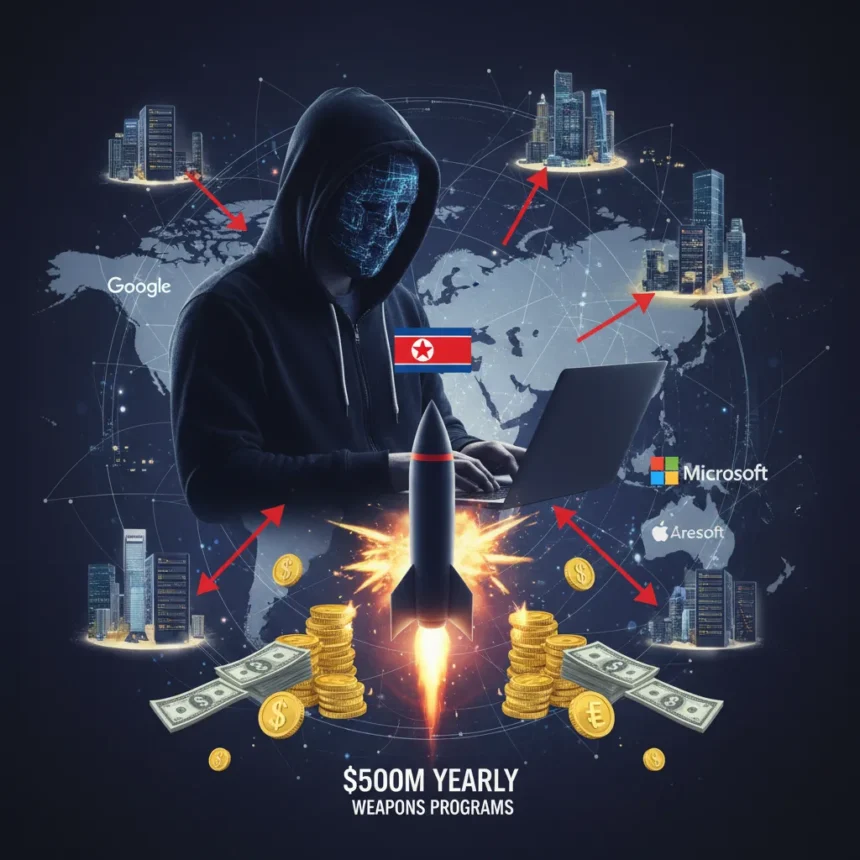
North Korean fake IT workers represent one of the largest coordinated workforce infiltration campaigns targeting U.S. and global tech companies. The regime deploys approximately 100,000 operatives worldwide, generating an estimated $500 million annually to fund weapons programs. CrowdStrike’s 2025 investigation uncovered over 320 incidents in just 12 months where North Korean operatives secured fraudulent remote software developer positions using generative AI tools to create fake resumes, social media accounts, video interviews, and headshots.
Key Takeaways
- North Korea operates a 100,000-strong fake IT worker network generating $500M yearly for weapons funding.
- CrowdStrike detected 320+ cases in 12 months of North Korean operatives using AI-generated fake credentials for remote developer jobs.
- Operatives use stolen U.S. identities, AI-enhanced photos, VPNs, and laptop farms to perform legitimate work while stealing data and funneling payments.
- The Justice Department charged multiple individuals, including a New Jersey resident who aided the scheme.
- Tactics expand beyond employment infiltration to fake cryptocurrency job postings targeting 230+ victims.
How North Korean Fake IT Workers Infiltrate Tech Companies
The infiltration process is methodical and increasingly sophisticated. North Korean operatives generate fake resumes and social media profiles using generative AI, then use AI-generated deepfakes to conduct video interviews that match enhanced stock photos. They bypass background checks by assuming stolen U.S. identities. Once hired, operatives request workstation shipments to mule addresses, then use VPNs routed through North Korea or China to access company networks. The critical deception: they perform legitimate work during night shifts to mimic U.S. time zones while simultaneously stealing intellectual property, source code, and sensitive data that gets funneled back to the regime.
A detection case from July 2024 illustrates how close these schemes come to succeeding. When a company’s endpoint detection and response software flagged suspicious activity on a newly hired Principal Software Engineer account, the security operations center contacted the hiring manager. The response was evasive. After sharing evidence with Mandiant and the FBI, investigators confirmed North Korean origin. Without that alert, the operative would have continued stealing data undetected.
North Korean Fake IT Workers Expand Beyond Employment Infiltration
The regime did not stop at infiltrating legitimate remote positions. North Korean hackers began posting fake cryptocurrency job offers to steal digital cash directly. Between January and March, operatives targeted over 230 people through exposed logs from security firms SentinelOne and Validin, using credible-sounding positions to lure victims into transferring funds or revealing wallet credentials. The Kimsuky group, aligned with North Korean interests, even used ChatGPT to generate fake South Korean military identification documents for spear-phishing campaigns targeting defense contractors.

This diversification reveals a regime adapting its playbook as detection improves. Rather than relying solely on employment infiltration, North Korea now runs parallel schemes: legitimate remote jobs for long-term data theft, fake crypto positions for quick cash grabs, and social engineering attacks using AI-fabricated credentials. Each avenue generates revenue while distributing risk across multiple attack vectors.
U.S. Law Enforcement Response and Named Operatives
The Justice Department has begun prosecuting individuals involved in the scheme. Named operatives include Kim Kwang Jin and Jong Pong Ju, who used false identities at U.S. and Serbian companies. Chang Nam Il, operating under the alias “Peter Xiao,” targeted sensitive systems. Kejia “Tony” Wang, a New Jersey resident, agreed to plead guilty for aiding the operation. The FBI warned that thousands of trained North Korean cyber operatives have been deployed to blend into the global digital workforce and systematically target U.S. companies.



Assistant Director Roman Rozhavsky of the FBI Counterintelligence Division stated: “North Korea remains intent on funding its weapons programs by defrauding U.S. companies… the FBI is equally intent on disrupting this massive campaign”. U.S. Attorney Leah B. Foley added: “Thousands of North Korean cyber operatives have been trained and deployed by the regime to blend into the global digital workforce and systematically target U.S. companies”. Despite these enforcement actions, the scale of the operation—320+ confirmed cases in a single 12-month period—suggests prosecution alone cannot contain the threat.
Why Generative AI Accelerated This Campaign
Generative AI tools transformed North Korean hiring fraud from a niche operation into an industrial-scale attack. Previously, creating convincing fake resumes and social media profiles required significant manual effort. Now, operatives generate entire personas in hours: resume text, LinkedIn profiles, GitHub repositories, and even video interview footage. AI deepfakes allow operatives to conduct synchronous video calls where hiring managers see a fabricated face that matches stolen identity documents. Stock photo enhancement tools provide headshots that pass visual scrutiny. The combination of these tools has compressed the time from identity creation to employment offer from weeks to days.
This acceleration explains why CrowdStrike detected 320+ incidents in 12 months. The barrier to entry has collapsed. North Korea can deploy operatives faster than companies can vet them, especially when hiring managers face pressure to fill remote positions quickly and rely on automated background check systems that accept stolen identities.
Comparative Context: Employment Infiltration vs. Direct Theft
North Korea’s strategy differs fundamentally from traditional cybercriminals who focus on external breaches. Rather than attacking firewalls, North Korean operatives become insiders. They work legitimate shifts, build trust, and access systems that would be nearly impossible to penetrate from outside. This inside-out approach is far more effective at stealing classified data, intellectual property, and source code than phishing campaigns or network exploits. The regime also diversifies: while employment infiltration targets high-value long-term theft, fake crypto jobs provide immediate cash with minimal infrastructure. This dual approach hedges against detection and enforcement.



FAQ
How do North Korean fake IT workers pass background checks?
Operatives use stolen U.S. identities to pass background verification systems. They combine stolen identity information with AI-generated supporting documents and fabricated employment histories. Many automated background check services do not catch this fraud because they verify against databases using the stolen identity itself, which appears legitimate in government records.
What data do North Korean operatives steal from tech companies?
Operatives target source code, intellectual property, technical documentation, and proprietary algorithms. In one case, a California defense contractor had ITAR-controlled technical data accessed by North Korean workers between January 19 and April 2, 2024. The specific value of stolen data varies, but access to defense contractor systems represents the highest-value targets.
How can companies detect North Korean fake IT workers?
Endpoint detection and response software flags unusual network behavior, suspicious login patterns, and data exfiltration attempts. Behavioral red flags include workers requesting unusual access permissions, working exclusively night shifts, and communicating through non-standard channels. Security teams should verify video interview footage independently and conduct secondary background checks using multiple identity verification services.
The North Korean fake IT worker campaign represents a watershed moment in cybersecurity: the regime has weaponized hiring itself. As long as remote work remains standard and AI tools lower the cost of identity fraud, this threat will persist. Companies that treat hiring as a security checkpoint—verifying identities through multiple channels, monitoring new hires for suspicious behavior, and investigating anomalies—can reduce their exposure. Those that treat hiring as purely an HR function will continue feeding North Korea’s weapons programs.
Edited by the All Things Geek team.
Source: Tom's Hardware