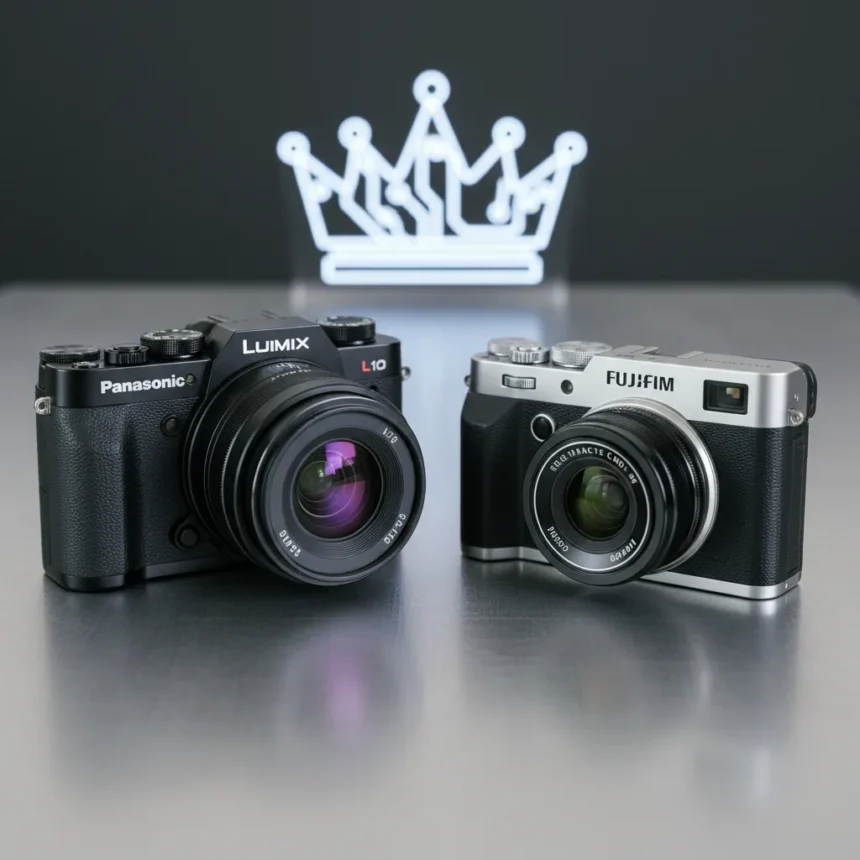
The compact camera comparison between the Panasonic Lumix L10 and Fujifilm X100VI reveals two fundamentally different philosophies for serious photographers who refuse to carry a full camera bag. The X100VI, Fujifilm’s flagship fixed-lens compact, has dominated this category since its 2024 release with a 40MP APS-C sensor, in-body image stabilization, and a loyal following. But Panasonic’s new entry challenges that dominance with a different approach: zoom capability where the Fuji insists on a fixed 23mm lens.
Key Takeaways
- Fujifilm X100VI features 40MP APS-C sensor with 6 stops of in-body stabilization and fixed 23mm f/2 lens
- Panasonic Lumix L10 introduces zoom flexibility as an alternative to fixed-lens design
- X100VI offers hybrid viewfinder (EVF/OVF) and AI-powered subject detection autofocus
- Lumix TZ300 delivers 15X optical zoom in a pocketable design for travel photographers
- Fixed-lens compacts like X100VI face supply shortages despite premium pricing around 1,599 USD
Fujifilm X100VI: The Fixed-Lens Standard
The Fujifilm X100VI remains the benchmark for premium fixed-lens compacts. Its 40MP APS-C sensor paired with the X-Processor 5 engine delivers exceptional image quality, while up to 11fps burst shooting and 6.2K video capability make it capable for both stills and motion work. The hybrid viewfinder—switchable between electronic and optical modes—is a feature no competitor fully replicates, letting photographers choose between real-time exposure preview or glass-optical simplicity mid-shoot.
What truly sets the X100VI apart is its AI-powered subject detection autofocus, which recognizes people, animals, birds, and vehicles with impressive accuracy. Combined with in-body image stabilization rated at up to 6 stops, the camera handles low-light situations where zoom-equipped compacts struggle. Battery life reaches approximately 450 shots per charge, though real-world usage varies depending on stabilization and autofocus demands. At 521g with battery, it remains genuinely pocketable for a full-frame-equivalent camera.
The trade-off is absolute: the 23mm f/2 fixed lens (35mm equivalent) means you cannot zoom. Street photographers and travel documentarians embrace this constraint as a creative discipline. Casual users who want framing flexibility face a choice: accept the fixed focal length or look elsewhere.

Why the Compact Camera Comparison Matters Right Now
The compact camera market has fractured into three distinct camps, each serving different needs. Fixed-lens cameras like the X100VI and Ricoh GR III (24MP APS-C, 257g) appeal to purists and professionals seeking minimalist kits. Zoom-equipped compacts like the Panasonic Lumix TZ300 prioritize versatility for travel and casual shooting. Premium full-frame options like the Leica Q3 (60MP, 743g) target luxury buyers willing to carry extra weight for sensor size.
The X100VI’s 2024 arrival with in-body stabilization marked the first major upgrade to the X100 series in this regard, addressing the primary weakness of its predecessors. Yet supply remains constrained—the camera frequently sells out despite its 1,599 USD price tag. This scarcity has created a cult following, particularly on Instagram and TikTok, where the camera’s vintage film simulations attract content creators. Whether that demand reflects genuine technical superiority or social media momentum remains debatable.



Panasonic Lumix: The Zoom Alternative
The Panasonic Lumix L10 enters this crowded space by rejecting the fixed-lens philosophy entirely. While specific L10 specifications remain limited in current information, Panasonic’s related Lumix TZ300 demonstrates the company’s zoom-first approach: 15X optical zoom, 20.1MP BSI CMOS sensor (1.0-type), 4K video, and 120fps slow-motion at full HD. At a significantly lower price point (£869 or €999), the TZ300 targets photographers who value framing flexibility over sensor size.
The Lumix TZ300 includes 22 filter modes and optical image stabilization, making it genuinely pocketable for travel. Its 30fps burst shooting handles action, though it cannot match the X100VI’s 11fps. The trade-off is sensor size and low-light performance—a 1.0-type sensor is substantially smaller than APS-C, affecting noise control at high ISO values. For vacation snapshots and casual content creation, this compromise works. For professional work or serious photography, the difference becomes apparent.
Fixed vs. Zoom: Which Compact Camera Comparison Wins?
The answer depends entirely on how you shoot. The X100VI excels for photographers who commit to a single focal length and prioritize image quality above all else. Its AI autofocus, stabilization, and sensor performance make it uncompromising within its constraints. Professionals shooting street, documentary, or travel photography—where decisive moments matter more than lens flexibility—gravitate toward it for exactly this reason.
Panasonic’s zoom-equipped approach serves a different audience: casual photographers, vloggers, and travelers who want one camera handling everything from wide landscapes to distant subjects. The Lumix philosophy accepts smaller sensors and lower burst rates in exchange for versatility. Neither approach is objectively superior; they solve different problems.



The Supply Reality
Both the Ricoh GR III and Leica Q3 face backorder status with no discounts available, signaling demand that exceeds supply across the premium compact segment. The X100VI commands similar scarcity, suggesting that photographers actively seeking premium compacts outnumber available inventory. This creates artificial demand momentum that can obscure whether consumers genuinely prefer one camera or simply cannot obtain alternatives.
Is the Fujifilm X100VI still the best compact camera for most people?
For photographers committed to fixed-lens discipline and willing to pay 1,599 USD, yes. The X100VI delivers exceptional image quality, handling, and autofocus performance. For everyone else—casual shooters, travelers, and content creators who value zoom flexibility—the Panasonic Lumix approach offers better practical utility at a lower price.
How does the Panasonic Lumix L10 compare to the Ricoh GR III?
The Ricoh GR III remains a fixed-lens competitor (24MP APS-C, 257g) positioned similarly to the X100VI but with a wider 28mm equivalent lens and no viewfinder. The Lumix L10’s zoom capability differentiates it fundamentally, making direct comparison difficult without confirmed L10 specifications.
Should I buy the Fujifilm X100VI or wait for alternatives?
If you value image quality and autofocus performance above lens flexibility, the X100VI justifies its price. If zoom capability matters to your shooting style, Panasonic’s approach may prove more practical. Neither camera is objectively perfect—each reflects different priorities in compact camera design.
The compact camera comparison ultimately reveals that no single camera serves every photographer equally. The Fujifilm X100VI dominates its fixed-lens category through exceptional execution and cult status, while Panasonic’s zoom-equipped alternatives address real-world shooting needs that fixed lenses cannot. Choose based on your actual workflow, not social media momentum or supply scarcity.
Where to Buy
Edited by the All Things Geek team.
Source: T3