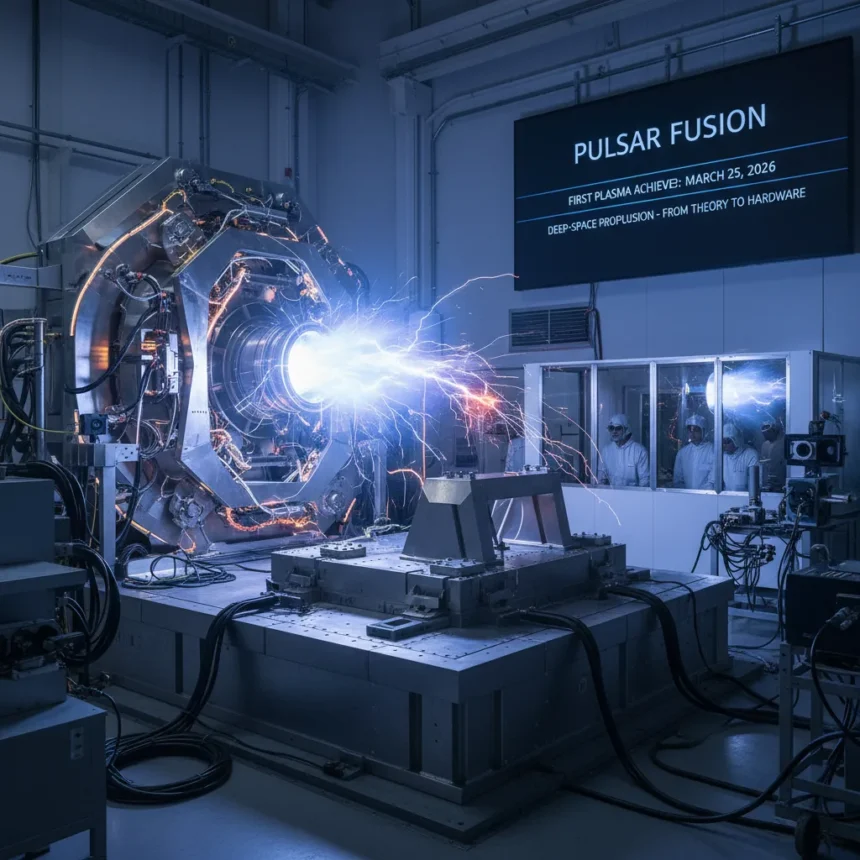
Pulsar Fusion’s nuclear fusion exhaust system achieved first plasma on March 25, 2026, marking a watershed moment for practical fusion-powered spacecraft. The UK-based company demonstrated confinement, guidance, and acceleration of charged particles within the exhaust channel of its Mark1 Sunbird test system, proving that decades of fusion theory can translate into working hardware.
Key Takeaways
- Pulsar Fusion achieved first plasma milestone in Mark1 Sunbird exhaust system on March 25, 2026, in Bletchley, England.
- Test demonstrated plasma confinement using electric and magnetic fields with krypton gas propellant.
- Direct fusion drive could potentially cut Mars travel time in half compared to conventional propulsion.
- Next phase involves thrust measurement and testing advanced heating techniques for performance validation.
li>Exhaust velocities reached 110 to 350 kilometers per second, far exceeding chemical rocket performance.
What Is the Nuclear Fusion Exhaust System?
A nuclear fusion exhaust system represents a fundamentally different approach to spacecraft propulsion. Rather than burning chemical fuel, Pulsar Fusion’s technology ionizes propellant gas and confines the resulting plasma using electromagnetic fields, expelling it at extreme velocities. The company’s Sunbird concept uses krypton gas because of its ionization efficiency and stability under test conditions. This architecture sidesteps the mass penalty that cripples conventional rockets—Apollo 11 required 100,000 pounds of launch mass just to reach the Moon, burning at temperatures between 4,500°F and 7,200°F, yet those speeds remain wholly inadequate for Mars-scale missions.
The first plasma test validated the core design principle: that plasma can be reliably created, shaped, and accelerated within a rocket exhaust channel. This is not a simulation or a theoretical model. Engineers in Bletchley built hardware, ran current through it, and watched superheated plasma behave exactly as the physics predicted.
Why This Milestone Matters for Deep-Space Travel
The nuclear fusion exhaust system represents the bridge between Apollo-era expeditionary missions and a future space economy built on routine transport networks. Pulsar Fusion CEO Richard Dinan stated that direct fusion drive technology could cut travel time to Mars in half. That is not hyperbole—it is a direct consequence of exhaust velocity. The Sunbird system achieved velocities between 110 and 350 kilometers per second, orders of magnitude faster than chemical rockets. Higher exhaust velocity means higher specific impulse, which translates to less fuel mass, faster transit times, and economic viability for regular crewed missions beyond Earth orbit.

The live demonstration at Jeff Bezos’s MARS Conference in California on March 25, 2026, was deliberate symbolism. Pulsar Fusion showcased the test to an audience of machine learning researchers, robotics engineers, Nobel laureates, and astronauts—the stakeholders who will build the next generation of space infrastructure. The message: fusion propulsion is no longer a physics paper. It is engineering.
What Comes Next for the Nuclear Fusion Exhaust System
First plasma is a proof of concept, not a finished product. Pulsar Fusion’s roadmap includes thrust measurement using thrust balance systems and diagnostic probes, testing of advanced heating techniques, and precise performance assessment. The company is also collaborating with the UK Atomic Energy Authority to study how neutron radiation affects reactor materials—a critical engineering challenge for sustained fusion operation.



The long-term engineering goal is aneutronic fusion fuel cycles, which eliminate or drastically reduce neutron production and the associated radiation damage to spacecraft structures. Achieving that milestone would transform deep-space travel from a high-risk scientific expedition into a routine commercial operation. Imagine refueling stations at Mars, lunar orbit, and beyond—the infrastructure that makes a true space economy possible.
Compared to chemical rockets, which have reached the limits of their physics, the nuclear fusion exhaust system offers a completely different performance envelope. Even compared to ion drives and other advanced propulsion concepts, fusion exhaust delivers higher specific impulse in a more compact package, making it the most practical solution for human Mars missions.
Is Pulsar Fusion’s Test Credible?
The test was real hardware in a real test facility, not a simulation. Pulsar Fusion created plasma, confined it, and accelerated it—the three critical steps that fusion propulsion requires. Independent commentary comparing the Sunbird test favorably to NASA’s SR1 Nuclear program suggests the achievement is genuine. That said, the company is still in the early-stage validation phase. Neutron radiation effects on materials remain an open engineering problem, and sustained high-temperature operation at scale has yet to be demonstrated.
How Does This Compare to Chemical Rockets?
Chemical rockets are mature, reliable, and well-understood. They are also fundamentally limited by the energy density of chemical bonds. The fastest chemical rockets achieve exhaust velocities around 4.5 kilometers per second. Pulsar Fusion’s nuclear fusion exhaust system demonstrated velocities 25 to 75 times higher. That performance gap is why fusion propulsion has been the holy grail of space engineering for decades. The first plasma test proves the gap is bridgeable with engineering discipline and funding.



Could This Enable Commercial Space Travel to Mars?
Not immediately. Pulsar Fusion is validating a propulsion concept, not building a spacecraft. Commercial Mars missions require life support, radiation shielding, landing systems, and dozens of other subsystems. However, a reliable nuclear fusion exhaust system removes the single biggest constraint: fuel mass and transit time. Conventional rockets require so much fuel to reach Mars that the payload fraction becomes economically prohibitive. Fusion propulsion changes that equation. If Pulsar Fusion’s next phases succeed—measuring thrust, validating heating techniques, and solving the neutron radiation problem—then yes, commercial Mars missions become feasible within 10 to 15 years.
What Is the Timeline for Practical Fusion Rockets?
Pulsar Fusion has not announced a specific launch date for a flight-qualified fusion engine. The company is currently focused on ground testing and validation. Based on the roadmap described in the research, thrust measurement and advanced heating tests are the immediate next steps. Full material qualification and flight-readiness testing would likely take several more years. The space industry typically requires 5 to 10 years of ground validation before flying new propulsion systems on crewed missions.
Does This Solve the Radiation Problem?
Not yet. Fusion reactions produce neutrons, which damage spacecraft materials over time. Pulsar Fusion is collaborating with the UK Atomic Energy Authority to understand these effects. The long-term goal is aneutronic fuel cycles—fusion reactions that produce minimal or no neutrons—but those are still in the research phase. The first plasma test used krypton gas, which is not a fusion fuel but rather a propellant for testing the confinement and acceleration architecture. Actual deuterium or boron-11 fusion reactions would introduce neutron challenges that the team has identified but not yet solved at scale.
Pulsar Fusion’s first plasma milestone proves that nuclear fusion exhaust systems are no longer theoretical. The company has moved from simulation and analysis into hardware validation, demonstrating that plasma confinement and acceleration work as predicted in a real rocket engine architecture. The next phase will measure thrust and refine heating techniques, bringing practical fusion propulsion closer to reality. For a space industry built on chemical rockets for 70 years, this is a genuine inflection point. The future of deep-space travel depends not on faster expeditions but on sustainable transport networks—and that future just moved one step closer to engineering reality.
Edited by the All Things Geek team.
Source: TechRadar