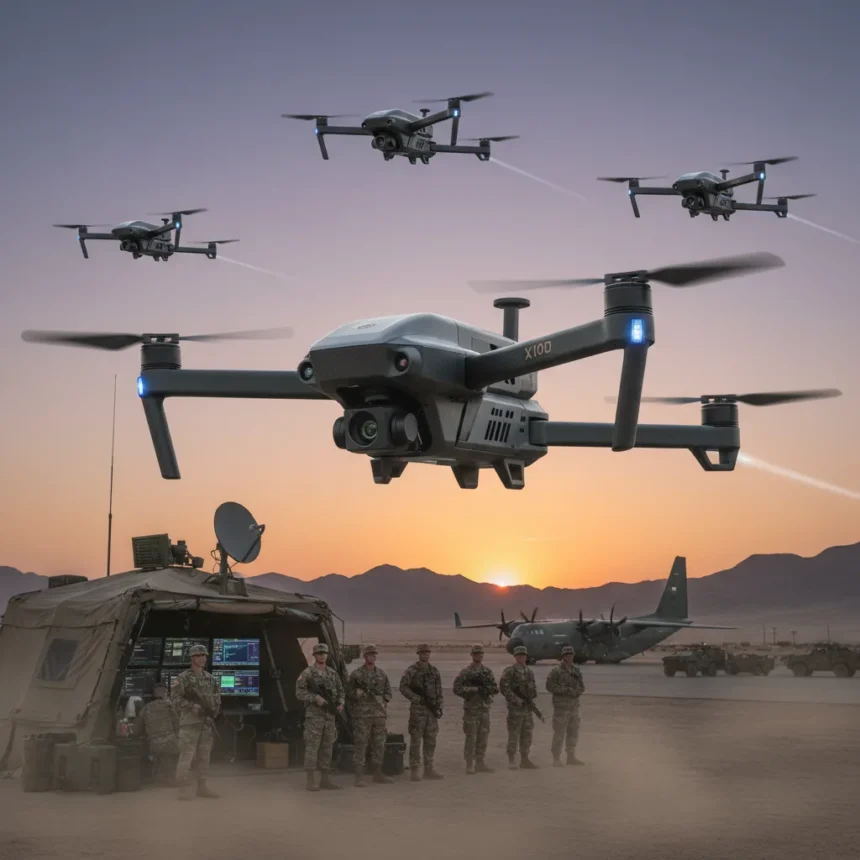
The US Army Skydio drones order announced on March 22, 2026, represents the largest single-vendor unmanned aircraft procurement in Army history—over 2,500 X10D units valued at exceeding $52 million. This is not just a contract renewal. It is a deliberate, high-speed pivot away from Chinese alternatives toward a domestic supply chain built for contested environments where GPS fails and adversaries jam signals.
Key Takeaways
- US Army Skydio drones order exceeds $52 million for over 2,500 X10D units, the largest single-vendor sUAS procurement in Army history
- Contract awarded in under 72 hours via Atlantic Diving Supply, bypassing traditional multi-year procurement timelines
- Skydio X10D features autonomous flight without GPS, thermal imaging, and multiband radio for high-interference environments
- Shift from DJI reflects security vulnerabilities and US commitment to domestic drone manufacturing
- Skydio already selected for Army’s Short Range Reconnaissance program in both 2022 and 2025, making it the sole dual-tranche winner
Why the US Army Chose Skydio Over DJI
The decision to award this massive contract to Skydio over Chinese competitors like DJI hinges on one word: security. DJI drones, despite their civilian market dominance and lower cost, carry inherent risks for military operations—potential data exfiltration, supply chain vulnerabilities, and exposure to foreign intelligence interests. The US Army needed a domestic alternative that could operate reliably without relying on foreign infrastructure or trusting Chinese-controlled software.
Skydio’s X10D operates autonomously using onboard navigation cameras for real-time terrain mapping, eliminating dependency on GPS in contested environments where electronic warfare is expected. This architecture matters in modern conflict. When adversaries jam satellite signals or deploy electronic countermeasures, a drone that still flies and maps its surroundings becomes a strategic advantage. The Army’s embrace of this capability signals a shift toward resilience over convenience—a recognition that speed and independence trump the cost savings DJI once offered.
The Speed Advantage: 72 Hours From Bid to Award
The procurement timeline itself tells the story. The contract moved from bid submission to award in under 72 hours, a pace that would be impossible under traditional multi-year federal acquisition processes. This rapid turnaround was enabled by Atlantic Diving Supply (ADS) as the contracting vehicle and reflects an urgent operational need: the Army needed these drones now, not in five years after committee reviews and competitive re-evaluations.

Mark Valentine, Global Head of National Security Strategy at Skydio, framed the order as evidence that “the United States can deliver world-class drone capability at the scale and speed required by today’s operational environment”. That statement carries weight. The order exceeds four times the FY25 Tranche 2 total, meaning Skydio’s Hayward, California manufacturing facility must ramp production immediately to fulfill delivery schedules. Each unit undergoes assembly and testing across 550 checkpoints, a quality-control standard that reflects military-grade reliability expectations.
Domestic Manufacturing as a Strategic Asset
Skydio manufactures the X10D entirely at its Hayward facility, keeping the entire supply chain within US borders. This eliminates the geopolitical risk that haunted DJI procurement—no foreign government can suddenly restrict exports, no overseas factory can be disrupted by sanctions, and no third-party nation can demand backdoor access to manufacturing data.



CEO Adam Bry acknowledged the competitive framing in a post congratulating the Army for “listening to their end users and doubling down on what’s working.” He also noted that Skydio’s civilian market scale—tens of thousands of units per year—drives military pricing down, allowing the company to compete on both cost and domestic credibility. The order demonstrates that US-made drones no longer carry a price penalty compared to Chinese imports; they carry a security dividend.
What the X10D Brings to the Battlefield
The X10D features high-resolution visual and thermal imaging for day and night operations, enabling intelligence, surveillance, and reconnaissance (ISR) at the platoon level in GPS-denied and high-interference environments. Multiband radio connectivity ensures the drone maintains command and control even when adversaries attempt to jam standard frequencies, a critical requirement for operations in contested airspace.
This is not a consumer drone repurposed for military use. The X10D was designed from the ground up for soldiers operating without the luxury of clear skies, reliable satellite signals, or electromagnetic silence. Skydio systems are already in use across all US military branches and by 29 allied nations, creating an installed base that justifies further investment and interoperability.
The Larger Shift in Defense Procurement
This order reflects a broader US strategy to rebuild domestic defense industrial capacity and reduce reliance on foreign technology in critical domains. The rapid award timeline and massive scale signal that the Pentagon sees small unmanned systems not as niche tools but as foundational capabilities for modern warfare. Skydio’s selection for both Tranche 1 (2022, up to $99.8 million over five years) and Tranche 2 (2025, this current order) as the sole manufacturer underscores the Army’s confidence in the company’s execution and roadmap.



DJI’s exit from US military procurement is not a temporary setback—it is a strategic reorientation. The US military has chosen domestic security over offshore cost savings, and the scale of this order makes that choice irreversible. Every soldier equipped with a Skydio drone reinforces the ecosystem and locks in supplier relationships for the next decade.
Could DJI Compete Domestically?
In theory, DJI could manufacture drones in the United States and attempt to regain military contracts. In practice, the trust deficit is too deep. The Army already has a proven domestic supplier in Skydio, the supply chain is now scaled, and the operational doctrine has been written around Skydio’s architecture. DJI would need not just US manufacturing but also a complete reputational overhaul—and neither is feasible within the timeframe of modern military conflicts.
What Does This Mean for Civilian Drone Markets?
This order does not directly affect civilian drone users. DJI remains the dominant player in consumer and commercial drone markets globally, and no US regulation currently prohibits civilian DJI purchases. However, the military’s public pivot away from DJI may accelerate regulatory pressure on civilian use, particularly for sensitive applications like infrastructure inspection or law enforcement. If the Pentagon views DJI drones as security risks for military operations, civilian agencies may follow suit.
FAQ
How many Skydio drones did the US Army order?
The US Army ordered over 2,500 Skydio X10D drones in a contract exceeding $52 million, announced on March 22, 2026. Some sources report nearly 3,000 units, but the confirmed figure is over 2,500.
Why did the US Army choose Skydio instead of DJI?
Security concerns about DJI’s Chinese ownership and potential data vulnerabilities drove the decision. Skydio offers domestic manufacturing, GPS-independent autonomous flight, and proven reliability in contested environments where electronic warfare is expected.
How fast was the procurement process?
The contract moved from bid submission to award in under 72 hours, an unprecedented pace for military drone procurement. This rapid timeline was enabled by using Atlantic Diving Supply as the contracting vehicle and reflects urgent operational need.
The US Army’s $52 million Skydio order marks a definitive end to the era of Chinese drones in US military operations. It is a bet on domestic manufacturing, security-first design, and operational speed over cost minimization. For Skydio, the challenge now is scaling production fast enough to meet demand. For DJI, the message is clear: the US military will no longer compromise on supply chain sovereignty, regardless of price.
Edited by the All Things Geek team.
Source: TechRadar