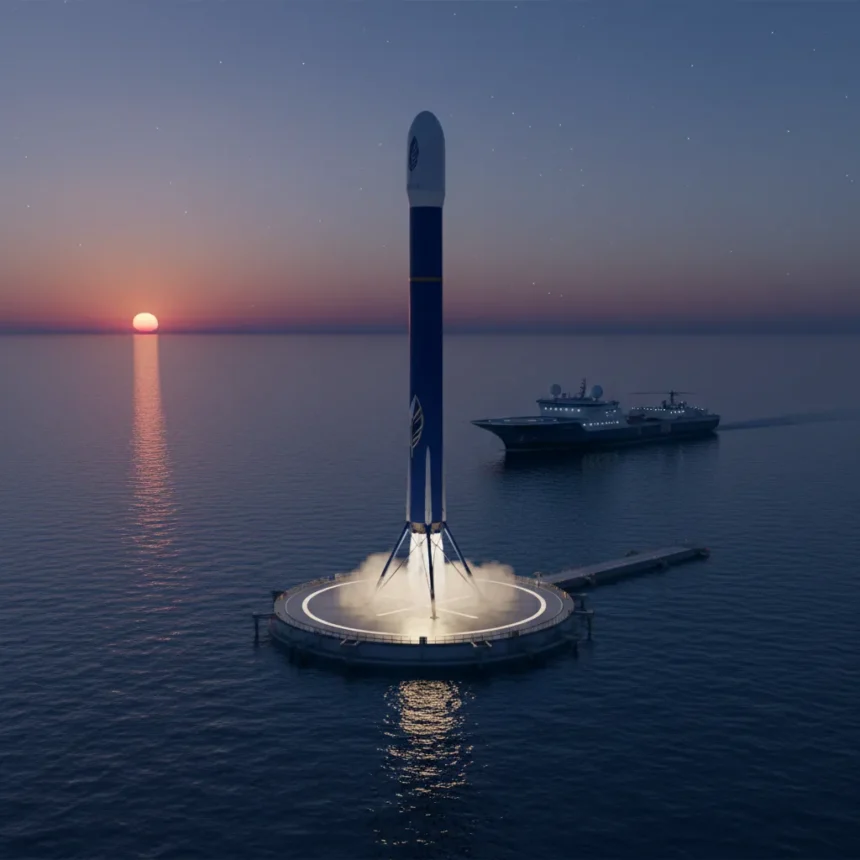
Reusable rocket technology is no longer the exclusive domain of SpaceX. Blue Origin just proved it by successfully landing the New Glenn first-stage booster named “Never Tell Me The Odds” on a barge in the Atlantic Ocean following the third launch from Cape Canaveral Space Force Station Launch Complex 36. The pristine condition of the booster—with its white, gold, and blue livery intact—showcases a fundamental advantage of the company’s methalox engine design.
Key Takeaways
- Blue Origin landed New Glenn’s first-stage booster on a downrange platform 620 miles from launch site, nine minutes after liftoff.
- The booster, powered by seven BE-4 engines generating 640,000 lbf thrust each, is designed for minimum 25 reuses.
- Only SpaceX and Blue Origin have successfully vertically landed orbital-class rocket boosters as of November 2025.
- New Glenn carries payloads like ESCAPADE Mars probes and Viasat communications tests, broadening commercial spaceflight access.
- SpaceX achieved 165-170 Falcon 9 launches in 2025; Blue Origin plans up to 12 New Glenn launches annually to compete.
Why Reusable Rocket Technology Matters Now
Reusable rocket technology fundamentally changes the economics of spaceflight. When a booster can be recovered, inspected, refurbished, and reflown, launch costs drop dramatically. Blue Origin’s New Glenn first stage is engineered for a minimum of 25 reuses, matching the proven reusability model SpaceX demonstrated with Falcon 9—one of whose boosters has reached 31 flights. The booster returned to Cape Canaveral for inspection and refurbishment ahead of future reflights, establishing the operational cadence required for commercial viability.
The technical elegance of Blue Origin’s approach lies in its engine choice. The seven BE-4 engines burn liquid oxygen and liquid methane, producing no appreciable soot. This clean-burning propellant combination explains why the landed booster emerged pristine—a visual marker of engineering maturity that matters to customers and regulators alike. SpaceX’s Falcon 9 boosters, by contrast, often require extensive post-flight cleaning due to kerosene residue.
New Glenn’s Specifications and Payload Capacity
The New Glenn rocket is built for serious work. The first stage delivers more than 13 metric tons to geostationary transfer orbit (GTO) and 45 metric tons to low Earth orbit (LEO). The upper stage uses two BE-3U engines, each producing 200,000 lbf of vacuum thrust with in-space restart capabilities, enabling complex multi-payload missions and orbital insertions. This architecture supports both commercial satellite deployments and national security payloads—a critical market segment where launch cadence and reliability determine contract awards.

The third New Glenn launch carried payloads including ESCAPADE Mars probes and a Viasat communications test. These missions demonstrate that Blue Origin’s reusable rocket technology is already enabling broader access to mobile satellite communications and deep-space exploration. The booster descent occurred autonomously about nine minutes after liftoff, with the landing platform positioned 620 miles downrange from the launch site.
Blue Origin vs. SpaceX: The Reusability Race Heats Up
SpaceX still dominates in launch cadence. The company executed 165-170 Falcon 9 launches in 2025, with boosters regularly achieving double-digit reflights. Blue Origin’s planned cadence of up to 12 New Glenn launches annually is ambitious but falls short of SpaceX’s scale—at least for now. However, only two companies on Earth have successfully demonstrated vertical landing of orbital-class rocket boosters: SpaceX and Blue Origin. This duopoly matters because reusable rockets represent the future of spaceflight economics.



The competitive pressure is real. U.S. national security contracts for reconnaissance and defense satellites increasingly require proven launch reliability and cadence. SpaceX’s dominance in this segment stems partly from operational experience—Falcon 9 has flown more than 300 times. Blue Origin must scale New Glenn operations to compete for these lucrative contracts, which in turn fund the development of larger, more capable systems.
What This Success Means for the Spaceflight Industry
Blue Origin’s third New Glenn launch is a watershed moment for commercial spaceflight. It proves that reusable rocket technology can be replicated and refined by competitors, not just SpaceX. The booster’s pristine post-landing condition demonstrates engineering confidence and operational maturity. For satellite operators, national security agencies, and space exploration programs, this competition is unambiguously good—more launch providers mean lower costs, higher reliability standards, and faster innovation.
The broader spaceflight industry is watching closely. Rocket Lab and Chinese state-owned enterprises are pursuing similar vertical landing capabilities, though neither has yet succeeded. If Blue Origin can sustain New Glenn operations and scale to higher launch rates, the reusable rocket market becomes genuinely competitive. That competition will drive down costs across the industry and accelerate the timeline for ambitious missions—from Mars exploration to global broadband constellations.
Can Blue Origin Compete at SpaceX’s Scale?
Blue Origin’s current challenge is not technology but operations. The New Glenn booster is proven; the engines are reliable; the landing procedure works. What matters now is execution—turning three successful launches into a sustained cadence of 12 or more annually. SpaceX took years to achieve its current operational tempo, and Blue Origin will need similar persistence and capital investment. The company has the resources and the engineering talent, but spaceflight is unforgiving. One catastrophic failure can reset timelines and budgets by months or years.



Is Blue Origin’s reusable rocket technology as advanced as SpaceX’s?
Blue Origin’s New Glenn booster uses different engines and propellants than SpaceX’s Falcon 9, making direct technical comparison difficult. Both platforms achieve vertical landing and reusability; both are proven in flight. The key difference is operational scale—SpaceX has flown far more missions and reflights, accumulating operational experience Blue Origin must still earn through sustained launches.
How many times can the New Glenn booster be reused?
The New Glenn first stage is designed for a minimum of 25 reuses. This matches SpaceX’s Falcon 9 architecture, where one booster has already reached 31 flights. Blue Origin’s 25-flight design target reflects confidence in the BE-4 engine’s durability and the structural integrity of the booster frame.
What payloads did the third New Glenn launch carry?
The third New Glenn mission deployed ESCAPADE Mars probes and a Viasat communications test. These payloads represent both deep-space exploration and commercial satellite communications—two critical markets where reusable rockets reduce launch costs and enable more frequent missions.
Blue Origin’s successful landing of the New Glenn booster marks a genuine inflection point in spaceflight. Reusable rockets are no longer a SpaceX monopoly. As Blue Origin scales operations and competes for national security contracts, the spaceflight industry enters a new era of genuine competition. That competition will benefit everyone—from satellite operators to space explorers. The question now is whether Blue Origin can sustain the operational cadence required to challenge SpaceX’s dominance. The technology is proven. Execution remains.
Edited by the All Things Geek team.
Source: TechRadar