





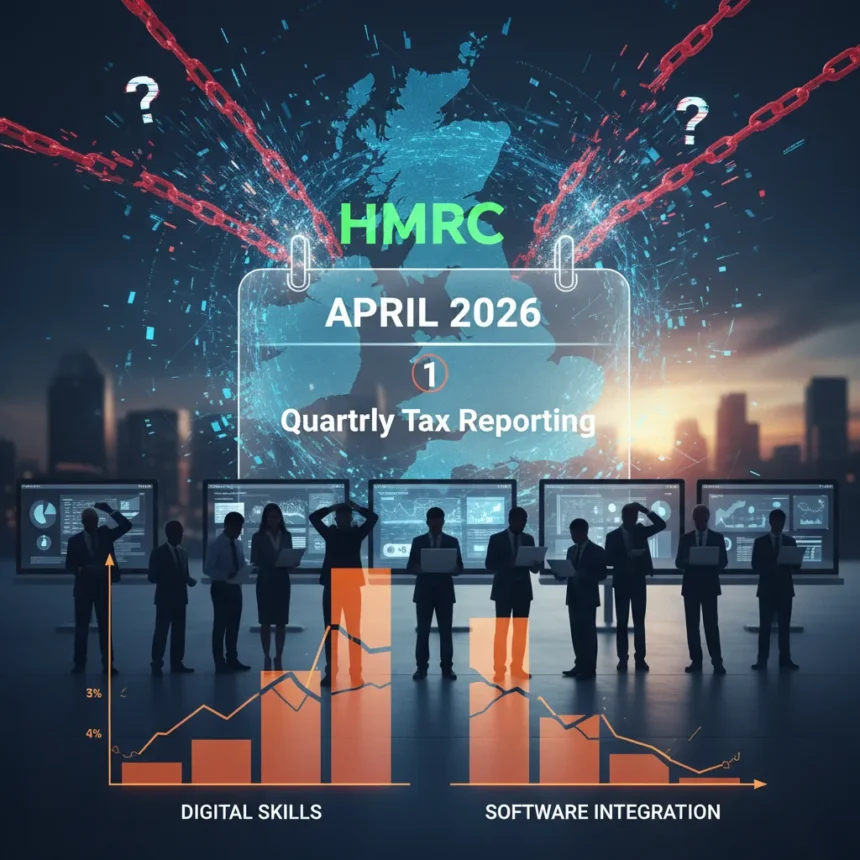
Quarterly tax reporting is no longer a distant policy proposal—it becomes mandatory for UK freelancers, sole traders, and landlords from April 2026, fundamentally reshaping how self-employed taxpayers manage their finances. The shift from a single annual Self Assessment return to four quarterly submissions plus a final declaration represents the most significant overhaul of UK tax administration in decades. Yet mounting evidence suggests HMRC and the businesses it regulates may not be operationally ready.
Key Takeaways
- Quarterly tax reporting for qualifying self-employed taxpayers begins April 2026, with the first filing due 7 August 2026.
- The income threshold for MTD is £50,000 from April 2026, dropping to £30,000 in 2027.
- 50% to 69% of income tax clients have not yet digitalized their records, per Wolters Kluwer research.
- Data quality, client onboarding, and software integration are the top barriers to MTD adoption.
- The annual tax payment deadline remains 31 January—only the reporting schedule has changed.
How Quarterly Tax Reporting Will Actually Work
Quarterly tax reporting transforms tax compliance from a once-a-year administrative event into an ongoing digital process. Taxpayers must maintain digital records of income and spending using HMRC-approved software, then submit quarterly updates to HMRC at fixed intervals. The first quarterly period runs 6 April to 5 July 2026, with a filing deadline of 7 August 2026. Subsequent quarters close on 5 October, 5 January, and 5 April, with submissions due 7 November 2026, 7 February 2027, and 7 May 2027 respectively. After all four quarters are submitted, taxpayers must file a final annual declaration by 31 January 2028. This differs fundamentally from the current annual Self Assessment model, where taxpayers submit a single return covering the entire tax year.
HMRC’s stated goal is to create a world-class taxation system and reduce tax lost through reporting inaccuracies. The quarterly structure theoretically achieves this by distributing compliance work across the year and giving HMRC real-time visibility into income flows. However, the operational burden on small businesses is substantial. A sole trader juggling client invoices, expense tracking, and software navigation must now do this four times annually instead of once, with no flexibility in deadlines.
The Readiness Crisis: Who Is Actually Ready?
The evidence of unpreparedness is stark. Research from Wolters Kluwer found that 50% to 69% of income tax clients have not yet digitalized their books. This is not a minor cohort—it represents the majority of the self-employed population HMRC expects to comply by April 2026. The barriers are not lack of will but structural obstacles. The top challenges cited are data quality and reconciliation (47%), client onboarding and migration (44%), client communication (43%), and software integration (43%). These are not easily solved in eighteen months. Migrating years of paper records or spreadsheets into HMRC-compliant software requires time, expertise, and often external help. Many accountancy firms report being under severe pressure to support this transition, yet capacity is limited.

HMRC itself faces implementation risks. The agency must ensure its systems can reliably receive and process millions of quarterly submissions, pull back accurate tax liability estimates, and handle exceptions and corrections. A single widespread system failure during the August 2026 deadline window could create a cascade of missed submissions and penalties. The stakes are high because HMRC has already signaled that penalties for late or missing quarterly submissions will apply—there is no grace period for teething problems.
Income Thresholds and Who Must Comply
Not all self-employed taxpayers face quarterly reporting immediately. The mandate applies only to those with qualifying income above £50,000 from April 2026. This threshold drops to £30,000 in 2027, expanding the compliance base significantly. Importantly, the obligation applies to sole traders and freelancers with income above these levels, but not to limited company directors—they remain under different corporate tax rules. This creates a two-tier system where some self-employed people must adopt quarterly reporting while others operating as limited companies do not. The distinction matters for tax planning and business structure decisions, though HMRC’s official guidance has not fully addressed all edge cases around partnership income, rental income thresholds, or combined income calculations.



Software and Integration: The Missing Piece
Quarterly tax reporting requires HMRC-approved software that uses an API to push data to HMRC and pull back estimated liability information. Options include Xero, QuickBooks, Sage, and IRIS Personal Tax, among others. Yet software compatibility is only part of the puzzle. Many accountancy firms and bookkeepers use multiple tools—one for invoicing, another for expense tracking, a third for payroll. Integrating these systems so that data flows cleanly into MTD-compliant software is technically possible but often requires custom setup and ongoing maintenance. For a sole trader managing everything in a spreadsheet, the jump to integrated digital accounting is a significant leap. The software integration barrier (43% of firms cite this as a major obstacle) reflects the reality that no single tool solves every business’s workflow.
What Happens to the Tax Payment Deadline?
One point of confusion worth clarifying: the tax payment deadline has not changed. The amount owed is still due by 31 January. What has changed is the reporting schedule. Instead of submitting one return in January covering the entire previous tax year, taxpayers will submit quarterly updates throughout the year and a final declaration in January. This means HMRC will have visibility into tax liabilities months earlier, but it also means taxpayers must have cash flow planning in place to pay tax bills on the traditional 31 January date even if they did not know the exact amount until late in the tax year.
Is HMRC Ready?
The honest answer is: probably not fully. HMRC has invested heavily in MTD infrastructure and has been piloting the system with volunteer taxpayers. The agency’s public communications emphasize readiness and support. However, the scale of the shift—moving millions of taxpayers from annual to quarterly reporting—is enormous. HMRC’s track record with large digital initiatives is mixed. Technical glitches, unclear guidance, and slow response times to edge cases are common complaints. The fact that accountancy firms are under huge pressure and many taxpayers remain undigitalized suggests that April 2026 will be chaotic, at least in the early months. HMRC may need to be pragmatic about enforcement in the first filing window, or risk overwhelming both taxpayers and its own systems.
What Should Freelancers and Sole Traders Do Now?
The window to prepare is closing. Taxpayers should audit their current record-keeping systems and identify an HMRC-approved software solution that fits their business. This is not a decision to delay until early 2026. Software selection, data migration, and training take time. Accountancy firms are already reporting capacity constraints, so getting help early is wise. Taxpayers should also begin conversations with their accountants or bookkeepers about the transition—not in March 2026, but now. The complexity of quarterly reporting means that many self-employed people will benefit from professional support, at least for the first year. Finally, taxpayers should monitor HMRC’s guidance pages regularly, as clarifications and updates will likely be issued as the April 2026 date approaches.



Frequently Asked Questions
When does quarterly tax reporting start?
Quarterly tax reporting begins 6 April 2026 for the 2026–27 tax year. The first quarterly submission is due 7 August 2026 and covers the period 6 April to 5 July 2026.
Who has to file quarterly tax returns?
Freelancers, sole traders, and landlords with qualifying income above £50,000 must file quarterly returns from April 2026. The threshold drops to £30,000 in 2027. Limited company directors are not affected by this change.
Does the tax payment deadline change under quarterly reporting?
No. The tax payment deadline remains 31 January, unchanged from the current system. Only the reporting schedule has shifted from annual to quarterly plus a final declaration.
Quarterly tax reporting is not a threat if you prepare now. The real danger is procrastination. Start auditing your records, choose your software, and speak to your accountant before the rush begins. HMRC’s readiness is one question; your own readiness is the one that matters.
Edited by the All Things Geek team.
Source: TechRadar




