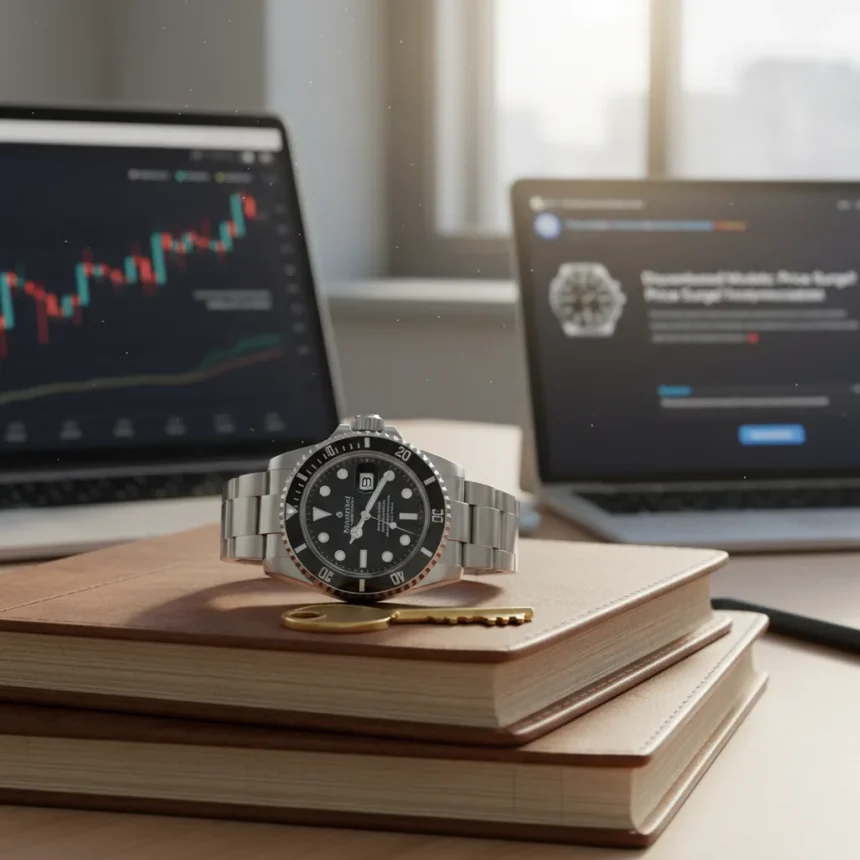
Rolex discontinuation of an iconic model is expected to trigger a sharp spike in secondary market values, potentially handing current owners a significant financial windfall without lifting a finger. When luxury watchmakers retire popular models, scarcity immediately becomes the engine driving resale prices upward. For Rolex owners holding the discontinued piece, this timing represents a rare opportunity to capitalize on the gap between what they paid and what collectors will now bid.
Key Takeaways
- A discontinued Rolex model is expected to drive secondary market prices substantially higher in coming months.
- Existing owners can sell without waiting for artificial vintage aging—discontinuation creates immediate scarcity value.
- Rolex authorized dealers typically acquire inventory at wholesale prices around $3,000 per unit.
- Owners can also access cash through watch-backed loans without selling outright.
- Competitors like Ciga Design actively position themselves as better long-term investments than Rolex.
Why Rolex discontinuation creates instant resale value
Discontinuation eliminates future supply of a model, instantly shifting it from current production to finite inventory. This scarcity dynamic is the core mechanism that drives secondary market premiums. Unlike waiting for a watch to age into vintage status—a process that takes decades—discontinuation creates urgency and desirability in real time. Collectors and investors know the window to acquire the piece is closing, which pushes bidding higher.
The luxury watch market operates on a principle that established brands like Rolex understand well: controlled supply maintains perceived value. When a model remains in production indefinitely, it stays anchored to retail pricing. The moment production ends, that price floor disappears. Existing owners suddenly hold something that cannot be easily replaced, and that asymmetry translates directly into resale leverage.
Secondary market pricing and owner opportunities
Rolex authorized dealers typically purchase models at wholesale rates around $3,000 per unit, assuming inventory risk in the process. That wholesale-to-retail spread represents the profit margin dealers build into their business model. However, on the secondary market after discontinuation, prices often exceed retail significantly as collectors compete for the last remaining examples. Owners who acquired their watches at retail now find themselves holding assets that command premiums of 20%, 30%, or higher depending on the model’s rarity and desirability.

Vintage Rolex models from secondary sources like Watch Gang or Becker Time command valuations between $2,000 and $5,000, depending on condition and provenance. These prices reflect what the market actually pays for scarce pieces. A discontinued current-production Rolex will follow a similar trajectory as it transitions from new to unavailable, with the price trajectory accelerating rather than stabilizing.
Alternative strategies: loans instead of sales
Not every owner wants to sell. Some prefer to hold their Rolex as a collectible while still accessing its financial value. Watch-backed loans have emerged as a viable alternative, allowing owners to borrow against their timepiece without relinquishing ownership. This strategy appeals to collectors who believe the watch will appreciate further or who have sentimental attachment to the piece. The loan market for luxury watches operates similarly to fine art lending—lenders assess the watch’s condition, provenance, and secondary market value, then offer a percentage of that value as a loan.



The competitive landscape: alternatives to Rolex
While Rolex discontinuation creates opportunity for current owners, the broader luxury watch market is increasingly fragmented. Competitors like Ciga Design have actively marketed themselves as superior long-term investments compared to Rolex, often leveraging influencer partnerships that include free watches and 7-8% sales kickbacks. These alternative brands position themselves as offering better value appreciation and less market saturation than the Rolex portfolio.
Timepiece Trading LLC operates at the high end of the secondary market, trading Rolex alongside competing luxury brands like Richard Mille, Audemars Piguet, and Patek Philippe, with offices spanning Miami, Hong Kong, Dubai, and the Caribbean. This global infrastructure reflects how the luxury watch market has become truly international, with pricing and availability varying significantly by region. Rolex owners selling into this market benefit from global demand, but they also compete against a wider array of alternative investments.
Timing the sale: should owners act now?
The discontinuation announcement typically triggers a two-phase market response. Initial euphoria among current owners creates a brief window where asking prices spike as sellers test the market’s appetite. However, as supply gradually depletes and genuine collector demand settles, prices stabilize at a new equilibrium. Owners who sell immediately after discontinuation capture peak sentiment; those who wait risk selling into a cooler market once the initial news cycle fades.
The optimal timing depends on individual circumstances. Owners who need liquidity should act relatively soon after the discontinuation announcement, while those comfortable holding can afford to wait and observe how the secondary market develops. The key advantage of discontinuation is that it removes the uncertainty factor—there is no new production coming, so the scarcity dynamic is permanent rather than temporary.



Will my Rolex appreciate after discontinuation?
Yes, discontinuation typically triggers secondary market price increases as scarcity becomes the primary value driver. However, the magnitude of appreciation depends on the specific model’s desirability, condition, and original retail price. Popular, iconic models see larger premiums than niche variants.
Can I sell my discontinued Rolex immediately?
You can list immediately, but secondary market platforms and dealers typically require authentication and condition assessment before purchase. The process usually takes 1-2 weeks. Expect the strongest buyer interest in the weeks immediately following the discontinuation announcement.
Is a watch-backed loan better than selling?
Loans preserve ownership and allow you to retain the watch as a collectible while accessing its financial value. Loans make sense if you believe the watch will appreciate further or have emotional attachment. Selling is preferable if you need permanent liquidity or want to redeploy capital elsewhere.
The Rolex discontinuation story is fundamentally about scarcity creating value in a market where supply has always been carefully controlled. Current owners hold the winning ticket—not because they made a brilliant investment decision, but because timing and production decisions aligned in their favor. The real question is whether they recognize the opportunity and act on it before the initial wave of enthusiasm subsides.
Where to Buy
Edited by the All Things Geek team.
Source: T3