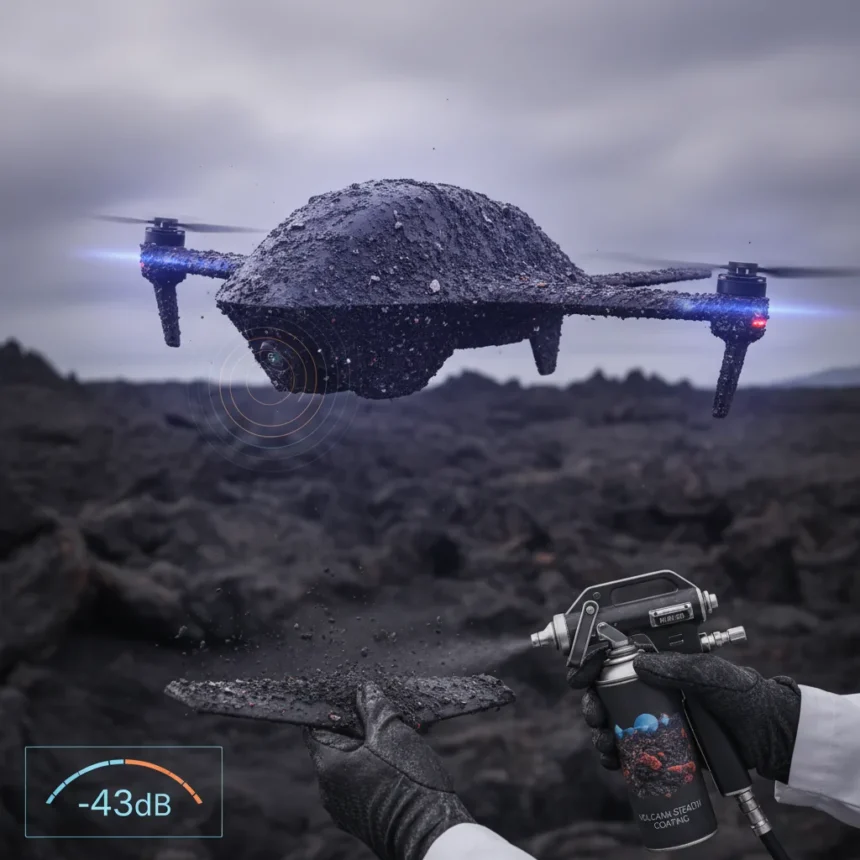
A spray-on stealth coating for drones using a volcanic-rock-based formulation could transform how unmanned aircraft evade radar detection. According to Tom’s Hardware, the coating claims to reduce radar return signals by up to 43 decibels, nearly double the 20 to 30 decibels achieved by typical radar absorbent materials. The innovation centers on application simplicity—instead of bonding layers of specialized materials to a drone’s fuselage, operators could spray the formulation directly onto any airframe, potentially making advanced stealth accessible to a wider range of drone platforms.
Key Takeaways
- Spray-on coating claims up to 43dB radar return reduction versus 20-30dB for conventional radar absorbent materials.
- Volcanic rock formulation enables simpler application than traditional layered stealth materials.
- Technology targets drone survivability in contested airspace where radar detection poses operational risk.
- Spray application could reduce manufacturing complexity and maintenance compared to bonded stealth layers.
- Claims exceed typical radar absorbent material performance by a significant margin.
How spray-on stealth coating for drones differs from traditional materials
Conventional radar absorbent materials rely on layered construction, where specialized foam, carbon-loaded composites, or ferrite-based coatings are bonded to airframes during manufacturing. These materials work by absorbing electromagnetic energy rather than reflecting it, reducing the radar cross-section of an object. The spray-on approach eliminates the need for complex lamination processes. By using a volcanic-rock-based formulation, the researcher claims the coating achieves superior performance—43 decibels compared to the baseline 20 to 30 decibels—while offering easier application and potential retrofit capability for existing platforms.
The practical advantage lies in deployment flexibility. Traditional stealth materials require factory integration, meaning older drone models cannot easily upgrade to modern radar absorption standards. A spray-on coating could theoretically be applied in the field, reducing downtime and enabling rapid modernization across drone fleets. The volcanic rock component likely provides electromagnetic loss properties—natural minerals with appropriate dielectric characteristics can dissipate radar energy efficiently.
Why the 43dB performance claim matters for drone operations
Decibels measure signal reduction logarithmically, so the jump from 20-30dB to 43dB represents a substantial improvement in radar evasion capability. At 20dB reduction, a radar return signal is reduced to one-tenth its original strength. At 43dB, that same signal drops to roughly one ten-thousandth of its original power, making detection far more difficult for adversary radar systems. For military and commercial drone operators, this difference translates directly to survivability in contested airspace where air defense radar poses a genuine threat.

The claim’s credibility hinges on testing methodology—whether the 43dB figure represents peak performance under ideal conditions or realistic operational scenarios. Typical radar absorbent materials achieve their rated performance within specific frequency bands and angles of incidence. A spray-on coating would need to maintain consistent absorption across the radar spectrum relevant to air defense systems, which typically operate in the X, S, and C bands. If the volcanic-rock formulation delivers 43dB across these frequencies at multiple aspect angles, it would represent a genuine breakthrough. If the figure applies only to narrow conditions, the practical advantage shrinks considerably.
Spray-on stealth coating for drones and real-world deployment challenges
Even if the coating performs as claimed, several obstacles remain before widespread adoption. Durability is critical—stealth coatings must withstand environmental exposure, UV radiation, temperature cycling, and moisture without degradation. A spray-applied material needs to adhere reliably to composite and metal airframes without peeling or cracking during flight stress. Maintenance becomes another consideration: if the coating degrades, reapplication must be simple and cost-effective, or operators will abandon it.



Thermal signature is equally important. While the coating addresses radar detection, drones also emit heat signatures detectable by infrared systems. A complete stealth solution requires addressing both radar and infrared domains, which may demand additional materials or design changes. The research brief does not indicate whether the spray-on formulation addresses thermal signature, limiting its utility in environments where infrared threats are present alongside radar threats.
What comes next for spray-on stealth technology
The transition from laboratory claim to operational deployment typically requires validation testing by independent parties. Military and commercial drone operators will want to see peer-reviewed results confirming the 43dB performance under realistic conditions before investing in new platforms or retrofit programs. Manufacturing scale-up presents another hurdle—spray application sounds simple, but consistent coating thickness, uniform coverage, and batch-to-batch reliability demand industrial-grade process control.
Cost will determine adoption speed. If the spray-on coating costs significantly less than traditional stealth materials while delivering superior performance, demand will be immediate. If it merely matches conventional costs while offering modest handling advantages, adoption will be slower. The volcanic-rock formulation suggests the base material is inexpensive, but processing, quality control, and application equipment add expense.
Can spray-on stealth coating be applied to commercial drones?
The technology targets drone survivability in contested environments, which primarily applies to military and government operations. Commercial drone operators in civilian airspace do not face radar threats, making stealth coating unnecessary for their missions. However, if the coating proves durable and cost-effective, commercial applications might emerge in industrial inspection, surveying, or security roles where operators want to minimize electromagnetic interference or reduce detection by competing systems.



How does spray-on stealth compare to other radar reduction methods?
Beyond radar absorbent materials, designers reduce radar cross-section through shaping—angled surfaces and curved edges scatter radar energy away from the transmitter rather than reflecting it back. Stealth aircraft like the F-117 Nighthawk rely heavily on geometric design combined with radar absorbent coatings. A spray-on coating alone cannot match the radar reduction achieved by dedicated stealth airframes, but it offers a practical upgrade path for conventional drones. The combination of optimized geometry plus spray-on coating could approach military stealth aircraft performance at a fraction of the cost.
Is the spray-on stealth coating available for purchase?
The research brief does not confirm commercial availability, pricing, or a launch timeline. The technology remains in the research phase, presented as a development by a researcher rather than a product ready for market. Interested parties should expect a multi-year path from laboratory demonstration to military testing to potential procurement by drone manufacturers or defense agencies.
The spray-on stealth coating for drones represents an intriguing approach to a real problem—how to make unmanned aircraft harder to detect in hostile environments. If the claimed 43dB radar reduction holds up under independent testing, it could reshape drone design and survivability. Until then, the claim remains promising but unverified, and the gap between laboratory innovation and operational deployment remains substantial. The volcanic-rock formulation is clever, the application method is practical, but the proof lies in performance data that extends beyond initial claims.
Edited by the All Things Geek team.
Source: Tom's Hardware