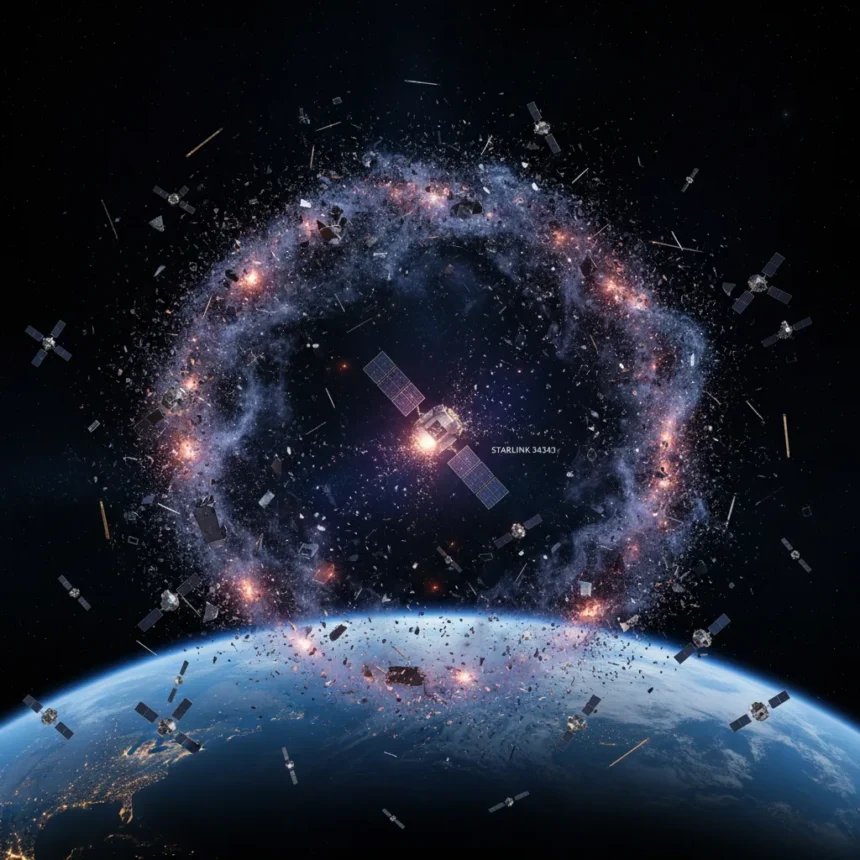
Starlink satellite fragmentation struck again on March 29, 2026, when Starlink satellite 34343 lost all communications and broke apart at approximately 560 kilometers altitude, creating a cluster of trackable debris objects in low Earth orbit. This marks the second Starlink fragmentation event in less than four months, following a similar anomaly with satellite 35956 on December 17, 2025. The recurring nature of these incidents is forcing a reckoning with how sustainable mega-constellations truly are.
Key Takeaways
- Starlink satellite 34343 experienced total communications loss on March 29, 2026, at 560 km altitude with confirmed fragmentation.
- LeoLabs detected tens of small, trackable debris objects immediately after the event in the satellite’s vicinity.
- Fragments at 560 km face moderate atmospheric drag and may persist for several months before decaying.
- This is the second Starlink breakup in less than four months, raising questions about constellation reliability.
- SpaceX is investigating the root cause and coordinating with NASA and U.S. Space Force on monitoring.
What Happened to Starlink satellite 34343
On Sunday, March 29, Starlink satellite 34343 experienced an on-orbit anomaly resulting in total loss of communications. The satellite, orbiting at approximately 560 kilometers altitude, underwent what space-tracking experts call a fragmentation or debris-generation event. Commercial space-tracking firm LeoLabs immediately detected a large cluster of tens of small, trackable objects scattered in the satellite’s immediate vicinity, confirming the structural failure. Unlike a controlled deorbiting or gradual degradation, this was a sudden, catastrophic event.
The altitude at which this fragmentation occurred matters significantly. At 560 kilometers, the satellite orbits within a relatively high shell of Starlink’s constellation architecture. This elevation means the resulting debris faces moderate atmospheric drag rather than the rapid decay that occurs at lower altitudes. Fragments created at this height have the potential to persist for several months before atmospheric friction finally pulls them into the lower atmosphere and burns them up. That extended lifespan increases the collision risk window for other active satellites and space infrastructure.
A Pattern Emerging: The December 2025 Precedent
The March 29 event is not an isolated incident. On December 17, 2025, Starlink satellite 35956 experienced a similar anomaly, also resulting in fragmentation and the creation of tens of trackable debris objects. That earlier event occurred at a lower altitude of 418 kilometers, where atmospheric drag is stronger, leading to faster decay of the debris field within weeks. The suspected cause in December was propulsion tank venting, a mechanism distinct from what engineers currently suspect caused the March event.

Two fragmentation events in four months creates a troubling pattern. While SpaceX maintains that its constellation operates with high reliability across more than 10,000 active units, these back-to-back failures suggest either a systemic design vulnerability, a manufacturing defect affecting a batch of satellites, or an operational issue that has not yet been identified. The fact that the suspected root causes differ between the two events—propulsion venting versus an internal energetic source—complicates the investigation and raises questions about whether a single corrective action will prevent future occurrences.
Implications for Orbital Sustainability and Space Safety
These fragmentation events expose a fundamental tension in mega-constellation design. Starlink satellites are engineered with full demise capability, meaning they are designed to burn up completely during reentry rather than creating larger debris pieces. However, that design philosophy assumes controlled reentry. When a satellite breaks apart on-orbit, it creates dozens or hundreds of smaller fragments before any of them eventually reenter—and those fragments pose collision hazards in the meantime. A single collision between an active satellite and a Starlink debris piece could cascade into more fragmentation, following the Kessler syndrome model that space agencies worry about constantly.



SpaceX is investigating the root cause and plans corrective software and hardware actions across its constellation. The company is also coordinating with NASA and the U.S. Space Force to monitor the debris field and assess ongoing risks. Neither the ISS, Artemis II, nor the Transporter-16 mission payloads face immediate risk from this debris, as those assets operate at different orbital altitudes. However, the broader question remains: as constellations grow larger and older, will fragmentation events become more frequent?
Why This Matters Right Now
The space industry is at an inflection point. Starlink is not the only mega-constellation in orbit—Amazon’s Project Kuiper and others are deploying thousands of satellites. If fragmentation becomes a recurring problem across multiple operators, the cumulative debris load in LEO could reach a tipping point where collision risk becomes unmanageable. Two events in four months is a signal that something in the design, manufacturing, or operational procedures needs urgent attention. SpaceX’s scale—over 10,000 active satellites—means that even a 0.1 percent failure rate translates to dozens of potential fragmentation events per year if the underlying issue is not resolved. The space community is watching closely to see whether this is a one-off manufacturing batch problem or a systemic vulnerability that requires constellation-wide redesign.
What is the suspected cause of the Starlink satellite fragmentation?
SpaceX suspects an internal energetic source caused the March 29 fragmentation, differing from the propulsion tank venting suspected in the December 2025 event. The investigation is ongoing, but the shift in suspected mechanisms between the two events complicates the diagnostic picture and suggests the root causes may not be identical.
How long will the debris from Starlink satellite 34343 remain in orbit?
Fragments created at 560 kilometers altitude face moderate atmospheric drag and are expected to persist for several months before decaying, unlike lower-altitude debris that decays within weeks. The exact timeline depends on fragment size and cross-sectional area, but none of the debris poses immediate risk to the ISS or other critical missions.



Is SpaceX taking action to prevent future fragmentation events?
Yes. SpaceX is investigating the root cause and plans to implement corrective software and hardware actions across its constellation of over 10,000 active satellites. The company is coordinating with NASA and the U.S. Space Force on monitoring efforts and risk assessment.
The disappearance of Starlink satellite 34343 is not just a technical failure—it is a wake-up call for the entire space industry. As mega-constellations grow, the margin for error shrinks. Two fragmentation events in four months means SpaceX must move quickly from investigation to correction, or risk setting a precedent that makes orbital sustainability a genuine crisis rather than a theoretical concern.
Edited by the All Things Geek team.
Source: Tom's Hardware