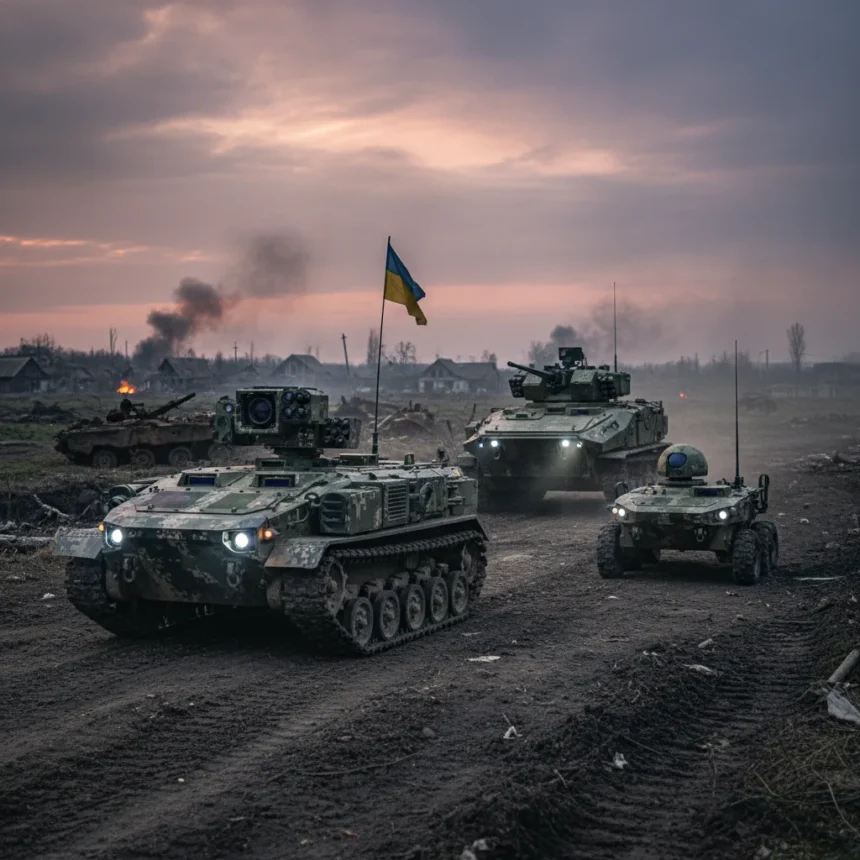
Unmanned ground vehicles are rapidly transforming how modern militaries operate, and Ukraine is leading the charge by building what could become the world’s first military brigade where robots outnumber human soldiers. The shift reflects a fundamental change in battlefield doctrine: instead of sending infantry into high-risk situations, commanders are deploying autonomous or remote-controlled systems to handle reconnaissance, supply transport, and combat support tasks.
Key Takeaways
- Ukraine is deploying unmanned ground vehicles for reconnaissance, logistics, and combat support roles to reduce infantry casualties.
- UGVs equipped with AI-driven sensors and thermal cameras enable faster decision-making by compressing the see-decide-act loop.
- Ground robots can operate in terrain where aerial drones struggle, such as dense canopy or austere environments.
- The broader military trend shows unmanned systems moving from niche support roles to core force composition.
- Ukraine’s wartime adoption cycle is accelerating robotics integration faster than traditional peacetime procurement.
Why Unmanned Ground Vehicles Matter Now
The deployment of unmanned ground vehicles represents a watershed moment in military technology. Rather than treating robots as supplementary tools, Ukraine is integrating them deeply enough that a single brigade may field more machines than soldiers, fundamentally altering how units engage enemies and manage logistics. This is not incremental innovation—it is a restructuring of force composition driven by urgent battlefield necessity.
The practical appeal is straightforward: unmanned ground vehicles perform high-risk tasks while keeping personnel safer and improving operational speed. Robots can scout dangerous terrain, transport supplies through contested zones, conduct explosive ordnance disposal, and provide fire support without exposing troops to direct fire. By compressing the time between observation, decision, and action, commanders gain a tactical advantage that translates into faster maneuvers and more effective targeting.
How Unmanned Ground Vehicles Change Battlefield Tactics
The integration of unmanned ground vehicles into active combat reshapes traditional infantry tactics. Rather than relying on human scouts moving through exposed positions, units deploy robots equipped with AI-driven sensors and thermal cameras to gather intelligence in real time. This networked approach allows commanders to see the battlefield continuously while their soldiers remain in protected positions.

Ground-based systems offer advantages that aerial drones cannot match. Unmanned ground vehicles excel in dense vegetation, urban rubble, and other terrain where aerial platforms struggle. They can carry heavier payloads for longer periods and operate in weather conditions that ground aircraft cannot penetrate. For logistics, robots transport ammunition, food, and medical supplies through conflict zones without risking convoy ambushes that have historically devastated supply lines.
The broader military trend reflects a shift from viewing robots as specialized equipment to treating them as force multipliers that fundamentally alter unit structure. U.S. military programs like the SMET robotic mule, designed to haul supplies and weapons for infantry units, illustrate how multiple militaries are converging on the same conclusion: autonomous ground systems reduce casualties while increasing firepower and supply efficiency.



The Acceleration of Military Robotics Adoption
Ukraine’s wartime environment has compressed the normal procurement timeline dramatically. Rather than spending years on trials and formal testing, the military is deploying unmanned ground vehicles in active combat, iterating rapidly based on field feedback. This accelerated adoption cycle demonstrates how existential pressure can bypass bureaucratic delays and force innovation at a pace peacetime militaries rarely achieve.
The significance extends beyond Ukraine. Other militaries are watching closely, recognizing that a brigade where robots outnumber soldiers is no longer theoretical—it is happening now. Systems like NMESIS and ROGUE Fires show that multiple defense programs are moving toward autonomous-enabled ground platforms that can maneuver, provide fire support, and operate with minimal human intervention. The convergence suggests that within the next decade, ground robotics will move from specialized niches to mainstream force structure across multiple militaries.
What This Means for Future Warfare
The deployment of unmanned ground vehicles at scale signals a fundamental restructuring of how land warfare is conducted. Rather than mass infantry formations, future brigades may rely on smaller human command elements supported by larger robot contingents that handle dangerous, repetitive, and logistically demanding tasks. This reduces casualties, improves situational awareness, and allows commanders to concentrate human soldiers on decision-making and complex tactical problems that still require human judgment.
The model also has implications for military doctrine. If robots can reliably handle supply transport, reconnaissance, and fire support, then infantry units can operate with smaller personnel footprints and still maintain effectiveness. This changes everything from recruitment requirements to training programs to the physical layout of forward positions.



Are unmanned ground vehicles replacing human soldiers entirely?
No. Unmanned ground vehicles are designed to handle specific high-risk tasks—reconnaissance, supply transport, explosive ordnance disposal, and fire support—while human soldiers focus on complex decision-making, leadership, and situations requiring adaptability. The goal is not to eliminate infantry but to reduce their exposure to danger and allow them to operate more effectively.
How do unmanned ground vehicles compare to aerial drones?
While aerial drones excel at surveillance and strike missions, ground robots can operate in terrain where aircraft cannot fly, such as dense forest or urban rubble. Ground systems also carry heavier payloads and can remain deployed longer without refueling, making them ideal for logistics and sustained reconnaissance in contested areas.
Can unmanned ground vehicles operate autonomously without human control?
Current systems use a mix of teleoperation, networked control, and increasing levels of autonomy. Rather than fully independent battlefield action, most unmanned ground vehicles operate under human command with AI-assisted sensors and real-time data links that accelerate decision-making. Full autonomy remains limited by technical challenges and military doctrine that still prioritizes human oversight for lethal decisions.
Ukraine’s rapid deployment of unmanned ground vehicles is rewriting the rulebook for modern warfare. By treating robots as core force components rather than specialized tools, the military is demonstrating that the future of land combat belongs to units that blend human command with robotic execution. Other militaries are taking notes, and the shift toward unmanned ground vehicles will likely accelerate across global armed forces in the coming years.
Edited by the All Things Geek team.
Source: TechRadar