





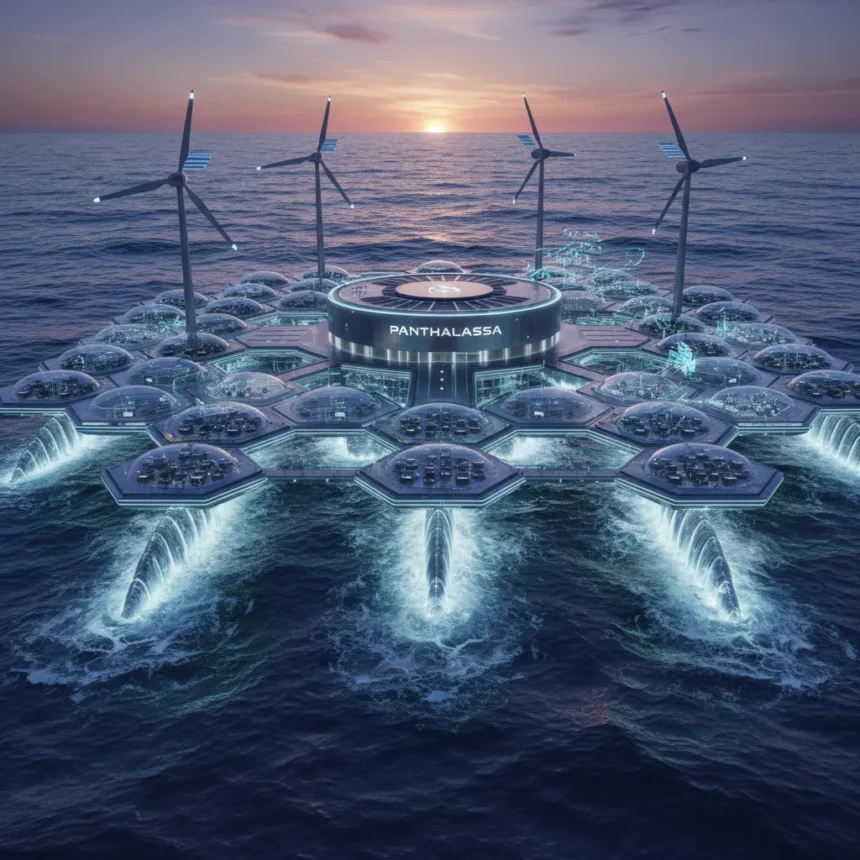
Wave-powered AI data centers could reshape how the world runs artificial intelligence. Panthalassa, a Vancouver-based startup, is building autonomous floating compute nodes that harvest energy directly from ocean waves, eliminating the grid strain and carbon emissions plaguing traditional data center infrastructure. The company just secured $140M in funding backed by Palantir co-founder Peter Thiel, validating a vision that seemed like science fiction just years ago.
Key Takeaways
- Panthalassa raised $140M to build Ocean-3, an offshore wave-powered AI compute node proof-of-concept
- Nodes are autonomous, self-propelled platforms that roam ~30 miles daily seeking optimal wave spots without tethers or shore power cables
- Company targets electricity costs around 2.5 cents per kWh at scale, undercutting solar and natural gas
- Ocean-3 deployment expected offshore around August; commercial-scale rollout targeted for Southern Hemisphere by 2027
- Team includes ~100 engineers, many recruited from SpaceX and Tesla
Why Wave-Powered AI Data Centers Matter Right Now
The AI boom is breaking data center infrastructure. Training and running large language models demands enormous electricity—enough to strain regional grids and trigger blackouts. Traditional land-based facilities consume millions of gallons of water for cooling, face fierce community opposition, and lock companies into fixed geographic locations. Wave-powered AI data centers eliminate all three problems at once. Panthalassa’s floating nodes use the ocean itself as both power source and cooling medium, require zero land use, and can relocate to follow energy availability.
The timing of the $140M raise underscores how urgent this problem has become. Major AI firms are desperate for compute capacity that does not trigger environmental backlash or grid emergencies. Panthalassa’s approach sidesteps both concerns by operating entirely offshore, invisible to land-based constituencies and immune to water scarcity. This is why Peter Thiel’s backing matters—it signals that serious technologists believe floating offshore compute is not a gimmick but an inevitable infrastructure shift.
How Panthalassa’s Wave-Powered Nodes Actually Work
The Ocean-2 and Ocean-3 nodes are not traditional buoys. They are autonomous platforms roughly 20 meters across at the top and 80 meters deep—shaped like a giant lollipop, according to CEO Garth Sheldon-Coulson. Unlike anchored offshore structures, these nodes are self-propelled. They move independently across the ocean, traveling roughly 30 miles per day to find optimal wave conditions. No cables tether them to shore. No power lines run to land. They are essentially mobile data centers.

The energy generation mechanism is elegantly simple. As waves rise and fall, they cause water inside a central tube to expand and contract. This pressure forces water upward into a spherical chamber at the top of the node. The descending water then flows through a turbine, spinning a generator to create electricity. Embedded server racks containing GPUs and TPUs tap this power directly for AI inference workloads. The ocean provides free cooling. Results transmit via satellite uplink—Starlink or similar networks—eliminating any need for undersea cables.
Multiple nodes work together as a distributed data center. This modular design means Panthalassa can scale by deploying more platforms rather than building monolithic land facilities. The company claims this approach will deliver electricity at roughly 2.5 cents per kilowatt-hour at scale, undercutting both solar and natural gas while avoiding the intermittency problems that plague renewable sources.



The Competitive Advantage Over Land-Based Alternatives
Wave-powered AI data centers face competition not from other offshore designs but from traditional land-based compute and emerging alternatives like orbital data centers. Amazon, Microsoft, and Tesla have explored space-based compute platforms, but orbital infrastructure remains years away and faces massive cost and regulatory hurdles. Land-based data centers, by contrast, are mature, proven, and widely deployed—but they are also the reason AI infrastructure is hitting a wall.
Panthalassa’s advantage is not speed to market but sustainability at scale. A land data center can be built faster, but it consumes water, occupies valuable real estate, and triggers local opposition. Wave-powered AI data centers solve all three by definition. They operate in international waters, consume no freshwater, and generate power from an infinite renewable source. For AI firms facing regulatory pressure and grid constraints, this is not just an alternative—it is the only path forward if compute demand continues to grow.
What Happens Next: Ocean-3 and Beyond
Panthalassa is currently constructing Ocean-3, a proof-of-concept platform designed to validate the entire system under real ocean conditions. The company expects to deploy this node offshore around August, marking the first detailed public test of wave-powered offshore compute. If Ocean-3 succeeds, it will prove the concept works and pave the way for commercial-scale deployment.
The real milestone is 2027. That is when Panthalassa targets deploying commercial-scale nodes in the Southern Hemisphere, where wave conditions are more consistent and AI demand from Asia-Pacific markets is surging. This timeline is ambitious—offshore engineering projects routinely face delays—but the $140M funding provides runway to iterate and solve problems. If the company hits its targets, wave-powered AI data centers could shift from curiosity to infrastructure standard within five years.



Is Panthalassa’s cost claim realistic?
The 2.5 cents per kilowatt-hour figure is what Panthalassa claims it will achieve at scale. This is cheaper than utility solar or natural gas in most markets, but the claim is based on company projections, not independent validation. Success depends on engineering challenges—durability in saltwater, maintenance logistics, and scaling manufacturing—that remain unproven at commercial volume.
Can wave-powered nodes really run AI workloads continuously?
Panthalassa focuses on inference, not training, which is a smart choice. Inference is more power-efficient and tolerates latency better than training, making it ideal for distributed offshore compute. The company relies on satellite uplinks for data transmission, which introduces latency but is sufficient for inference tasks where sub-second response times are not required.
Why hasn’t this been done before?
Wave energy is harder to harness than wind or solar because water is dense and unpredictable. Most wave energy projects have failed or stalled due to engineering complexity and harsh marine environments. Panthalassa’s approach—autonomous, self-propelled nodes that relocate to optimal conditions—sidesteps some of these problems, but execution at scale remains unproven. The company has operated semi-secretly for roughly 10 years, only recently going public with detailed plans.
Wave-powered AI data centers represent a bet that offshore energy infrastructure is the inevitable next phase of compute scaling. If Panthalassa succeeds with Ocean-3 and reaches commercial deployment by 2027, the company will have solved one of AI’s most pressing problems: how to power exponential compute growth without destroying grids, consuming freshwater, or triggering environmental backlash. Peter Thiel’s $140M backing suggests serious technologists believe this outcome is not just possible but probable. The ocean, it turns out, might be the best data center real estate on the planet.
Edited by the All Things Geek team.
Source: Tom's Hardware




