





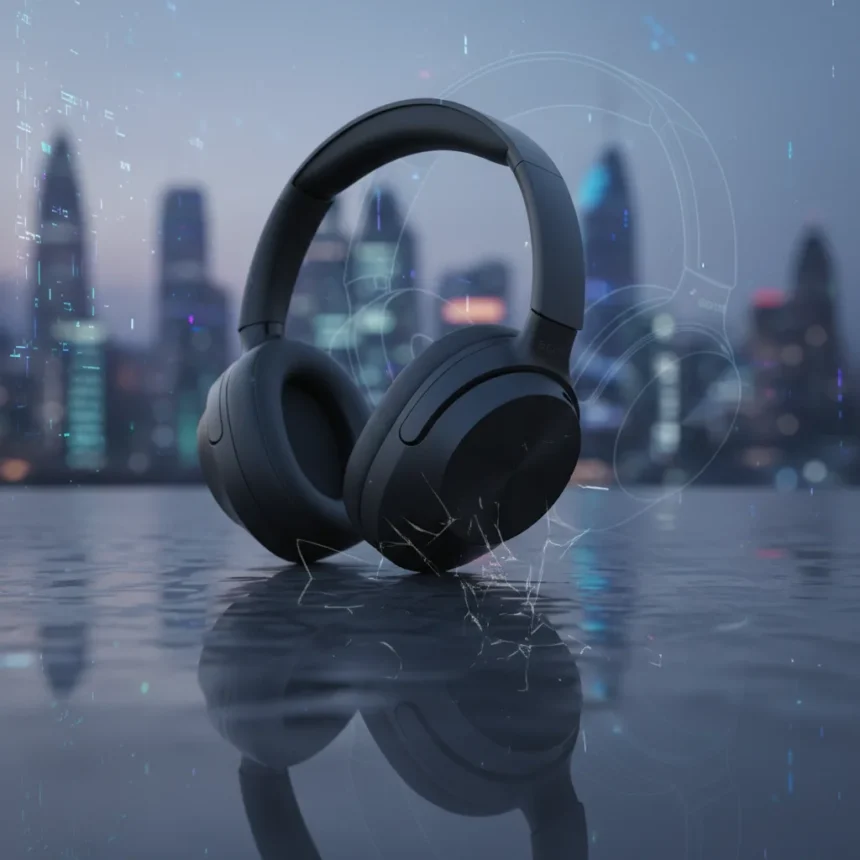
Sony flagship headphones are about to arrive, and leaked images suggest they could be more powerful than the current WH-1000XM6 — except in one critical area where they may actually underperform. The photos, which are suspiciously high-quality, hint at a design that looks like an XM6 supercharged, but the performance regression raises a legitimate question: is this really an upgrade, or a lateral move masquerading as progress?
Key Takeaways
- Leaked Sony flagship headphones show design evolution but hint at weakness in one unspecified key performance area
- Current WH-1000XM6 benchmark set at £329 / $400 / AU$699 across markets
- High-quality leak photos suggest official or near-official source, indicating launch timeline may be imminent
- Competitors like Sennheiser HDB 630 and Dali IO-8 continue raising the bar at premium price points
- No confirmed specs, pricing, or release date available yet for Sony’s next flagship
What the Leaked Sony Flagship Headphones Actually Show
The leaked images reveal a design language that borrows heavily from the XM6 formula but with visible refinements to the headband, ear cup geometry, and overall aesthetic. The photos are professional enough to suggest either official product photography or exceptionally detailed renders, which typically means Sony’s announcement window is closer than the usual product leak cycle would indicate. What is absent from the leaks, however, is any concrete specification data — drivers, codec support, battery life claims, or noise cancellation performance metrics remain completely unknown.
This is where the story gets interesting. If Sony is confident enough to leak this design, why is there no accompanying spec sheet? The answer likely lies in that one unspecified performance weakness. Leaks often highlight what is good and bury what is problematic. The fact that reviewers and leakers are already flagging a regression versus the XM6 suggests this is not a minor tweak but a meaningful step backward in something users actually care about. Is it noise cancellation depth? Sound signature? Comfort during extended wear? Without details, buyers are left guessing.
Sony Flagship Headphones Against the Current Competition
The WH-1000XM6 currently sits at the top of Sony’s over-ear lineup at £329 / $400 / AU$699, and it has held that position through sheer competence rather than innovation. It is a mature product — refined, reliable, and rarely surprising. But the premium headphone market has moved on. The Sennheiser HDB 630 (£400 / $500 / AU$1000) and Dali IO-8 (£499 / $500 / AU$1000) represent a different philosophy: they prioritize sound quality and build durability over feature count, and they have attracted buyers willing to pay for that trade-off.



If Sony’s next flagship is genuinely worse in one key area, it risks losing ground to these rivals precisely when the market is demanding better, not just different. The XM6 succeeded because it bundled noise cancellation, battery life, and a neutral sound signature into a package that worked across genres and use cases. A regression in any of those pillars — particularly noise cancellation, which is Sony’s historical strength — would be a strategic misstep. Apple’s upcoming AirPods Max 2 is also generating serious interest among premium buyers, adding urgency to Sony’s need to deliver a genuine upgrade.
Why the Leak Timing Matters Right Now
High-quality product leaks rarely appear by accident. They typically surface when a company is either preparing an official announcement or when a retailer has received stock early. The fact that these images are circulating now suggests Sony may be planning a launch within the next few weeks to months, which means any performance concerns will soon be public knowledge. For potential buyers currently considering the XM6, this leak creates a decision paralysis: do you buy now at the current price, or wait for the new model despite its rumored weakness?



The smarter play depends entirely on what that weakness is. If it is something you do not care about — say, a slightly different EQ curve or marginally reduced battery life — then the new model might still be worth waiting for. If it is noise cancellation performance, comfort, or build quality, then the XM6 remains the safer choice. Sony has not yet publicly acknowledged these leaks, which is standard practice, but the silence also means no clarification is coming until the official reveal.
What Happens If the Leak Is Accurate?
Sony faces a credibility problem if this flagship genuinely represents a step backward in any meaningful way. The company has built its reputation on incremental but consistent improvements — the XM5 was better than the XM4, the XM6 was better than the XM5. If the next generation breaks that chain, it signals either cost-cutting or a misalignment between engineering priorities and user expectations. Premium buyers do not accept regressions; they expect progression, even if it is modest.
The leaked design does look refined, which suggests Sony has invested in aesthetics and possibly build quality. But aesthetics do not matter if the headphones sound worse or fail to isolate ambient noise as effectively as their predecessor. This is where the disconnect between industrial design and acoustic engineering becomes apparent. A prettier headphone is only a win if it does not sacrifice performance.
When Will Sony Officially Announce These Headphones?
Based on typical product leak cycles and the professional quality of these images, an official announcement likely comes within the next 4-8 weeks. Sony usually announces major audio products either at CES in January, during spring product events, or in autumn ahead of the holiday season. The exact timing will determine market reception — announce too early and you cannibalize XM6 sales, announce too late and competitors grab market share.



Should You Wait for Sony’s Next Flagship Headphones?
That depends on your priorities and the nature of the performance regression. If you need premium noise-cancelling headphones right now, the XM6 at £329 / $400 / AU$699 remains a solid choice. If you can tolerate uncertainty and are willing to wait a few weeks, holding out for the official specs makes sense — at least then you will know whether the weakness affects your use case. Do not buy the new model solely because it is new; buy it because it solves a problem the XM6 does not.
What Performance Area Might the Sony Flagship Headphones Be Weaker In?
The research brief does not specify which performance area represents the regression, only that one exists. It could be noise cancellation, which would be particularly damaging given Sony’s expertise in that domain. It could be sound signature — perhaps a shift toward brightness that alienates fans of the XM6’s neutral tuning. It could even be comfort during extended listening sessions, which would be surprising given how refined the XM6 feels. Without official confirmation, speculation is all we have.
Are There Better Alternatives to Sony’s Flagship Headphones Right Now?
If you are not willing to wait and you value acoustic performance above all else, the Sennheiser HDB 630 (£400 / $500 / AU$1000) and Dali IO-8 (£499 / $500 / AU$1000) are genuinely excellent choices that do not sacrifice sound quality for feature count. Both offer superior build durability and a more refined listening experience, though neither matches Sony’s noise cancellation technology. The trade-off is worth considering if you spend more time enjoying music than fighting ambient noise.
Sony’s next flagship headphones look promising on paper and in photos, but that one unspecified weakness is a red flag worth taking seriously. Wait for the official specs, ignore the design hype, and focus on whether the performance regression actually matters to your listening habits. A beautiful headphone that sounds worse than its predecessor is not progress — it is a mistake Sony should not make, and buyers should not accept.
Edited by the All Things Geek team.
Source: What Hi-Fi?




