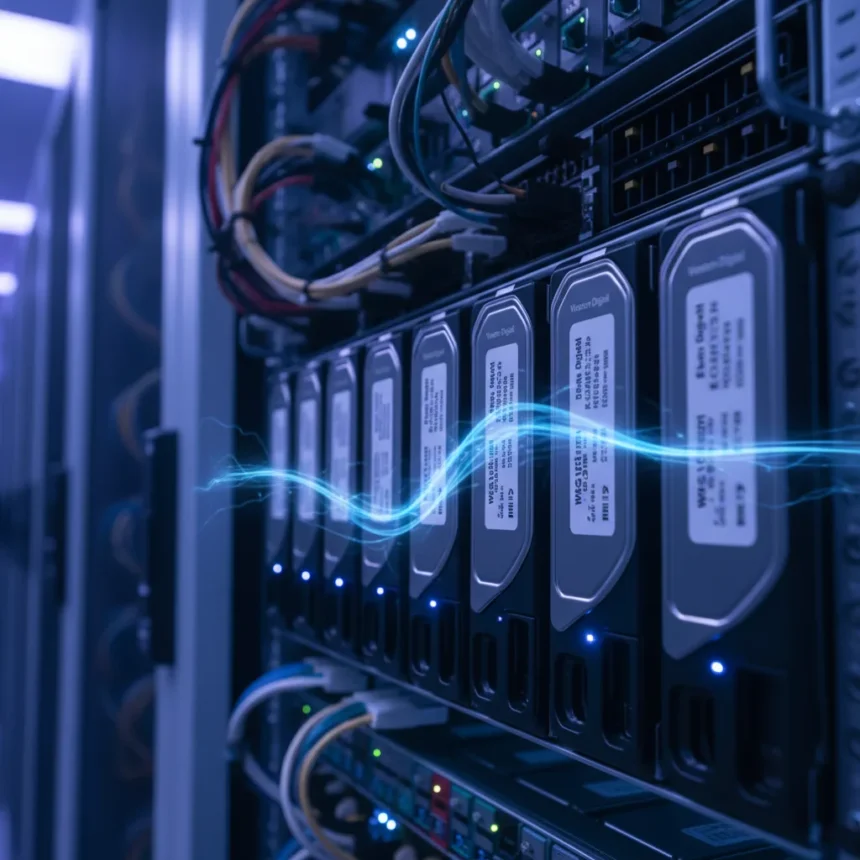
Western Digital’s HDD spin-down technology represents a shift in how enterprise storage handles idle periods, balancing power consumption against the latency penalties that have historically plagued aggressive drive shutdown methods. The company claims its approach reduces power usage by 20-30% during idle states while keeping performance acceptable for hyperscale production workloads—a claim that matters as cloud providers and data centers face mounting electricity costs.
Key Takeaways
- WD’s spin-down method cuts idle power consumption by 20-30% compared to traditional always-spinning drives.
- The technology targets hyperscale data centers and cloud providers managing massive storage footprints.
- Advanced firmware and platter management minimize spin-up latency, avoiding the performance penalties of older spin-down approaches.
- Higher storage density becomes possible by reducing the need for constant high-power operation.
- Enterprise HDDs like the Ultrastar DC HC series are expected to integrate this technology in future releases.
How HDD spin-down technology works in practice
Most hard drives consume power continuously, even when idle. Western Digital’s approach uses firmware-level intelligence to transition drives into low-power states without the severe latency spikes that plagued earlier spin-down methods. The company optimizes how drives manage platter rotation and head positioning, allowing them to enter sleep states more aggressively while still waking quickly enough for production workloads. This balance is critical for hyperscale environments where millisecond delays can cascade into measurable performance degradation.
The technology works by monitoring drive activity patterns and predicting idle windows, then spinning down platters to consume minimal power during those periods. When data access is needed, the drive spins back up faster than conventional designs would allow. This reduces the cumulative mechanical stress on the drive while cutting electricity draw—a dual benefit that appeals to data center operators managing both operating costs and equipment longevity.
Why this matters for data centers and cloud providers
Data centers house thousands of drives, and even a 20-30% reduction in idle power translates to significant cost savings at scale. A hyperscaler running petabytes of storage across multiple regions could save millions annually in electricity costs. Beyond raw power consumption, this technology also addresses the environmental pressure mounting on cloud infrastructure as AI workloads and data proliferation drive demand for larger storage systems. Western Digital’s approach allows operators to pack more storage density per rack without proportionally increasing power draw, making it a practical response to both economic and sustainability pressures.

Traditional enterprise drives like the HGST HUH721212ALE604 spin continuously for maximum reliability but lack customizable spin-down capabilities. Seagate’s Exos series and Toshiba’s offerings include spin-down features, but Western Digital claims its method achieves a superior balance between low latency and power savings—a distinction that matters when milliseconds of delay can impact service level agreements across thousands of simultaneous requests.
The trade-offs: performance versus power savings
Spin-down technology inherently involves compromise. Older WD Green drives spin down aggressively but suffer high start-stop cycles and noticeable latency when waking from sleep—problems that made them unsuitable for enterprise use. Western Digital’s new approach minimizes these penalties through firmware optimization, but the company’s claims remain promotional and lack independent third-party validation. Real-world performance in hyperscale environments may vary depending on workload patterns, access frequency, and drive placement within the storage hierarchy.



NAS drives like WD Red Pro are rated for 600,000 load-unload cycles and 50,000 start-stop cycles, designed to withstand frequent spin-ups. WD’s spin-down technology reduces mechanical cycle stress by keeping drives in low-power states more intelligently, potentially extending drive lifespan while cutting power. However, the actual longevity benefits remain unproven in production deployments.
When will this technology arrive?
Western Digital has not announced specific pricing or launch dates for drives featuring this spin-down technology. The company describes it as in development for future enterprise releases, with expected integration into the Ultrastar DC HC series—their high-capacity enterprise line. Availability through enterprise channels is likely, but consumer pricing and timelines remain unconfirmed. Data center operators interested in this capability should contact Western Digital directly for roadmap details and early access programs.
Does HDD spin-down technology reduce drive lifespan?
Not necessarily. While spin-down cycles add mechanical stress, intelligent firmware management reduces unnecessary start-stop events, potentially offsetting that wear. Enterprise drives are engineered to handle thousands of power cycles, and WD’s approach minimizes aggressive spinning by predicting idle periods more accurately. However, independent long-term testing in production environments is needed to confirm actual lifespan impact.
How much electricity can data centers actually save?
Western Digital claims 20-30% power reduction during idle periods based on internal testing, but real-world savings depend on workload patterns. Data centers with high access frequency will see smaller gains than those with bursty, irregular traffic. A hyperscaler running warm storage tiers might see 15-25% savings, while cold storage deployments could exceed 30%. The actual number matters more than the marketing claim—enterprise buyers should request detailed power consumption specifications for their specific use cases.



Can this technology work in consumer NAS systems?
Potentially, but consumer NAS environments differ significantly from hyperscale data centers. Consumer drives prioritize reliability over density, and most NAS systems already include software-based spin-down controls. Western Digital’s technology is engineered for the scale and performance demands of cloud providers, not home storage. If the company brings this capability to consumer products like WD Red, it would need to prove the technology doesn’t compromise the reliability guarantees that NAS users depend on.
Western Digital’s spin-down innovation addresses a real pain point for hyperscalers—power consumption at scale. The technology won’t reshape the industry overnight, but it represents practical progress on a problem that costs cloud providers billions annually. The catch: Western Digital’s power-saving claims remain unvalidated by independent testing, and the technology won’t reach production systems immediately. For data center operators evaluating long-term storage strategies, this is worth monitoring, but don’t expect miracles. A 20-30% idle power reduction is meaningful only if your drives actually spend significant time idle—and in many hyperscale workloads, they don’t.
Edited by the All Things Geek team.
Source: TechRadar