





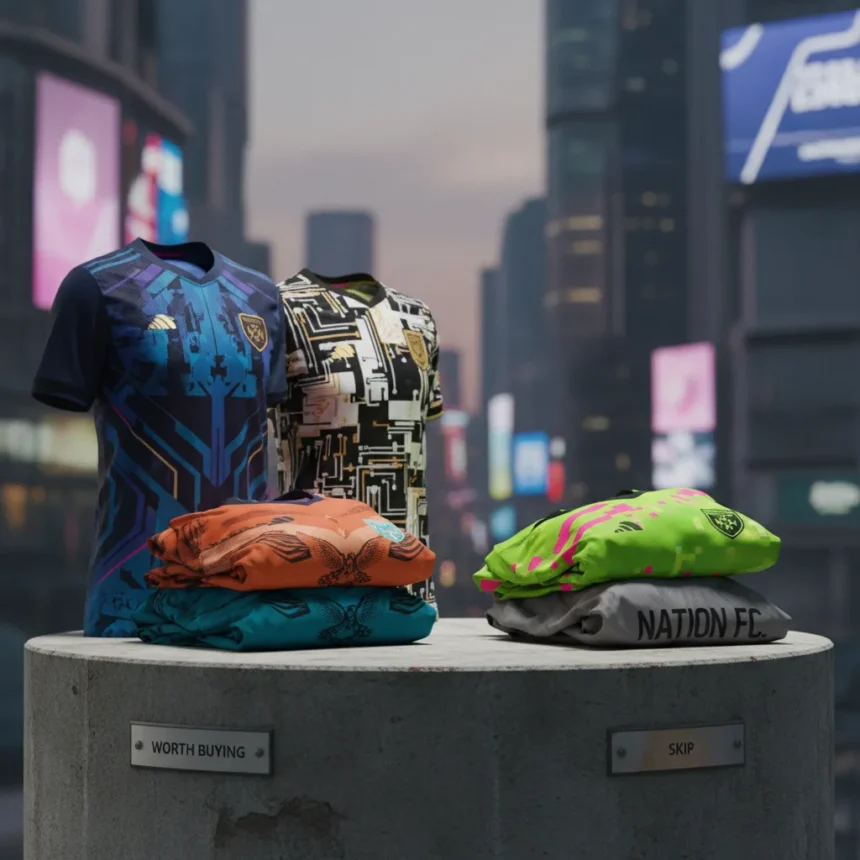
The 2026 World Cup jerseys are rolling out now, and not every kit deserves your money. With 48 teams competing for the first time in World Cup history, that means 96 different home and away jerseys hitting the market—but most are still arriving in phases. The designs range from genuinely inspired tributes to past tournaments to lazy, forgettable efforts that should stay in the warehouse. Here’s what you actually need to know before spending on these kits.
Key Takeaways
- 2026 World Cup features 48 teams, requiring 96 total kits; not all released yet
- Uruguay away (Adidas) ranks as top jersey overall with indigo design honoring 1930 winners
- Nike supplies major teams including Brazil, France, USA, and Netherlands with standout S-tier designs
- South Africa away, Curacao away, and Italy away rank among the best available designs
- F-tier kits exist but vary by ranking system; design, colorway, and wearability are key judgment criteria
The S-Tier Kits That Actually Deserve Your Money
The absolute best 2026 World Cup jerseys share one thing: they either innovate boldly or honor history with genuine respect. Uruguay away sits at the top of most rankings, and for good reason. Adidas designed it in indigo to pay tribute to the 1930 World Cup winners, with a shimmering blue and orange neck mantle that mimics indigenous armor. That is not just a pretty color—it is a story on fabric.
Brazil home, supplied by Nike, swaps the familiar canary yellow for something more refined: a rich yellow with green trim, a notched neckline, and a diamond flag pattern that feels fresh without abandoning tradition. Meanwhile, Norway home, USA home, and Netherlands away round out the Nike S-tier selections, each bringing distinct visual identity and wearability. France home deserves mention too—a dark blue base with a diagonal pattern, white collar, and bronze logos that feels premium in person.
What separates S-tier from the rest? These kits work both on the pitch and off it. You can wear them casually without looking like you are cosplaying a football match.

Strong Mid-Tier Options: A-Tier and B-Tier Kits
Once you move past the absolute elite, the rankings diverge depending on which source you trust. South Africa away ranks as the top pick in GiveMeSport’s full ranking, followed by Curacao away at number two and Italy away at number three. Spain away also cracks the top tier in that same ranking. These are kits with personality—bold colorways, thoughtful details, or both.
The difference between S-tier and A-tier is often subtle: maybe the neckline is slightly less flattering, or the colorway is striking but harder to style into a regular wardrobe. ESPN’s full ranking places Brazil home at number eight and France home at number twelve, suggesting that even Nike’s biggest names have trade-offs. A-tier and B-tier kits are still worth buying if the design speaks to you, but they lack the universal appeal of the elite tier.



What to Avoid: F-Tier Kits and Design Failures
Tom’s Guide’s ranking system includes F-tier kits—jerseys that missed the mark on design, colorway, or wearability. The brief does not name specific teams in the F-tier category, but the principle is clear: some kits are objectively worse than others. A poor neckline, a clashing color combination, or a design that feels dated before it even ships can sink a jersey.
The challenge with 2026 World Cup jerseys is that not all 96 kits have released yet, so the full ranking picture remains incomplete. As more teams unveil their kits, expect the consensus to shift. What matters is looking at the design philosophy: does it respect the team’s history, does the colorway work in real life, and would you actually wear it outside a stadium? If you answer no to any of those questions, skip it.
Nike vs. Adidas: Who Is Winning the Kit Wars?
Nike supplies powerhouse teams like Brazil, France, USA, and Netherlands, and their S-tier selections prove they understand how to balance innovation with tradition. Yet Adidas is not playing for second place. Uruguay away, their flagship design, ranks above most Nike offerings, including Brazil and France. This suggests that in 2026, the best kit is not about the manufacturer—it is about the specific design team and their vision for each nation.
The real competition is not Nike versus Adidas. It is between kits that understand their team’s identity and those that treat the jersey as a blank canvas for generic sponsorship placement. The winners—whether made by Nike, Adidas, or anyone else—are the ones that tell a story.



Which 2026 World Cup jerseys are worth buying right now?
Start with Uruguay away if you can find it in your size. Brazil home and France home are both exceptional, and if you follow the USMNT, the USA home kit is genuinely one of the best designs in the tournament. If you want to take a risk on something less obvious, South Africa away and Italy away offer bold, distinctive designs that stand out.
Should I buy a 2026 World Cup jersey if my team’s kit has not been released yet?
Wait. Not all 96 kits are available yet, so if your nation’s jersey has not dropped, hold off. The design could be stunning or forgettable—and you will only know once it is official. Rushing to buy a placeholder or leaked image is how you end up with a kit you regret.
Are 2026 World Cup jerseys better designed than previous tournaments?
The standout designs—Uruguay, Brazil, France, USA—suggest that kit design in 2026 is reaching new creative heights, especially with tributes to World Cup history and bolder colorways. However, the expanded 48-team format also means more kits overall, which statistically increases the number of mediocre designs. Quality is higher at the top, but the average has likely dipped.
The 2026 World Cup jersey market is wide open right now, and early buys are paying off for fans who did their homework. Stick with the S-tier and A-tier designs, skip the obvious misses, and you will build a collection you actually wear. The worst jersey is the one gathering dust in your closet—so be selective, and choose designs that matter.
Edited by the All Things Geek team.
Source: Tom's Guide




