





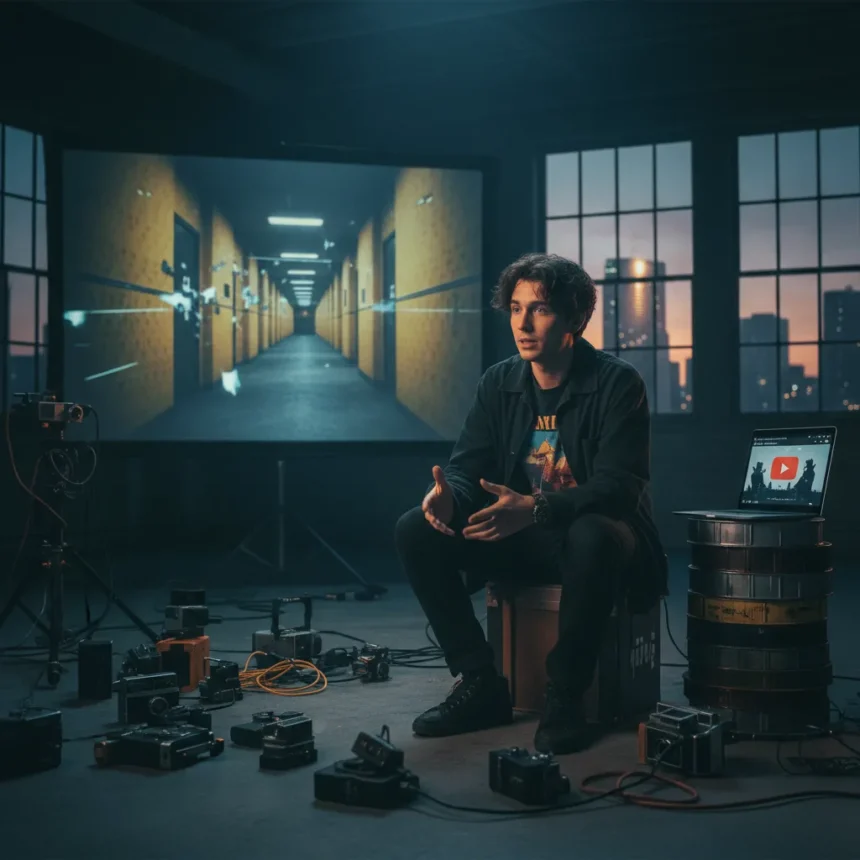
YouTube horror creators are reshaping how Hollywood discovers and develops new filmmaking talent. Kane Parsons, the 19-year-old director behind A24’s feature adaptation of The Backrooms, is at the forefront of this shift—and he’s not alone in recognizing YouTube’s power as a launchpad for genre filmmakers.
Key Takeaways
- Kane Parsons became A24’s youngest director when the studio greenlit his Backrooms feature adaptation.
- Parsons’ web series accumulated tens of millions of views, proving audience demand for online horror content.
- YouTube now functions as an industry pipeline where studios actively scout for horror and genre talent.
- YouTube exposure can rival or exceed festival circuits as a path to studio attention for emerging creators.
- Producers are mining YouTube, TikTok, and Instagram for new filmmakers and proof-of-concept ideas.
Why YouTube Horror Creators Matter to Studios Now
The traditional path to a studio feature deal ran through film festivals, agent representation, and years of industry networking. That pipeline still exists, but it’s no longer the only route. Studios are increasingly treating YouTube horror creators as legitimate talent sources, recognizing that online audiences function as both proof of concept and marketing engine. When a creator like Parsons builds a massive audience for original horror content, they’ve already solved one of Hollywood’s biggest problems: proving people want to watch the work.
What makes this shift significant is speed. A festival submission cycle takes months. YouTube visibility is immediate. The industry is looking at these platforms not as amateur hour but as the next best place to get visibility for emerging horror talent. Parsons’ rise exemplifies this: his web series caught studio attention precisely because it demonstrated audience appetite for the Backrooms concept before a single frame of a feature film was shot.
YouTube Horror Creators vs. the Festival Circuit
The comparison between YouTube exposure and traditional festival discovery reveals something important about how the industry has evolved. Both pathways work, but they work differently depending on the project and filmmaker. One industry observer noted: I’ve seen YouTube exposure do wonders for people where festivals didn’t, and I’ve seen festivals do wonders where YouTube couldn’t. The distinction matters because it means YouTube hasn’t replaced festivals—it’s created an alternative ecosystem with its own advantages.

Festival circuits still offer prestige, critical validation, and agent attention. But they’re slow, selective, and favor certain types of work over others. YouTube, by contrast, is democratic and immediate. The platform’s algorithm actively promotes content that keeps viewers watching, which means creators who understand their audience can build momentum without gatekeepers. For horror specifically, this matters enormously. Genre audiences are passionate, loyal, and highly engaged online—exactly the demographic that drives YouTube visibility.
How the Algorithm Works for YouTube Horror Creators
YouTube’s incentive structure fundamentally favors the kind of audience-building that studios now value. As one creator explained, by making what you want, the audience will find it because the platform wants that audience to find it. This is the opposite of traditional gatekeeping. YouTube wants to bring people to the project—not because the platform cares about art, but because engagement drives ad revenue and watch time. For horror creators, this alignment is powerful. The platform’s algorithm doesn’t discriminate between festival-approved work and viral proof-of-concept shorts; it simply promotes what viewers click on and watch to completion.



This creates a measurable record of audience interest that studios can evaluate. Parsons’ tens of millions of views weren’t abstract metrics; they were concrete evidence that people wanted more Backrooms content. That evidence became the foundation for A24’s feature greenlight. The algorithm, in effect, became a market research tool that replaced focus groups and test screenings.
The Broader Ecosystem: TikTok, Instagram, and Beyond
YouTube isn’t the only platform where studios are scouting talent. Producers are actively mining TikTok, Instagram, and similar platforms for new filmmakers and ideas. This suggests the shift toward internet-to-cinema pipelines extends beyond any single platform. The common thread is audience-building and proof of concept. Whether a creator builds an audience through short-form TikTok videos, Instagram Reels, or YouTube series, the underlying principle is the same: demonstrated audience appetite now functions as a credential.
For horror specifically, this ecosystem matters because the genre thrives on community and word-of-mouth. Horror fans are early adopters of new platforms and creators. They’re also the most likely to evangelize work they love across social media. This makes horror creators particularly valuable to platforms and studios alike—they bring built-in audiences that are primed to engage and share.
What This Means for Emerging YouTube Horror Creators
The Parsons example creates both opportunity and pressure for aspiring horror filmmakers on YouTube. Opportunity is obvious: a studio feature deal is now within reach for creators who build genuine audiences online. Pressure comes from the fact that the bar has been raised. Studios aren’t just looking for interesting ideas anymore; they’re looking for creators who can demonstrate they understand their audience and can sustain engagement over time.



This doesn’t mean every YouTube horror creator needs millions of views to catch industry attention. It means visibility matters. Consistency matters. Understanding your audience matters. The platform rewards creators who show up regularly, iterate based on feedback, and build community. Those are exactly the skills studios need in filmmakers who can navigate modern release strategies and audience expectations.
Can YouTube exposure really lead to a studio deal?
Yes. Kane Parsons’ feature deal with A24 is the clearest proof, but it’s not an isolated case. Studios now actively scout YouTube, TikTok, and Instagram for talent. However, the path isn’t automatic—it requires genuine audience engagement and a concept that translates to feature scale. Parsons succeeded because his web series demonstrated both.
What makes YouTube horror creators appealing to studios?
YouTube horror creators bring three things studios value: proof of audience interest, existing marketing reach, and demonstrated understanding of what viewers want. A creator with millions of engaged followers has already solved the hardest part of the equation—convincing people to care about the work.
Is the festival circuit dead for horror filmmakers?
No. Festivals and YouTube are complementary pathways, not competing ones. Some creators will thrive on YouTube while others benefit more from festival exposure. The key difference is that YouTube is now a legitimate alternative rather than a consolation prize.
The rise of YouTube horror creators represents a fundamental shift in how Hollywood discovers talent. Kane Parsons didn’t attend film school, win a festival award, or work his way up through industry connections. He made compelling horror content on YouTube, built an audience, and got noticed. That pathway is now real—and it’s attracting a new generation of filmmakers who might never have gotten a studio meeting through traditional channels. For horror specifically, this democratization matters. The genre has always thrived on passion and community, and YouTube’s algorithm rewards exactly those qualities. The next golden generation of horror filmmakers may already be building their audiences online.
Edited by the All Things Geek team.
Source: TechRadar




