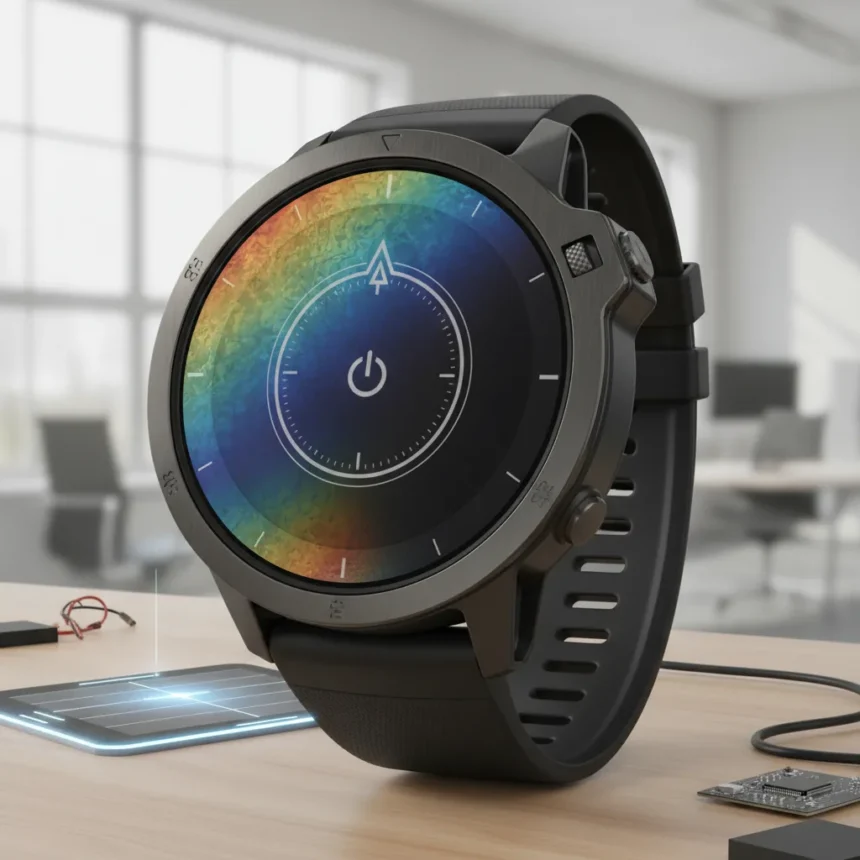
Garmin Fenix 9 solar charging has been the subject of intense speculation, and for good reason. If Garmin actually delivers solar cells beneath an AMOLED display—ending the decade-old trade-off between rich color and multi-week battery life—it would be the most significant smartwatch breakthrough since the original Fenix series launched in 2012.
Key Takeaways
- Fenix 9 rumors suggest solar-over-AMOLED using semi-transparent solar cells, potentially delivering “Forever Battery” capability
- Current Garmin solar tech uses Power Sapphire (synthetic sapphire crystal) on premium models like Fenix 8 Solar, extending battery 20-70% depending on mode
- Power Glass solar cells appear on mid-tier Garmin Instinct models, using strengthened glass with bonded solar cells
- Fenix 8 Solar smartwatch mode lasts 28 days with solar versus 21 days without; GPS multi-band reaches 43 hours with solar versus 37 hours non-solar
- Expected Fenix 9 release is 2026, with rumors including MicroLED display, Elevate Gen 6 blood pressure sensor, and titanium bezel
Why Garmin Fenix 9 solar charging matters right now
The smartwatch market has split into two camps: AMOLED watches with brilliant displays but three-to-five-day battery life, and MIP (Memory-in-Pixel) watches with monochrome screens but weeks of runtime. Garmin has dominated the MIP segment since acquiring SunPartner Technologies in 2019 and debuting solar in the Fenix 6 series. But that dominance comes with a visual compromise. High-end outdoor enthusiasts want both stunning color and genuine multi-week autonomy. Fenix 9 rumors suggest Garmin is finally chasing that middle ground.
The proposed solution: semi-transparent solar cells stacked beneath an AMOLED or MicroLED display, allowing sunlight to pass through while charging the battery underneath. This is not theoretical. Garmin already uses Power Glass—strengthened glass with solar cells bonded beneath—on the Instinct series. The leap to a full color display would require overcoming optical degradation and cell efficiency in a thinner stack, but the engineering path is clear.
How Garmin Fenix 9 solar charging would reshape the category
Current solar gains are substantial but light-dependent. The Fenix 8 Solar in smartwatch mode delivers 28 days with adequate sunlight versus 21 days without. In GPS multi-band mode, solar extends runtime from 37 hours to 43 hours. These gains assume consistent outdoor exposure—a runner in Seattle or London sees far less benefit than someone in the UAE or Arizona. A true solar-over-AMOLED stack could theoretically enable “indefinite” runtime in low-power modes, provided the wearer spends time outdoors.


The catch: solar intensity varies wildly by geography, season, and time of day. Garmin already displays solar input via watch face widgets, showing lux readings over the past six hours. A Fenix 9 with semi-transparent solar would need transparent enough glass to render AMOLED colors faithfully while dense enough to capture meaningful photons. That is an engineering tightrope. If Garmin nails it, the Fenix 9 becomes the uncontested premium outdoor smartwatch. If the display looks washed out or solar gains disappoint, it is just another expensive Fenix with a gimmick.
What Fenix 9 rumors reveal about Garmin’s direction
The leaked Fenix 9 spec sheet includes more than solar. Rumors point to a 4500-nit MicroLED display—dramatically brighter than current AMOLED—Elevate Gen 6 sensor with blood pressure monitoring, Sat-Link 360 messaging, titanium bezel, reinforced polymers, and thinner screens to accommodate larger batteries. These are not incremental updates. They suggest Garmin is willing to redesign the entire watch stack to compete with Apple Watch Ultra and Coros Vertix 2, not just iterate on the Fenix 8.


The 2026 timeline matters. Garmin is not rushing. That suggests either confidence in the engineering or acknowledgment that solar-over-AMOLED is harder than it sounds. Supply chain leaks point to mid-2026 availability, giving competitors like Coros and Apple time to respond. But Garmin’s five-plus-year solar lead is not easily replicated. No competitor has shipped meaningful solar on a color display yet.
Should you wait for Fenix 9, or buy Fenix 8 Solar now?
If you need a solar smartwatch today, the Fenix 8 Solar is the best available option. Its Power Sapphire crystal is durable, its battery gains are real, and its MIP display is proven. But if you can wait until 2026 and you prioritize color display quality alongside battery life, holding out for Fenix 9 makes sense—assuming Garmin delivers on the solar-over-AMOLED promise. The gap between Fenix 8 and Fenix 9 will likely be larger than previous generations, not because of processor speed or sensor count, but because of fundamental display and power architecture changes.
Is the Fenix 9 confirmed to have solar charging?
No. Fenix 9 solar charging is rumored based on patent filings, YouTube leaks, and supply chain reports, but Garmin has not officially announced the feature. Official specs will come closer to launch, likely in late 2025 or early 2026. Treat all Fenix 9 details as educated speculation, not confirmed fact.
How much better is solar charging than non-solar on current Garmin watches?
Battery improvements vary by watch mode and sunlight exposure. On the Fenix 8 Solar, smartwatch mode gains seven days (28 vs 21 days), while GPS multi-band gains six hours (43 vs 37 hours). In low-light climates or indoor-heavy use, gains shrink significantly. Real-world solar benefit depends entirely on how much time you spend outdoors in direct sunlight.


What is the difference between Power Glass and Power Sapphire solar?
Power Glass uses strengthened glass with solar cells bonded beneath it, appearing on Garmin Instinct mid-tier models. Power Sapphire uses synthetic sapphire crystal (Mohs hardness 9, second only to diamond) on premium devices like Fenix 8 Solar, Enduro 3, and tactix models. Sapphire is more scratch-resistant and optically superior, but also more expensive. Fenix 9 rumors suggest Power Glass might finally enable solar on color displays, closing the gap between the two technologies.
The Fenix 9 hype is justified—if Garmin ships solar-over-AMOLED. If the company plays it safe and sticks with MIP, it is just another incremental update. The smartwatch category is waiting for someone to prove that color and battery life are not mutually exclusive. Garmin has the solar expertise to do it. Whether it actually does is the only question that matters.
Where to Buy
Garmin Fenix 7S | Garmin Fenix 7 | Garmin Fenix 7 Solar | Garmin Fenix 8 | Garmin Fenix 6
Edited by the All Things Geek team.
Source: T3