





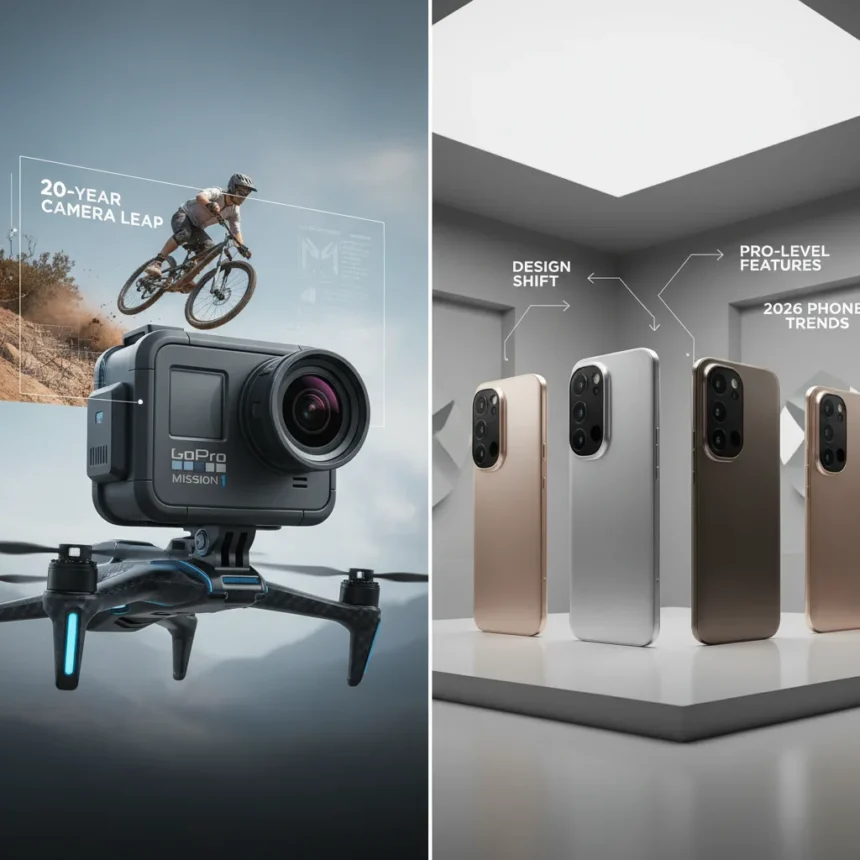
2026 tech trends are crystallizing around a shift from artificial intelligence toward professional-grade hardware and design innovation. This week’s tech news cycle underscores that pivot, with GoPro’s Mission 1 series launching as the biggest action camera upgrade in 20 years and phone makers positioning themselves for a design-focused year ahead.
Key Takeaways
- GoPro Mission 1 series represents the largest action camera upgrade in two decades with 8K professional capabilities.
- One Mission 1 model supports hundreds of pro camera lenses, bridging consumer action cams with professional cinema.
- 2026 phone trends are moving away from AI features toward design and camera innovation.
- Samsung Galaxy S26 series, iPhone 18, and other flagship phones expected to emphasize aesthetics and pro imaging.
- DJI’s first 360 drone and multiple advanced cameras signal 2026 as a hardware-focused year.
GoPro Mission 1 Marks a Professional Turn for Action Cameras
GoPro’s Mission 1 series is not a minor iterative update. The trio of professional 8K action cameras represents the company’s most significant hardware leap in 20 years, positioning GoPro firmly in the pro-level space rather than just consumer adventure recording. This is a strategic shift. One of the three Mission 1 models supports hundreds of pro camera lenses, meaning users can attach professional cinema glass to an action camera form factor—something unthinkable in GoPro’s traditional market. That hybrid approach blurs the line between consumer and professional gear, and it signals where action camera makers see opportunity in 2026.
The competitive context matters here. Previous GoPro models dominated consumer action camera sales but remained constrained by fixed optics and consumer-grade codecs. Mission 1’s 8K capture and lens compatibility directly challenge traditional cinema cameras in their own territory, particularly for documentary and sports production where compact, rugged form factors are valuable. This is not incremental—it is categorical repositioning.
2026 Tech Trends Pivot Away From AI to Design and Hardware
2025 was the year of AI-focused phones. Every major manufacturer rushed to integrate on-device AI features, generative tools, and neural processing into their flagships. But 2026 is signaling a different priority: design, professional camera systems, and hardware innovation. The hype around the “most beautiful phone of 2026” is not accidental—it reflects market fatigue with feature-parity AI and renewed focus on industrial design and user experience.


This shift appears across multiple product categories. Samsung’s Galaxy S26 series is expected to emphasize visual design and imaging capabilities. The iPhone 18 is rumored to bring significant camera improvements. Google’s Pixel 10 Pro is anticipated to push computational photography further. Even emerging brands like Nothing Phone 4a are positioning themselves around design-forward aesthetics. The pattern is clear: manufacturers believe 2026 consumers want phones that look and feel premium, not phones that promise the most AI features.
Professional Cameras and Drones Dominate 2026 Hardware Roadmap
Beyond phones and action cameras, 2026’s camera ecosystem is expanding into new territory. DJI is preparing its first 360 drone, a category-defining product that opens drone imaging to new creative possibilities. Canon, Sony, and Fujifilm are expected to release advanced cameras targeting both enthusiasts and professionals. The GoPro Mission 1 launch is not an isolated event—it is part of a broader industry movement toward pro-grade, specialized hardware.



Why does this matter? Because it signals that consumer tech manufacturers have stopped competing purely on processor speed and AI capability. They are now competing on what you can actually create with their tools. A phone with a 200-megapixel sensor and advanced computational photography is more valuable to a content creator than a phone with slightly faster AI inference. A drone that captures 360-degree video opens entirely new creative possibilities. An action camera that accepts professional lenses enables filmmakers to use a single ecosystem across multiple devices.
What This Means for Tech Buyers in 2026
If you are shopping for tech in 2026, expect to see manufacturers emphasize durability, design, and imaging capability rather than listing AI features as primary selling points. GoPro’s Mission 1 series shows that “professional-grade” is no longer exclusive to expensive cinema equipment—it is filtering down into consumer categories. That means your next phone, camera, or drone will likely have more creative power and longer-term relevance than 2025 models that prioritized AI gimmicks.
The trade-off is real, though. Pro-level features often come with steeper learning curves and higher prices. Mission 1’s lens compatibility is powerful, but it also means buying lenses. Advanced phone cameras require understanding computational photography. This is not a year for casual tech buyers—it is a year for people who actually want to create something with their hardware.
Is 2026 really moving away from AI in tech?
Not entirely. AI will remain embedded in 2026 devices, but it will be less of a marketing headline and more of a background tool. The shift is from “AI-first” positioning to “capability-first” positioning. Manufacturers will still use machine learning for image processing, voice recognition, and optimization—but they will not lead with it in advertisements or product names.



What is the biggest camera launch coming in 2026?
GoPro’s Mission 1 series is among the most significant, but the year will see launches from DJI (360 drone), Canon, Sony, Fujifilm, and others. The iPhone 18 camera system and Samsung Galaxy S26 imaging capabilities will also be major releases. There is no single “biggest” launch—2026 is shaping up as a year of distributed innovation across multiple categories.
Should I wait to upgrade my phone until 2026 models arrive?
If your current phone still captures usable photos and runs your apps smoothly, waiting makes sense. 2026 phones are expected to bring meaningful design changes and camera improvements, not just processor bumps. If your device is aging or showing battery degradation, upgrading now is reasonable—2025 flagships are still excellent tools.
This week’s tech news reflects a maturing market where manufacturers are no longer chasing raw performance or AI headlines. They are chasing creativity, durability, and design—the things that actually matter to people who use technology to make things. GoPro’s Mission 1 series is the clearest signal yet that 2026 will reward companies that understand this shift.
Edited by the All Things Geek team.
Source: TechRadar




