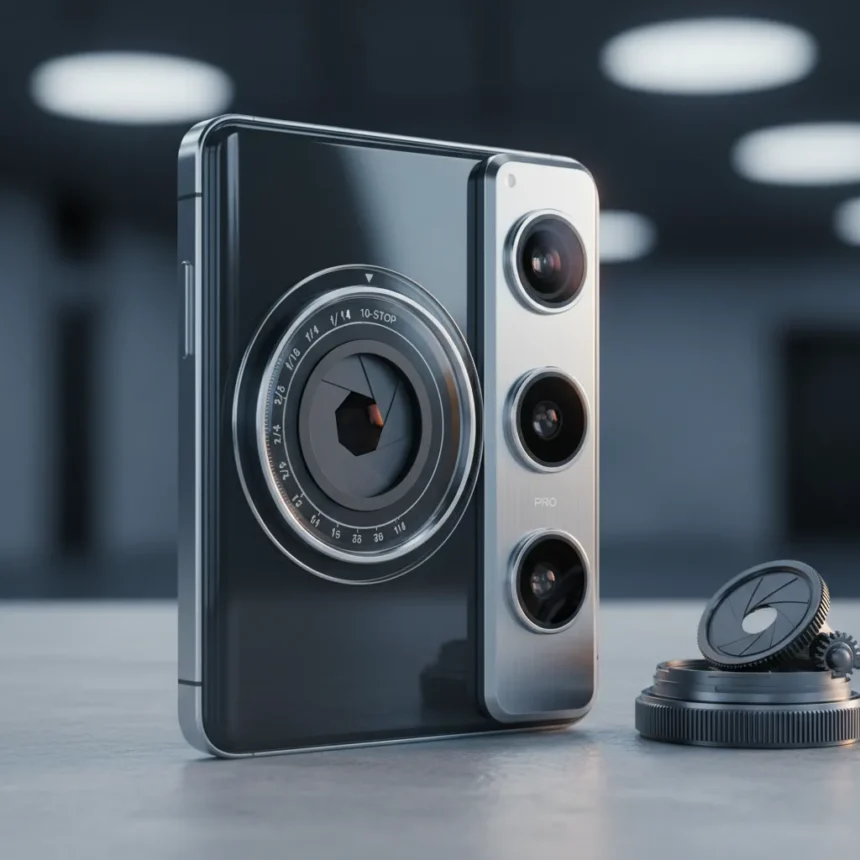
The variable aperture smartphone is no longer a pipe dream—Huawei’s Pura 90 Pro Max proved it in July 2025, and now Apple faces pressure to match it. The Pura 90 Pro Max features a 50MP main camera with a 10-stop variable aperture (f/1.4 to f/4.0), adjustable in 1/3 EV increments via an on-screen slider or automatic scene detection. This is the kind of pro-level control that iPhone users have been missing out on.
Key Takeaways
- Huawei Pura 90 Pro Max’s 10-stop variable aperture is the first smartphone to offer true DSLR-like aperture control.
- The variable aperture adjusts physically in approximately 0.5 seconds, enabling real-time preview and creative control.
- iPhone 16 Pro and iPhone 17 Pro rely on fixed f/1.78 aperture with software simulation for depth and exposure control.
- Variable aperture eliminates the need for neutral density filters and enables daytime long exposures on smartphones.
- Huawei’s feature pressures Apple to adopt similar hardware for the iPhone 18 Pro, expected in 2026.
What Makes Huawei’s Variable Aperture a significant shift
The variable aperture smartphone represents a genuine leap in mobile photography hardware. Huawei’s implementation lets photographers adjust aperture from f/1.4 for maximum light and bokeh in low-light scenes to f/4.0 for sharp, detailed landscapes without relying on computational tricks. The hardware iris physically adjusts in roughly 0.5 seconds, giving real-time preview feedback as you drag the slider—something no iPhone can match today.
This is fundamentally different from what Apple offers. The iPhone 16 Pro and iPhone 17 Pro use a fixed f/1.78 aperture on their 48MP main sensor, relying entirely on software algorithms to simulate depth of field and adjust exposure. It’s competent, but it’s not the same as hardware control. A variable aperture smartphone gives photographers tangible, optical control over light intake and depth of field—exactly what DSLR and mirrorless shooters have had for decades.
The Pura 90 Pro Max’s 10-stop range is staggering. Wide apertures (f/1.4 to f/2.8) excel in low light and create pronounced bokeh. Mid-range settings (f/2.8 to f/4.0) balance sharpness and light gathering. Narrow apertures (f/4.0) deliver edge-to-edge sharpness for landscapes and architectural shots, all without requiring a neutral density filter to prevent overexposure in bright daylight. High-contrast scenes—think a bright sky with shadowed foreground—become manageable without clipping highlights or crushing shadows.


Real-World Performance: Where Variable Aperture Shines
Testing the Pura 90 Pro Max reveals the practical advantage. In bright daylight, narrow apertures prevent overexposure without sacrificing shutter speed or ISO, enabling long exposures (e.g., silky water effects) in daytime conditions—something that typically requires ND filters on traditional cameras. In low light, wide apertures gather maximum light while maintaining sharp autofocus, reducing the need for computational noise reduction that can destroy detail.
The adjustment speed matters. At roughly 0.5 seconds per shift, the aperture responds fast enough for real-time composition decisions. You can frame a shot, adjust aperture on the fly, and see the preview update before pressing the shutter. This tactile, immediate feedback is absent from iPhone’s fixed-aperture approach, where exposure and depth adjustments feel like post-processing rather than optical choices.


Huawei’s automation option—AI scene detection that adjusts aperture automatically—also addresses users who want simplicity. The variable aperture smartphone thus serves both photographers seeking manual control and casual users who prefer hands-off adjustment.
Why iPhone 18 Pro Needs Variable Aperture Urgently
Apple has dominated smartphone photography for years through computational excellence, but Huawei’s variable aperture smartphone approach exposes a hardware gap. The iPhone 18 Pro, expected in 2026, faces mounting competition from Android flagships offering optical capabilities that software cannot fully replicate.
The variable aperture smartphone is not a gimmick—it is a fundamental shift in mobile camera architecture. Rival systems like Xiaomi’s 14 Ultra attempt to simulate variable aperture through dual lenses and computational blending, but Huawei’s true hardware iris is optically superior and faster. Samsung abandoned its early variable aperture experiments (Galaxy S9 and S10 featured 2-stop f/1.5 to f/2.4 systems) years ago, but the technology has matured.
For Apple to ignore this trend would be a strategic mistake. Pro photographers and content creators increasingly expect optical control, not just software simulation. The variable aperture smartphone is becoming table stakes for flagship cameras. If iPhone 18 Pro arrives with the same fixed aperture as its predecessors, it will feel outdated before launch.



Practical Use: How Variable Aperture Works on Huawei Pura 90 Pro Max
Using the variable aperture smartphone is intuitive. Open the Camera app on the Pura 90 Pro Max, tap the aperture icon (marked A) on the viewfinder, and drag a slider from f/1.4 to f/4.0. Each adjustment spans 1/3 EV increments—ten stops total. The hardware iris adjusts in real time. Alternatively, enable auto mode and let AI detect the scene and adjust aperture dynamically. Press the shutter and the image captures with your chosen optical settings, not software approximations.
This simplicity belies the engineering complexity. A variable aperture smartphone requires precision mechanical control, advanced lens design, and fast autofocus calibration across the full aperture range. Huawei’s implementation is the first to achieve this at smartphone scale and speed, building on earlier variable aperture experiments in the P60 Pro (2-stop) and Mate 70 Pro (5-stop).
Huawei Pura 90 Pro Max vs. iPhone’s Current Approach
The Pura 90 Pro Max launched in China in July 2025 at CNY 9,999 (approximately $1,400 for the 16GB/1TB model). iPhone 16 Pro and iPhone 17 Pro, by contrast, rely on a fixed f/1.78 aperture paired with computational depth simulation and software exposure blending. Apple’s approach is computationally sophisticated but optically static—you cannot adjust aperture independently of the camera app’s automated decisions.
The variable aperture smartphone vs. fixed aperture represents a philosophical divide. Huawei prioritizes hardware control and optical flexibility; Apple prioritizes algorithmic refinement and user simplicity. Both approaches work, but they serve different audiences. Professionals and enthusiasts want hardware control. Casual users often prefer automation. A variable aperture smartphone can satisfy both—manual control for pros, automatic adjustment for everyone else.
What iPhone 18 Pro Rumors Suggest (and What They’re Missing)
iPhone 18 Pro rumors circulate about potential camera upgrades, including hints at variable aperture on the 48MP main sensor, possibly for the Pro Max model. However, nothing is confirmed. If Apple does adopt variable aperture, it would be a watershed moment for smartphone photography, finally closing a gap that Android flagships have begun to exploit. If iPhone 18 Pro arrives without it, the flagship will face legitimate criticism for lagging in hardware innovation.
Is variable aperture smartphone technology practical for everyday use?
Yes. While enthusiasts will appreciate manual control, the automatic mode on the Pura 90 Pro Max proves that variable aperture can work smoothly for casual photographers. AI scene detection adjusts aperture without user input, making the feature transparent to non-technical users while remaining available for those who want hands-on control.
Can iPhone’s computational approach match Huawei’s variable aperture hardware?
Not entirely. Software can simulate depth of field and adjust exposure, but it cannot replicate the optical properties of a true variable aperture—the light-gathering benefits of wide apertures or the sharpness of narrow apertures. Hardware control offers optical advantages that algorithms cannot fully substitute, especially in extreme lighting conditions or when capturing video.
When will iPhone 18 Pro launch, and will it have variable aperture?
iPhone 18 Pro is expected to launch in September 2026, but no official specifications have been confirmed. Variable aperture has not been officially announced for any iPhone model. However, given Huawei’s success and industry momentum, variable aperture would be a logical upgrade for iPhone 18 Pro to remain competitive in the flagship camera market.
The variable aperture smartphone is no longer experimental—it is shipping in flagship devices today. Apple has a choice: innovate with hardware like Huawei, or risk being perceived as resting on computational laurels while competitors offer optical capabilities that software simply cannot match. For the iPhone 18 Pro to feel like a genuine leap forward, variable aperture should be on the spec sheet. Without it, Apple risks ceding professional photography to Android rivals who understand that true camera control requires hardware, not just algorithms.
Edited by the All Things Geek team.
Source: Tom's Guide