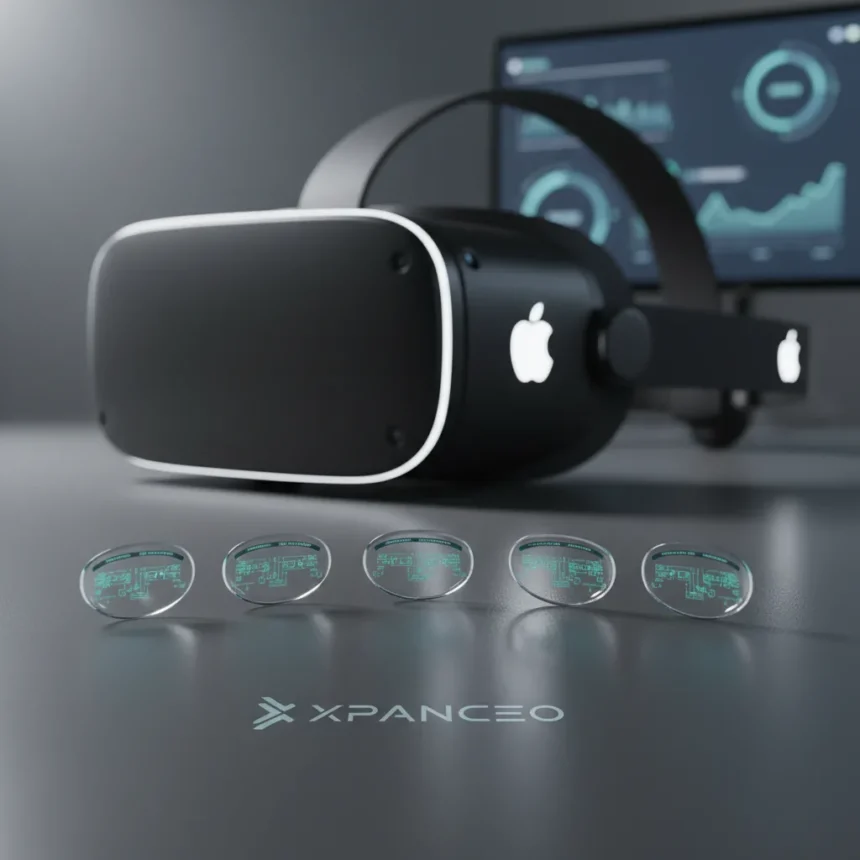
Smart contact lenses from Xpanceo, a Dubai-based deep tech company founded in 2021, represent a radical departure from the bulky headsets and glasses dominating AR today. The startup demonstrated five fully working prototypes at MWC 2026 in Barcelona, each solving a different piece of the puzzle: AR visuals, health tracking, glucose monitoring, holographic display, and interactive AR with spatial tagging. These are not concept sketches or marketing renders—they are functional hardware with micro-displays, biosensors, antennas, onboard batteries, and wireless power transfer, shown publicly at UnitedXR Europe in Brussels on December 17, 2025.
Key Takeaways
- Xpanceo raised $250 million in Series A funding at a $1.35 billion valuation in July 2025, rejecting acquisition offers from major tech firms.
- Five working prototypes demonstrated at MWC 2026 include AR, health monitoring, glucose sensing, holographic display, and interactive AR with micro-OLED.
- Lenses are as thin as traditional contacts, using 2D materials and flexible transparent electronics only nanometers thick to avoid bulkiness.
- Feature-complete prototype targeted for end of 2026; consumer hardware potentially available by 2027 pending regulatory approval.
- Smart contact lenses enable continuous health monitoring, full field of view via eye tracking, and context-aware AR without frames or screen time.
Why Smart Contact Lenses Beat Bulky Headsets
The core advantage of smart contact lenses is architectural simplicity. Unlike Apple Vision Pro—which costs roughly ten times more and delivers only 2-3 hours of battery life—contact lenses sit directly on the eye, drastically reducing power consumption to microwatts. No frame, no weight, no screen time guilt. The lenses achieve full field of view by following eye movements, enabling seamless AR that responds to where you actually look, not where a fixed display points. Xpanceo’s approach eliminates the transitional form factor of smart glasses entirely, restoring natural eye contact and peripheral vision while delivering immersive AR.
The company uses 2D materials and flexible transparent electronics only a few nanometers thick to avoid the bulkiness of traditional optoelectronics. This engineering choice is the difference between a product people wear and a product people tolerate. Competitors like Meta Ray-Ban and Xreal have made smart glasses genuinely useful, but they remain glasses—visible, heavy, and dependent on external batteries. Xpanceo’s lenses are invisible to observers and require no charging infrastructure beyond wireless power transfer.
Five Technologies Solving the Full AR Problem
Xpanceo is not building a single product; it is building a platform. The five prototypes revealed at MWC 2026 represent four distinct technological approaches bundled into one roadmap. Holographic lenses deliver mixed reality via platform holograms. Biosensing lenses measure glucose and other health metrics directly from tear fluid using electrochemical sensors. Nanoparticle-infused lenses enable low-light vision and zoom capabilities—what the company calls superpowers. Transparent electronics lenses include a 1-pixel screen for content delivery and AR overlays. The vision is an all-in-one lens that combines all four capabilities into a cognitive layer that merges digital screens directly with human vision.


This modular approach differs sharply from how Apple or Meta approach AR. Rather than forcing one form factor (headset or glasses) to solve every problem, Xpanceo is demonstrating that contact lenses can be specialized, then integrated. Glucose monitoring via tear fluid is a medical-grade capability that smart glasses cannot deliver. Night vision and zoom are superpowers that require nanoparticle chemistry. Holographic display requires a different optical stack than AR overlays. By solving each problem independently, then layering solutions, Xpanceo is positioning itself as the infrastructure play—the invisible interface that works everywhere.
The Funding and Timeline Question
Xpanceo raised $250 million in Series A funding in July 2025 at a $1.35 billion valuation, rejecting acquisition offers from major tech firms. This capital injection signals confidence from serious investors that the technology roadmap is credible. The company aims for a feature-complete lens prototype by the end of 2026, a public reveal at a major conference in early 2027, and potential final regulatory testing starting in 2026. Consumer hardware could arrive by 2027, though regulatory approval for medical-grade biosensors adds complexity.



The timeline is aggressive but not implausible. Xpanceo has already demonstrated working prototypes with integrated components—a milestone that separated them from competitors like Mojo Vision, which faced roadblocks and eventually shut down. Apple, Meta, and Google have not shown public working prototypes of smart contact lenses, despite investing heavily in the space. For a startup founded in 2021 to be demonstrating five functional versions while tech giants remain in stealth mode suggests either Xpanceo has cracked a problem others are still wrestling with, or the public timelines from those giants are conservative. Either way, Xpanceo is moving faster in public.
What Happens After 2027?
The company envisions lenses pairing with external devices for power and content in extreme sports or space applications, exploring partnerships with space agencies. This is not marketing fantasy—it is a realistic use case. An astronaut wearing smart contact lenses with heads-up displays, health monitoring, and night vision has immediate operational value. A mountain climber with glucose monitoring and zoom lenses has a genuine safety advantage. The lenses are not designed for everyday consumer use alone; they are designed for professional, medical, and extreme-environment applications first, then consumer adoption follows.
The regulatory path for medical-grade biosensors is the real bottleneck. A contact lens that measures glucose or intraocular pressure is a medical device in most jurisdictions. That means clinical trials, FDA approval (or equivalent in other regions), and years of safety documentation. Xpanceo’s founders Roman Axelrod and Dr. Valentyn Volkov understand this—they are building the hardware and the regulatory strategy in parallel. The 2027 timeline assumes regulatory approvals move faster than historical precedent, which is possible if early data is compelling but not guaranteed.
Does This Kill Smart Glasses?
Not immediately. Smart glasses like Meta Ray-Ban are shipping today and solving real problems for real users. Smart contact lenses are still prototypes, and they will remain prototypes for at least another year. The market will have room for both form factors during the transition. Glasses are better for outdoor use, longer battery life, and external sensors. Lenses are better for invisibility, health monitoring, and full field of view. Over time, as lens technology matures and battery life extends, lenses will likely absorb the use cases where invisibility and continuous monitoring matter most. But that transition is five to ten years away, not imminent.



The real threat is not to smart glasses but to smart headsets like Apple Vision Pro. A $3,500 device with 2-3 hour battery life and a visible form factor makes less sense when a contact lens can deliver superior AR with invisible hardware and all-day battery via wireless power. Vision Pro was designed for a world where AR required a screen-based interface. Xpanceo is betting on a world where AR is so seamless it does not require a screen at all.
Is Xpanceo’s Timeline Realistic?
The company has demonstrated working prototypes with integrated components, which is further along than competitors. However, feature-complete does not mean consumer-ready. Development on all basic components was largely complete as of late 2025, but work remains on neuro interfaces, AR elements, and improving biosensors. Regulatory approval for medical-grade biosensors could delay consumer launch beyond 2027. The timeline is ambitious but not impossible—it depends on whether the remaining engineering challenges are integration problems (hard but solvable) or fundamental physics problems (much harder).
How do smart contact lenses compare to smart glasses?
Smart contact lenses are invisible, weightless, and enable continuous health monitoring via tear fluid biosensing. Smart glasses like Meta Ray-Ban are visible, heavier, and better for outdoor use and external sensors. Lenses follow eye movements for full field of view AR; glasses deliver AR via fixed displays. Both are viable, but lenses eliminate the social friction of wearing visible frames.
When will Xpanceo smart contact lenses launch?
Xpanceo targets a feature-complete prototype by end of 2026, a public reveal in early 2027, and potential consumer hardware by 2027 pending regulatory approval. Medical-grade biosensor certification could delay launch, and no final launch date has been confirmed.
How much will smart contact lenses cost?
Xpanceo has not shared pricing. Regulatory complexity for medical-grade biosensors will influence final cost, and early versions may be more expensive than smart glasses.
Xpanceo’s smart contact lenses represent the clearest path to invisible, weightless AR we have seen from any company—startup or giant. Five working prototypes, $250 million in funding, and a credible regulatory strategy suggest the company is serious about delivering consumer hardware by 2027. Whether that timeline holds depends on engineering challenges that remain unsolved, but the company has already proven it can move faster than Apple, Meta, or Google in public. That alone makes Xpanceo worth watching.
Edited by the All Things Geek team.
Source: Tom's Guide