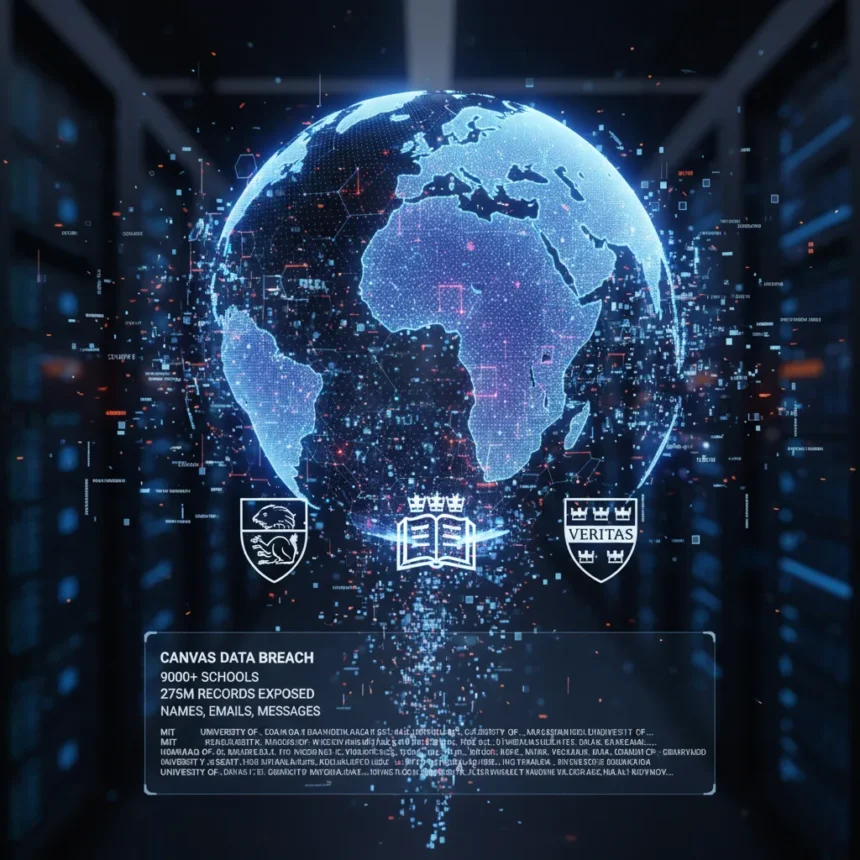
The Canvas data breach represents one of the largest education sector cyberattacks in recent history, with the ShinyHunters extortion gang claiming responsibility for breaching Instructure, the company behind Canvas, the learning management system used by 41% of North American higher education institutions. The hackers allege they stole data from nearly 9,000 schools, universities, colleges, school districts, and online education platforms across Europe, North America, and Asia-Pacific, exposing approximately 275 million records belonging to students, teachers, and staff.
Key Takeaways
- ShinyHunters claims the Canvas data breach affected nearly 9,000 institutions globally with 275 million records stolen.
- Exposed data includes names, email addresses, student ID numbers, and billions of private messages between students and teachers.
- Elite universities including MIT, Oxford, Harvard, and Stanford have been publicly named as victims.
- Instructure confirmed the cyberattack and stated the incident has been contained with the vulnerability patched.
- Canvas is used by 41% of North American higher education institutions, making it the nation’s most popular learning management system.
Instructure disclosed the Canvas data breach after the ShinyHunters gang publicly released a list naming 8,809 affected institutions. The company confirmed that a criminal threat actor gained unauthorized access to user data, with an outside forensics team investigating the incident. According to Instructure’s statement, the breach exposed users’ names, email addresses, student ID numbers, and user communications, though the company believes the incident has been contained and the vulnerability has been patched.
Which Universities Were Hit in the Canvas Data Breach
The Canvas data breach named four of the world’s most prestigious universities as direct victims: MIT, Oxford University, Harvard University, and Stanford University. The public disclosure of these elite institutions signals a shift in ShinyHunters’ tactics—previous breaches by the group targeted companies like Salesforce and Infinite Campus, but naming recognizable universities amplifies pressure on Instructure and raises the profile of the incident. Beyond these four flagships, the hackers claim access to records from nearly 9,000 educational institutions, though independent verification of the full victim list remains incomplete.
Universities across the English-speaking world confirmed exposure. The University of Colorado Boulder acknowledged the nationwide breach affecting multiple Canvas-using institutions. Rutgers University stated it had not been directly impacted, though Canvas remained operational for its users. In New Zealand, Victoria University of Wellington confirmed that hackers accessed the Canvas third-party software but did not compromise the institution’s independent internal systems, according to vice-chancellor Nic Smith.


What Data Was Stolen in the Canvas Data Breach
The Canvas data breach exposed personally identifiable information spanning names, email addresses, and student ID numbers, but the most sensitive exposure involves billions of private messages exchanged between students and teachers. These communications represent a serious privacy violation beyond typical PII breaches—they contain personal conversations, academic discussions, and potentially sensitive subject matter shared within the supposedly secure Canvas environment. The ShinyHunters gang claims to have accessed several billion private messages, though Instructure has not independently confirmed the exact volume.
The scale of the Canvas data breach dwarfs many recent education sector incidents. For context, the Vice Society ransomware attack on the Los Angeles Unified School District in 2022 compromised data on 600,000 students across 1,000+ schools, making it one of the largest K-12 breaches on record. The Canvas breach’s claimed 275 million records and billions of messages represent an order of magnitude larger exposure, affecting both K-12 and higher education globally.



Why the Canvas Data Breach Matters Now
The timing of the Canvas data breach public disclosure escalates pressure on Instructure at a moment when education technology has become a high-priority target for cybercriminals. ShinyHunters previously breached Infinite Campus, a K-12 student information system, and McGraw Hill, signaling a coordinated focus on edtech vendors that hold centralized access to millions of student records. Canvas’s dominance—serving 41% of North American higher education—makes it an especially valuable target for extortion campaigns.
The breach also exposes a critical vulnerability in third-party integration architecture. Many universities rely on Canvas to connect with other systems and services, and the attackers exploited this interconnected ecosystem to gain access across multiple institutions simultaneously. University of Colorado Boulder’s statement emphasized that the breach was a nationwide event affecting multiple institutions, highlighting how a single compromised vendor can cascade risk across an entire sector. Security experts recommend stronger access governance for third-party integrations, particularly in education where student privacy is both legally protected and ethically paramount.
What Instructure Said About the Canvas Data Breach
Instructure confirmed the Canvas data breach and stated that an outside forensics team is investigating the incident alongside internal teams. The company’s official position is that the incident has been contained and the underlying vulnerability has been patched, though the investigation continues. Instructure did not dispute the ShinyHunters claim that nearly 9,000 institutions were affected, nor did it provide its own independent victim count. The company’s measured response contrasts with the hackers’ public pressure campaign, which included releasing the full list of affected institutions and threatening further data publication if ransom demands were not met.
Is my university affected by the Canvas data breach?
If your institution uses Canvas as its learning management system, it is likely affected by the Canvas data breach. The ShinyHunters gang published a list of 8,809 affected institutions with per-institution record counts, though BleepingComputer and other security outlets have not independently verified every entry. Check your university’s official communications or contact your IT department directly—many institutions have published breach notification statements on their websites or sent emails to students and staff.



What should I do if my data was exposed in the Canvas data breach?
If you are a student or staff member at an affected institution, monitor your email and financial accounts for suspicious activity. The Canvas data breach exposed email addresses, names, and student ID numbers, which are commonly used in phishing and identity theft campaigns. Consider enabling two-factor authentication on your email and other online accounts, and watch for unsolicited contact claiming to be from your university or financial institutions. Do not click links in unexpected emails—contact your institution’s IT support directly if you have concerns.
Will there be a lawsuit over the Canvas data breach?
Multiple affected universities and students may pursue legal action against Instructure for failing to secure sensitive educational data. The Canvas data breach involves millions of minors and adults whose personal information and private communications were exposed, creating potential liability under data protection regulations like FERPA (Family Educational Rights and Privacy Act) in the United States and GDPR in Europe. However, no class action lawsuits have been announced as of publication, and the legal landscape will depend on how quickly Instructure can demonstrate the incident was contained and whether any additional data exposure occurs.
The Canvas data breach represents a watershed moment for education technology security. It demonstrates that even vendors serving the nation’s most elite universities are vulnerable to sophisticated extortion campaigns, and it underscores the need for stronger security standards across the edtech supply chain. For students and educators, the breach is a stark reminder that learning management systems hold some of the most sensitive data in the digital ecosystem—and that protecting it requires more than patching vulnerabilities after attackers have already broken in.
Edited by the All Things Geek team.
Source: TechRadar