





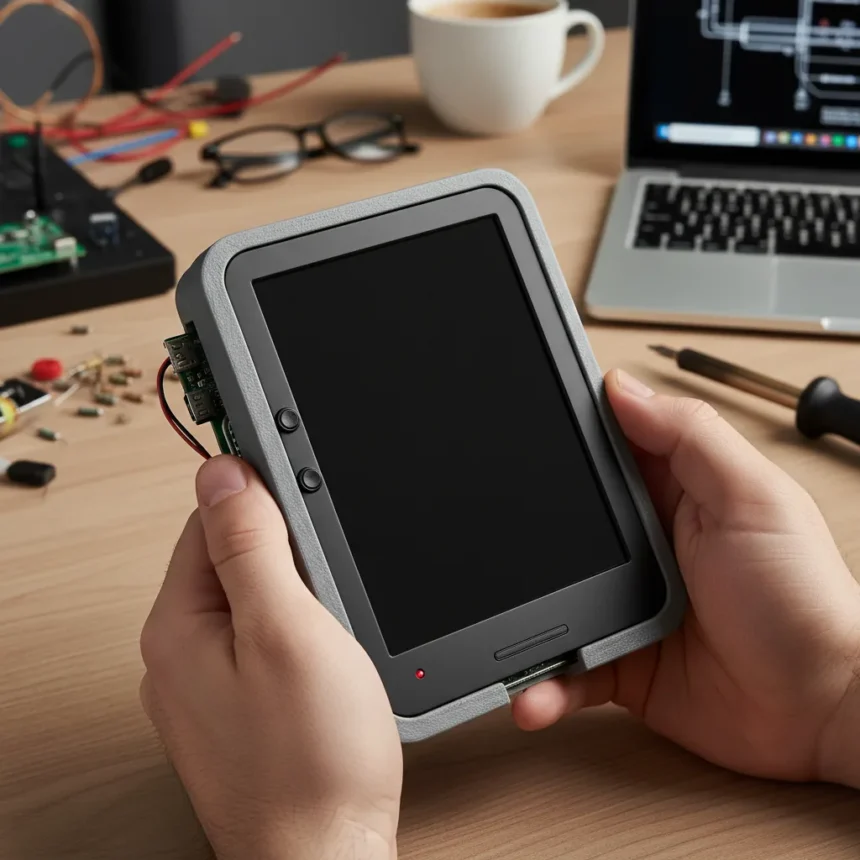
A DIY pocket e-reader built by Paul Lagier proves you do not need to spend hundreds on a commercial device to read distraction-free in your palm. Using an all-in-one E Ink display module, Lagier assembled a functional reader that costs roughly $30 in parts, with firmware and 3D design files available for about $5 on his Ko-fi page.
Key Takeaways
- DIY pocket e-reader costs approximately $30 in components plus $5 for design files and firmware
- 1,500 mAh battery lasts about two weeks per charge thanks to E Ink’s low-power design
- 3D-printed enclosure snaps together with no visible screws and single USB-C port
- Wi-Fi hotspot file transfer eliminates need for cables; supports standard text files converted from DRM-free EPUBs
- Integrated E Ink module simplifies assembly compared to discrete component designs
Why This DIY Pocket E-Reader Matters Right Now
Paul Lagier built this DIY pocket e-reader because he wanted to reclaim time spent on gaming with something more meaningful: reading. The result is a stripped-down device that does one thing well—display text without notifications, infinite scroll, or battery anxiety. Commercial pocket readers exist, but they carry premium pricing and locked-down ecosystems. This open-source approach proves you can build a capable alternative at a fraction of the cost, making it accessible to hobbyists and minimalists who value simplicity over polish.
The core innovation is the integrated E Ink module, which combines the display, microcontroller, and charging circuitry into a single component. This dramatically reduces wiring complexity and shrinks the overall footprint compared to designs using separate parts. For builders, that means fewer potential failure points and faster assembly.
How to Build Your DIY Pocket E-Reader
Assembly is straightforward: components snap and screw into place within a 3D-printed enclosure designed with a clean aesthetic and no visible fasteners. The single USB-C port handles both charging and data transfer. The 1,500 mAh battery provides roughly two weeks of reading time per charge, thanks to E Ink’s inherent low-power consumption and the firmware’s deep-sleep modes.



Software setup requires converting DRM-free EPUBs to standard text files using Calibre, then uploading them via Wi-Fi. The device creates a hotspot that your phone or PC can connect to through a browser, eliminating the need for cables or proprietary software. Once loaded, the firmware presents a simple library view and reading mode with automatic progress saving.
The 3D design files and firmware source code are available on Lagier’s Ko-fi page for approximately $5, making the total build cost around $30 for parts plus the files.


How DIY Pocket E-Reader Compares to Commercial Alternatives
The Xteink X4 is the closest commercial competitor, featuring a 4.3-inch E Ink display with 200ppi resolution, a 650mAh battery lasting over a week, and physical buttons for navigation. It costs between $40 and $70 depending on the retailer, with the official site pricing at $69. The Xteink uses an ESP32 microcontroller, allowing firmware customization similar to Lagier’s design, but its larger screen and longer battery life come at the cost of portability and price.
The Kobo Mini offers a 5-inch touchscreen and up to one month of battery life, making it the lightest and smallest full-featured commercial reader available. However, it lacks the open-source appeal and extreme affordability of the DIY build. Other options like the Boox Palma 2 and Hisense models provide pocket-sized form factors but at significantly higher cost and with closed ecosystems.
For readers who prioritize cost and customization over polish and ecosystem integration, the DIY pocket e-reader is genuinely compelling. You are not paying for brand markup, marketing, or features you do not use. You are buying the ability to build, modify, and own your reading device outright.
What Makes This Project Accessible to Beginners
The integrated E Ink module is the breakthrough that makes this project accessible. Previous DIY e-reader projects required soldering multiple components, writing complex firmware from scratch, and troubleshooting wireless connectivity. Lagier’s design abstracts away most of that complexity by using a pre-assembled module that handles the hard electrical work.



Assembly requires basic tools—a 3D printer to produce the enclosure, a screwdriver, and patience. No soldering iron needed. The firmware is pre-written and available; you are not expected to code from the ground up. File transfer happens over Wi-Fi, so you do not need to understand USB protocols or command-line interfaces. This democratizes e-reader building in a way previous projects could not achieve.
Is the DIY pocket e-reader worth building instead of buying?
If you value cost and open-source control, absolutely. The $30 price point is unbeatable, and you own the design completely. If you need a device immediately or prefer commercial support and warranty coverage, a commercial reader like the Xteink X4 or Kobo Mini makes more sense.
Can you modify the firmware after building your DIY pocket e-reader?
Yes. The firmware is open-source and available via Ko-fi, so you can customize it to your needs. However, modifying firmware requires some coding knowledge and familiarity with embedded systems. The default version is functional and feature-complete for reading, so modifications are optional.
How does battery life compare between the DIY build and commercial pocket readers?
Lagier’s DIY pocket e-reader delivers approximately two weeks per charge thanks to the 1,500 mAh battery and E Ink’s low-power nature. The Kobo Mini lasts up to one month, while the Xteink X4 lasts over a week with its 650mAh battery. The DIY build falls in the middle, which is respectable for its price and size.
The DIY pocket e-reader proves that commercial gadgets often charge premium prices for features and polish you may not need. For readers who want distraction-free, affordable, and customizable hardware, building your own is now genuinely practical.
Where to Buy
from Amazon | Amazon Kindle Paperwhite 12th Gen 2024
Edited by the All Things Geek team.
Source: TechRadar