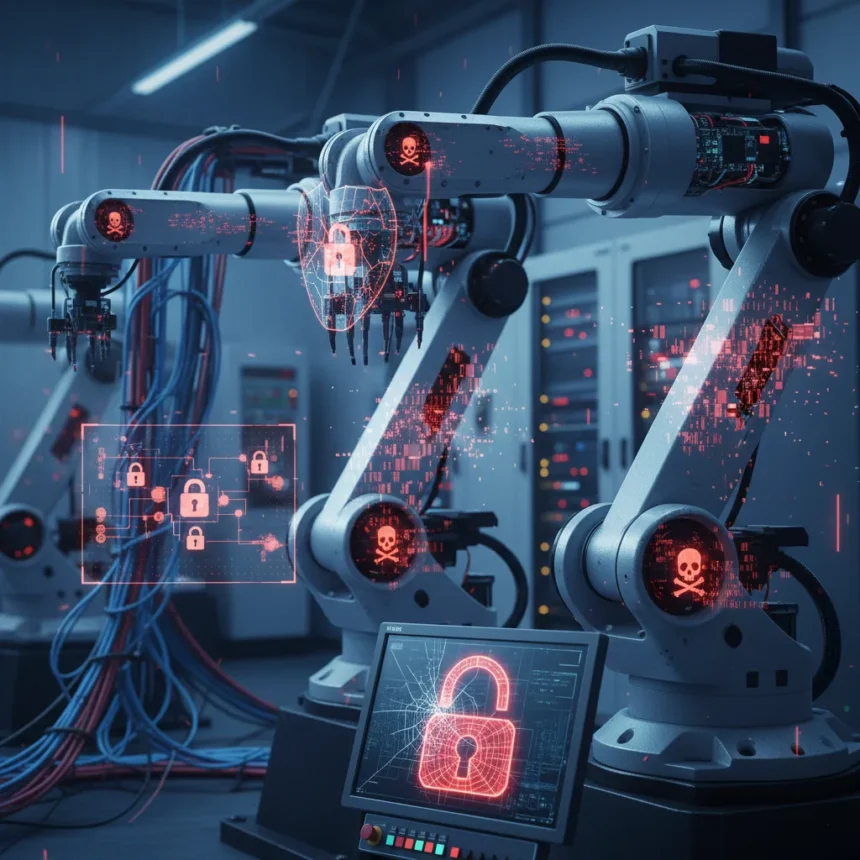
Industrial robots malware security has become a critical concern as factories connect robotic systems to networked environments without proper safeguards. A newly identified vulnerability in Universal Robots equipment demonstrates that attackers can remotely execute commands on industrial robots, potentially compromising entire factory networks. This is not a theoretical risk—it is a live threat that manufacturers must address immediately.
Key Takeaways
- Industrial robots can be remotely compromised when connected to insecure networks.
- Attackers can execute arbitrary commands on vulnerable robots, altering control parameters and calibration.
- Cyberattacks on factory robots can disrupt production, damage equipment, and endanger workers.
- Network segmentation and endpoint protection are essential defenses for robotics systems.
- Universal Robots explicitly warns that unsecured network connections introduce both security and safety risks.
How Malware Reaches Factory Robots
The vulnerability affecting Universal Robots reveals a straightforward attack vector: a robot connected to a network that lacks proper security controls becomes an entry point for attackers. Once inside, malicious actors can issue commands that alter how the robot operates, compromise calibration settings, or change the robot’s operational state entirely. This transforms a single machine into a potential gateway into the broader industrial control environment.
Unlike consumer devices, industrial robots operate in environments where downtime costs thousands of dollars per minute and safety failures can injure workers. A hacked robot is not just a data breach—it is an operational and physical safety emergency. The risk extends beyond the robot itself: attackers who gain access to one networked device can use it as a stepping stone to reach production control systems, inventory management platforms, and other critical factory infrastructure.
Why Network Security Is the Real Battleground
Universal Robots has been explicit about this risk: the security of the network is essential to the security of the robot. This means that even a perfectly designed robot becomes vulnerable the moment it connects to an unsecured or poorly managed network. Factory managers often treat network security as an IT concern separate from operational technology, but that boundary no longer exists.


Industrial environments traditionally relied on air-gapped systems—machines isolated from external networks. Modern factories have abandoned that model in pursuit of efficiency and real-time monitoring. Connected robots feed data to cloud platforms, receive firmware updates over the internet, and integrate with enterprise systems. Each connection is a potential attack surface. Without proper segmentation, encryption, and access controls, a vulnerability in one device cascades into compromise of the entire operation.
What Happens When Attackers Gain Control
The consequences of a successful attack on industrial robots are severe and concrete. Cyberattacks targeting factory control systems can disrupt production schedules, cause equipment damage, and create immediate safety hazards for workers on the floor. A robot executing unauthorized commands could move in unexpected ways, strike personnel, or damage products in progress. The financial impact is compounded by the time required to restore systems, verify safety, and resume operations.



Beyond immediate operational damage, compromised robots can serve as reconnaissance tools. Attackers who gain access can map the factory network, identify other vulnerable devices, and plan larger-scale attacks against critical systems. The robot becomes a beachhead for deeper infiltration into manufacturing infrastructure.
Protecting Robots Without Sacrificing Connectivity
Manufacturers do not need to abandon networked robots to stay safe—they need to implement proper security controls. Universal Robots and industry experts emphasize that network segmentation, endpoint protection, regular patching, and strong access controls are non-negotiable. Robots should operate on isolated network segments separate from general IT infrastructure, with strict rules governing which devices can communicate with which systems.
Firmware updates must be applied promptly when vendors release patches. Many factories delay updates to avoid production downtime, but unpatched systems are open invitations to attackers. Authentication mechanisms should require strong credentials and multi-factor verification for any administrative access. Monitoring tools should log and alert on unusual robot behavior—unexpected command sequences or parameter changes that deviate from normal operations.
Is This the Beginning of Industrial Cyberattacks?
The vulnerability in Universal Robots is not the first attack on factory automation, but it is a stark reminder that industrial systems are no longer isolated. As robots become more sophisticated and more networked, they become more attractive targets. The threat is not speculative—it is active and growing.



Manufacturers who treat robot security as an afterthought are gambling with production continuity and worker safety. The factories that will thrive in the next decade are those that integrate security into every networked device from the moment it arrives on the floor. This is not a one-time fix; it is an ongoing commitment to monitoring, updating, and defending connected systems against evolving threats.
What Should Factory Managers Do Right Now?
Audit your current robot deployments and identify which systems are connected to your network. If you have Universal Robots equipment, check whether patches are available and plan deployment windows that minimize production impact. Implement network segmentation so that robots operate on separate subnets from general IT systems. Require strong authentication for any robot administrative functions. Enable logging and monitoring to detect unauthorized access attempts.
Can a Factory Operate Safely With Connected Robots?
Yes, but only with proper security controls in place. Network segmentation, encryption, strong authentication, and regular patching create multiple layers of defense that make attacks significantly harder. The key is treating robot security with the same rigor that manufacturers apply to physical safety—as a non-negotiable operational requirement, not an optional add-on.
How Often Are Industrial Robots Actually Targeted by Attackers?
The research brief does not provide statistics on active exploitation rates in the wild. What is documented is that the vulnerability exists, that attackers have the capability to exploit it, and that the consequences of successful attacks are severe. Manufacturers should assume that determined adversaries will eventually attempt to target their systems and defend accordingly.
Industrial robots malware security is no longer a niche concern for security researchers—it is a mainstream manufacturing challenge. Factories that connect robots to networks without proper safeguards are not just accepting technical risk, they are accepting operational, financial, and safety consequences. The time to act is now, before an attack forces the issue.
Edited by the All Things Geek team.
Source: TechRadar