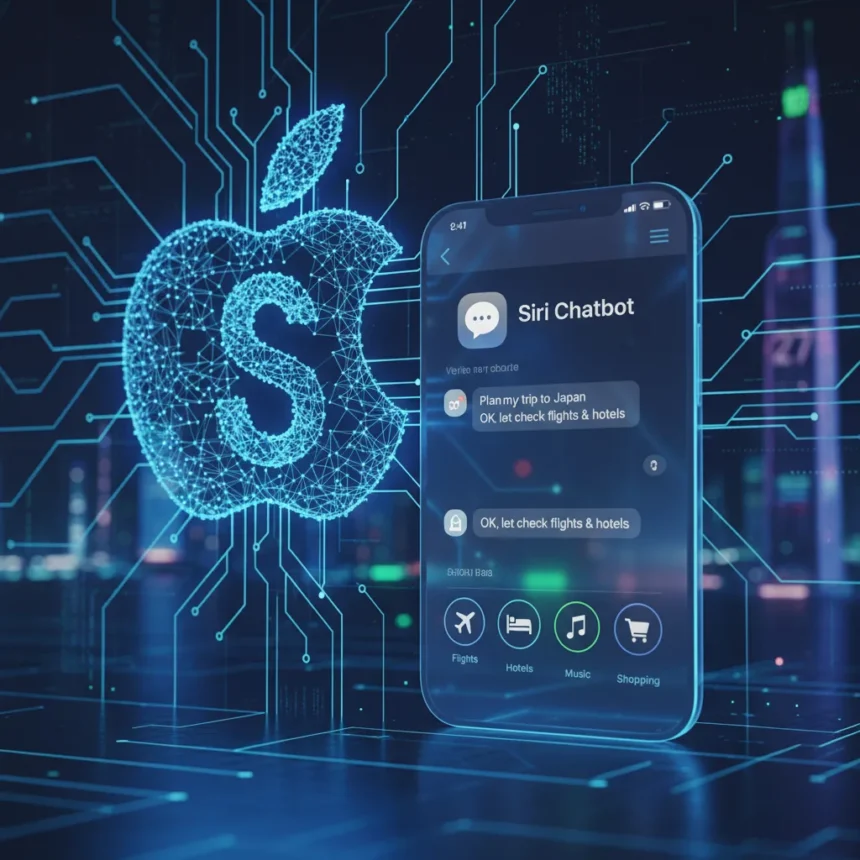
The iOS 27 Siri overhaul represents Apple’s most ambitious reimagining of its voice assistant in years, moving beyond simple command execution toward agentic artificial intelligence that can handle complex, multi-step tasks. Apple is expected to reveal the new Siri at WWDC 2026 on June 8, and early details suggest a fundamentally different architecture: a standalone chatbot application with persistent conversation history, cross-app action capabilities, and integration with third-party AI providers.
Key Takeaways
- iOS 27 Siri will launch as a standalone chatbot app with conversation memory, not just a voice command system
- Apple plans to integrate third-party AI providers alongside its own models, expanding capability beyond first-party technology
- The redesign shifts Siri from reactive command handler to proactive agentic AI that can execute multi-step workflows
- Announcement expected at WWDC 2026 in June, with rollout likely in fall 2026
- Google Gemini will serve as a foundational AI layer through Apple’s multi-year partnership
What the iOS 27 Siri Overhaul Actually Changes
Apple’s new Siri is no longer a voice-activated lookup tool. The iOS 27 Siri overhaul transforms the assistant into a conversational AI engine that remembers what you asked, what you did, and what you’re trying to accomplish across sessions. This shift from stateless commands to stateful conversation is architectural, not cosmetic. Instead of asking Siri to “play music” or “set a timer,” users will be able to reference previous requests, build on earlier decisions, and chain actions together without repeating context.
The standalone app format matters. By separating Siri from iOS’s system-level integration, Apple gains flexibility to update the assistant independently of major OS releases, iterate on the interface faster, and A/B test different conversation models without requiring a full system update. This mirrors how other AI assistants (ChatGPT, Claude, Gemini) operate as primary apps rather than secondary system features.
Third-Party AI Integration Breaks Apple’s Walled Garden
Historically, Apple has kept Siri tightly locked within its own technology stack. The iOS 27 Siri overhaul breaks that pattern by allowing third-party AI providers to power parts of the assistant’s functionality. This is a strategic admission: Apple recognizes that no single company owns the best AI model for every task. By opening Siri to external AI providers, Apple can offer users choice while maintaining control over privacy, security, and the overall user experience.


The multi-year Google partnership is the most visible example. Apple has signed a deal to use Google’s Gemini AI as a foundational layer for Siri capabilities. Rather than compete directly with Google’s AI, Apple is integrating it into its own assistant. This approach differs sharply from rivals like Samsung, which builds its own AI layers, or Microsoft, which deeply embeds OpenAI’s models. Apple’s strategy is pragmatic: leverage the best external models while keeping the user-facing experience distinctly Apple.
Why Agentic AI Matters for Siri’s Future
Agentic AI describes systems that can plan, decide, and execute tasks autonomously across multiple steps without human intervention at each stage. Traditional Siri executes single commands: “set a timer for 10 minutes.” Agentic Siri could handle “I have a meeting at 2 PM across town; remind me when to leave, book a ride, and cancel my 3 PM call.” The assistant breaks the goal into subtasks, executes them in sequence, and adapts if circumstances change.



This capability requires persistent memory, access to multiple apps and services, and the ability to reason about dependencies and timing. The iOS 27 Siri overhaul addresses all three by building conversation history into the app, enabling cross-app actions, and pairing multiple AI models to handle different reasoning tasks. The result is an assistant that feels less like a search engine and more like a capable colleague.
How iOS 27 Siri Compares to Today’s Assistant
Current Siri (in iOS 18 and earlier) is primarily a voice command interface. You ask it a question, it executes a single action or returns a result, and the conversation ends. Each new request starts fresh—Siri has no memory of what you asked five minutes ago. This design works fine for quick tasks but breaks down for complex workflows that require context or coordination across multiple apps.
The iOS 27 Siri overhaul introduces persistent conversation state, meaning the assistant knows what you’ve already discussed and can reference earlier decisions. It also enables true cross-app orchestration, where Siri can coordinate actions across Calendar, Maps, Messages, and third-party apps without you manually switching between them. These are not incremental improvements; they are foundational architectural changes that reposition Siri as a genuine AI agent rather than a voice-activated search box.
When Will iOS 27 Siri Launch?
Apple is expected to announce the iOS 27 Siri overhaul at WWDC 2026 on June 8. The company typically announces new iOS versions in June and releases them to the public in September. Based on this pattern, iOS 27 and its new Siri would likely roll out in fall 2026, initially available on newer iPhone models before potentially expanding to older devices. The exact device compatibility list will depend on hardware capabilities, particularly processing power and on-device AI acceleration.



What About Privacy and On-Device Processing?
Apple has positioned privacy as a core differentiator, and the iOS 27 Siri overhaul will need to address how it handles sensitive data while integrating third-party AI providers. The company’s approach with other AI features (like on-device image processing) suggests a hybrid model: basic tasks and conversation history stay on-device, while complex reasoning or third-party AI calls route through encrypted channels to external servers. Expect Apple to emphasize end-to-end encryption and user transparency about which AI provider is handling each request.
Is the iOS 27 Siri overhaul worth the wait?
For users frustrated with Siri’s current limitations, the shift to agentic AI and multi-turn conversation is overdue. For users satisfied with voice commands and quick lookups, the changes may feel like unnecessary complexity. The real value emerges in workflows that Siri currently cannot handle—coordinating across apps, remembering context, and executing sequences of actions without manual intervention. If Apple executes the design well, this is the Siri redesign that finally makes the assistant competitive with ChatGPT and other modern AI tools.
Will third-party AI providers slow down Siri?
Integration with external AI providers introduces network latency that on-device processing would avoid. However, Apple’s hybrid approach—keeping simple tasks local while routing complex requests to external providers—should minimize noticeable slowdowns. The tradeoff is worthwhile: slower but smarter beats fast but limited.
Can I use iOS 27 Siri on Android?
No. Siri is exclusive to Apple devices. Android users have access to Google Assistant and other third-party AI apps, but not Siri. The iOS 27 Siri overhaul is designed for iPhone, iPad, and Mac users only.
The iOS 27 Siri overhaul signals a fundamental shift in how Apple approaches AI assistance. By moving toward agentic AI, embracing third-party integrations, and building persistent conversation into the core experience, Apple is finally positioning Siri as a true AI agent rather than a voice command system. The June 2026 announcement will reveal the full scope of the redesign, but the architectural groundwork is already clear: Apple is betting that the future of assistants is conversational, cross-app, and powered by the best AI models available—not just Apple’s own.
Edited by the All Things Geek team.
Source: Tom's Guide