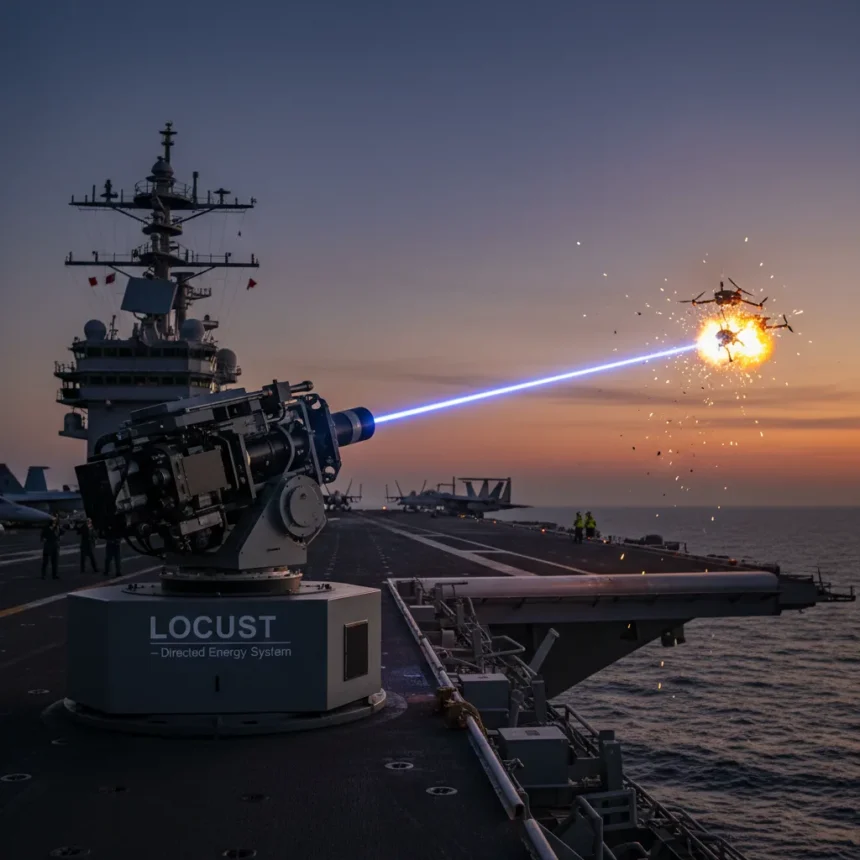
The LOCUST laser weapon system, developed by AeroVironment, successfully detected, tracked, and neutralized multiple target drones during live-fire tests aboard the USS George H.W. Bush supercarrier on October 5, 2025, in the Atlantic Ocean. This marks the first known instance of a laser weapon fitted to a U.S. supercarrier and represents a major shift in how the Navy plans to defend against cheap, abundant drone threats.
Key Takeaways
- LOCUST laser weapon system destroyed multiple drones during October 2025 tests on USS George H.W. Bush supercarrier
- Cost per shot runs under $5, compared to million-dollar missiles currently used for drone defense
- System integrates with existing Navy command networks and requires no permanent ship modifications
- AI-powered tracking enables automated target switching across multiple simultaneous threats
- Upgraded version unveiled in March 2026 scales power from 20kW to over 35kW
How the LOCUST Laser Weapon System Works at Sea
The LOCUST laser weapon system is a palletized, high-energy laser designed to fit onto existing naval platforms without requiring costly ship modifications. Installed on the forward weapons pedestal of the USS George H.W. Bush—the same location previously occupied by a Phalanx CIWS (Close-In Weapon System)—the system operates from a containerized, roll-on roll-off design that can be rapidly deployed across the Fleet. Power comes from either rechargeable batteries or the ship’s electrical grid, delivering what amounts to essentially unlimited shots limited only by available power.
The system’s AI-powered tracking automatically detects and engages targets without requiring constant manual intervention. During the October test, the LOCUST laser weapon system successfully engaged Group 1-3 unmanned aerial vehicles, including Shahed-type drones, while the carrier maneuvered at sea—a crucial validation that the weapon works in real-world conditions, not just in controlled environments. John Garrity, Vice President of Directed Energy Systems at AeroVironment, stated that rolling LOCUST onto a ship and initiating operations quickly facilitates expanded use of high-energy lasers across the Fleet without costly modifications.
Why the Navy Needs Laser Weapons Against Drones
The U.S. Navy faces a mounting problem: cheap, expendable drones are becoming the weapon of choice for adversaries in the Middle East and beyond. Iranian-backed attacks using Shahed drones have demonstrated that traditional air defense systems—particularly expensive guided missiles costing millions per shot—are economically unsustainable when defending against swarms of inexpensive unmanned aircraft. The LOCUST laser weapon system addresses this asymmetry directly. At under $5 per shot, it allows the Navy to engage drone threats without depleting expensive munitions inventories.


Previous Navy laser systems like HELIOS and ODIN proved the concept but lacked mobility and easy integration into existing platforms. The LOCUST laser weapon system solves that problem through its platform-agnostic design. Before the supercarrier test, AeroVironment demonstrated the system on fixed sites and ground vehicles including the Joint Light Tactical Vehicle (JLTV) and Infantry Squad Vehicle (ISV). The October test aboard USS George H.W. Bush proves the technology works on the Navy’s most valuable assets—supercarriers that must defend themselves against coordinated drone attacks.
What Makes LOCUST Different From Previous Laser Weapons
The LOCUST laser weapon system integrates AI-powered automated targeting with open interfaces designed for cross-service use, meaning Army and Navy units can operate the same equipment without extensive retraining. Unlike earlier directed energy weapons that required permanent installation and extensive ship modifications, LOCUST deploys in a containerized format that takes hours, not months, to integrate. The system also features precision aim-point and beam control, allowing operators to engage specific components of target drones rather than relying on brute-force energy output.



The collaboration between the U.S. Navy and U.S. Army Rapid Capabilities and Critical Technologies Office (RCCTO) under the Army Multi-Purpose High Energy Laser (AMP-HEL) program ensures the weapon meets requirements across multiple service branches. An upgraded version unveiled in March 2026 scales the laser power from the current 20kW-class system to over 35kW, demonstrating AeroVironment’s roadmap for increased capability without requiring new platforms.
What the Test Results Actually Mean for Fleet Defense
The October 2025 test proved that a laser weapon can track, engage, and destroy multiple drones while mounted on a moving supercarrier in open ocean conditions. This is not a laboratory demonstration—it is a validation that directed energy weapons are operationally ready for the most demanding naval environment. The Navy’s decision to install LOCUST on the USS George H.W. Bush, rather than a test vessel, signals confidence in the system’s reliability and readiness for immediate fleet deployment.
However, the test does not mean laser weapons will replace traditional air defense systems overnight. Weather, atmospheric conditions, and the need for multiple layers of defense mean the Navy will likely integrate LOCUST alongside existing Phalanx systems and guided missile defenses. The real value lies in the cost-per-engagement metric: defending a supercarrier against a coordinated drone swarm using $5 laser shots instead of million-dollar missiles fundamentally changes the economics of naval air defense.
When Will LOCUST Reach the Fleet?
The LOCUST laser weapon system is ready for mass production, though no specific dates have been announced for widespread deployment across U.S. Navy platforms. The palletized design means installation can happen on any ship with available deck space and power capacity, making rapid fleet-wide adoption feasible once production ramps up. The March 2026 upgrade announcement suggests AeroVironment is already working on next-generation variants, indicating the company sees strong demand from the military.



Can laser weapons actually destroy drones reliably?
Yes, the October 2025 test aboard USS George H.W. Bush demonstrated that the LOCUST laser weapon system successfully tracked, engaged, and neutralized multiple target drones in real-world sea conditions. The system’s AI-powered targeting and precision beam control allow reliable engagement across varying atmospheric and weather conditions typical of naval operations.
How much does it cost to shoot down a drone with LOCUST?
Each shot costs less than $5 in electrical power and consumables, making laser-based air defense dramatically cheaper than traditional guided missiles that cost millions per unit. This cost advantage becomes critical when defending against drone swarms, where multiple shots may be needed to neutralize multiple targets.
What drones did the Navy test LOCUST against?
The October 2025 test included Group 1-3 unmanned aerial vehicles, specifically including Shahed-type drones, which are the same Iranian-backed systems used in attacks across the Middle East. Testing against Shahed drones validates the system’s ability to defeat the actual threats the Navy faces operationally.
The LOCUST laser weapon system represents a genuine shift in naval air defense strategy. By proving that directed energy weapons can operate reliably on a supercarrier without permanent modifications, the Navy has cleared the path for rapid fleet-wide adoption. For a military facing budget constraints and increasingly affordable drone threats, a weapon that costs $5 per shot instead of millions per missile is not just an incremental improvement—it is a fundamental change in how surface warfare will be conducted.
Edited by the All Things Geek team.
Source: Tom's Hardware