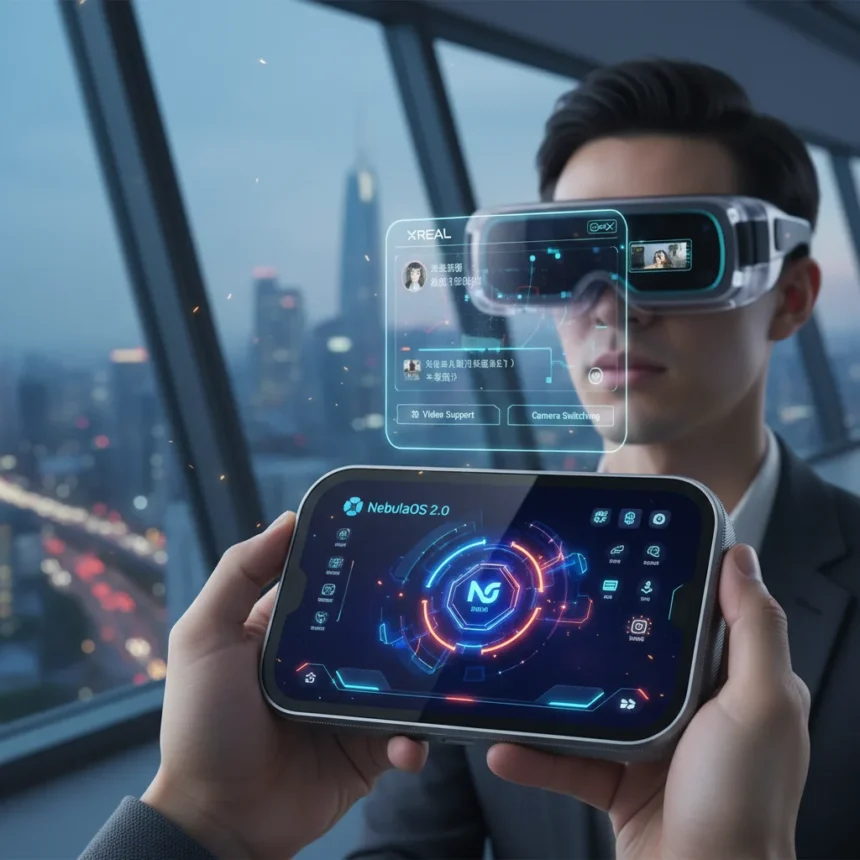
NebulaOS 2.0 Beam Pro is the most significant software patch Xreal has released for its spatial computing device, currently available in beta and expected to roll out publicly soon. This update does far more than tweak the existing interface—it repositions the Beam Pro as a stepping stone toward Android XR, with a redesigned Nebula interface, 3D video support, and features that hint at Xreal’s larger ecosystem ambitions.
Key Takeaways
- NebulaOS 2.0 is the largest Beam Pro patch to date, now in beta with public release imminent
- Redesigned Nebula interface includes tappable clock theme switching and swipe-down quick access to Wi-Fi, Bluetooth, and settings
- New 3D mode enables side-by-side 3D video playback for compatible content
- Xreal Eye camera integration allows apps like Zoom to use the glasses’ camera instead of Beam Pro’s built-in sensor
- AI 2D-to-3D conversion feature expected around late March 2026
What NebulaOS 2.0 Beam Pro Actually Changes
The update overhauls the Nebula interface with a tappable clock that cycles through themes, eliminating the need to dig into settings for visual tweaks. Quick access controls arrive via swipe-down or tap, exposing Wi-Fi, Bluetooth, settings, color temperature adjustment, and app content scaling without navigating menus. These aren’t flashy additions—they’re quality-of-life improvements that make daily use less friction-heavy. For a spatial computing device that still feels like early-stage hardware, reducing menu navigation is practical.
The standout feature is 3D mode for side-by-side 3D video playback. This is native 3D support, not AI-powered 2D-to-3D conversion, which means it works with pre-recorded 3D content. That limitation matters: the AI conversion tool—which would let users watch any 2D video in pseudo-3D—isn’t here yet and won’t arrive until around late March 2026. For now, NebulaOS 2.0 Beam Pro users get true 3D but only for content shot or edited in 3D format.
Camera Switching and Translation: Ecosystem Moves
NebulaOS 2.0 Beam Pro now lets the device switch to the Xreal Eye camera when connected, meaning apps like Zoom calls can use the glasses’ camera instead of the Beam Pro’s built-in sensor. This is a small but telling shift—it acknowledges that Xreal’s glasses are becoming the primary interface, with the Beam Pro serving as a compute and display bridge. The move positions the ecosystem as modular rather than siloed.


Translation support ties into ChatGPT, enabling real-time language translation within the spatial interface. This feature suggests Xreal is thinking about the Beam Pro as a tool for global communication, not just local content consumption. Combined with the camera switching, these additions hint at Android XR’s potential: a spatial OS that treats glasses, compute modules, and AI services as interconnected parts of a single experience.
Beta Status and the Compatibility Question
Beta software carries risk. As one creator noted, “It is a beta software, so it may not work perfectly, but so far a lot of people have had good things to say about it”. Users who opt into the beta should expect occasional glitches, and Xreal recommends waiting for the stable release unless you’re comfortable troubleshooting. The fact that the beta has received positive feedback is encouraging, but beta praise doesn’t guarantee smooth public rollout.



Compatibility extends beyond the Beam Pro. NebulaOS 2.0 Beam Pro works with Xreal Eye and Xreal One glasses, and the original Beam device has received updates to support other glasses as well. This modularity—allowing different glasses to pair with the Beam Pro—is a competitive advantage. It means users aren’t locked into a single hardware combo, unlike some spatial computing competitors that bundle glasses and compute devices tightly.
How to Update When It Launches
Firmware updates for the Xreal ecosystem can be applied via PC, Android, or the original Beam device. For PC updates, connect your glasses via USB-C to a computer with DisplayPort support, then use Xreal’s update tool to flash the MCU firmware first, followed by DP firmware. Android users can update through the Xreal Nebula app on their phone or Beam Pro. The original Beam device also supports automatic updates when glasses are connected, with a firmware restore option in settings.
When NebulaOS 2.0 Beam Pro launches publicly, these same update mechanisms will apply. Xreal recommends checking the Xreal Support website for the latest stable firmware versions. Free updates are standard; Xreal doesn’t charge for OS or firmware patches.
Where This Fits in Xreal’s Android XR Strategy
NebulaOS 2.0 Beam Pro reads as a preview of Android XR, Google’s spatial computing operating system expected to debut on consumer hardware in the coming years. The interface redesign, 3D support, and ecosystem modularity align with what Android XR is supposed to deliver: a spatial OS that works across multiple manufacturers’ glasses and compute modules. Xreal is essentially showing that its current hardware can evolve toward that vision without requiring a complete redesign.



Compared to the original Beam Pro, this update is transformative. The original device launched as a capable but somewhat rigid spatial display. NebulaOS 2.0 Beam Pro adds flexibility—theme switching, 3D playback, camera swapping—that makes the device feel less like a fixed appliance and more like a platform. That distinction matters for long-term appeal.
Is NebulaOS 2.0 Beam Pro worth updating to?
Yes, as soon as the stable version launches. The interface improvements alone justify the update, and 3D video support opens new content possibilities. If you use Zoom or rely on translation, the camera switching and ChatGPT integration add genuine utility. The only reason to hesitate is if you need rock-solid stability immediately—wait for the public release rather than jumping into beta.
When will AI 2D-to-3D conversion arrive for NebulaOS 2.0 Beam Pro?
Xreal expects to ship AI 2D-to-3D conversion around late March 2026. This feature will let users watch any 2D video in pseudo-3D, a capability that could significantly expand the usable content library. Until then, 3D mode is limited to natively shot or edited 3D content.
Can I use NebulaOS 2.0 Beam Pro with non-Xreal glasses?
Yes. NebulaOS 2.0 Beam Pro is compatible with Xreal Eye and Xreal One glasses, and the original Beam device has received updates to support other glasses as well. This modular approach gives users flexibility in choosing which glasses to pair with the Beam Pro’s compute module.
NebulaOS 2.0 Beam Pro marks a turning point for Xreal’s spatial computing strategy. It’s not a minor patch—it’s a demonstration that the Beam Pro can evolve into something closer to what Android XR promises: a flexible, interconnected spatial platform rather than a locked-down device. The beta feedback is positive, and the public release should arrive soon. For anyone invested in Xreal’s ecosystem, this update is essential. For those still evaluating spatial computing, it’s worth watching as a sign of where the category is heading.
Edited by the All Things Geek team.
Source: Android Central