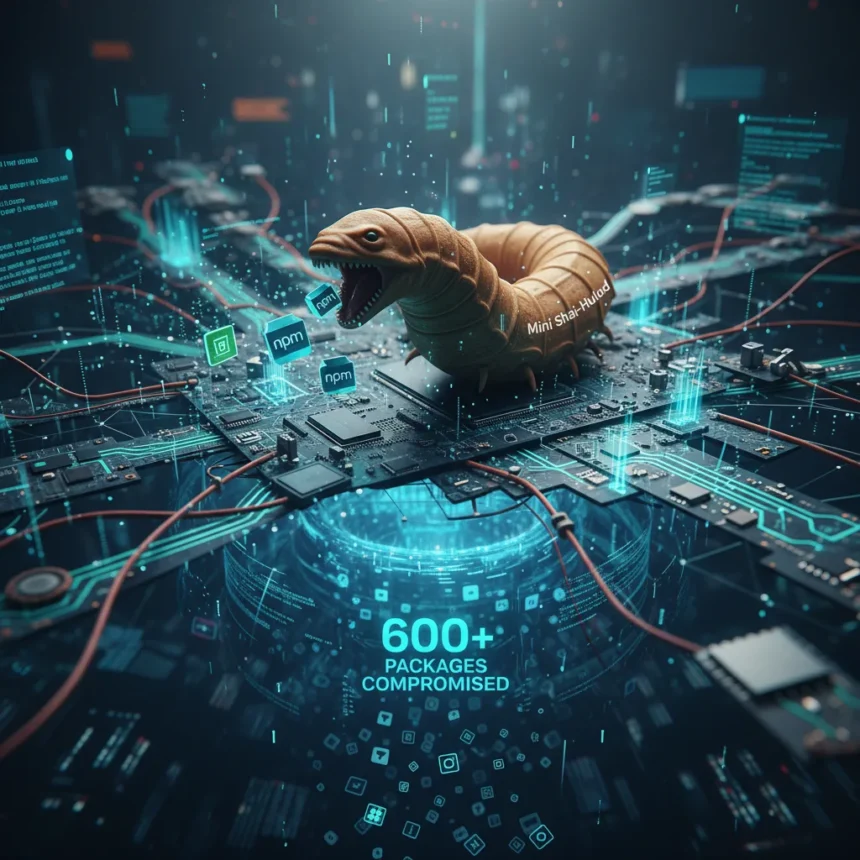
An npm supply-chain attack targeting the JavaScript ecosystem has expanded dramatically, with attackers publishing over 600 malicious packages to the npm registry. The campaign, dubbed Mini Shai-Hulud, represents an escalating threat to developers and organizations relying on open-source dependencies, with security researchers warning that thousands of downstream projects could be affected.
Key Takeaways
- Over 600 compromised npm packages have been published as part of the Mini Shai-Hulud campaign.
- The attack targets developers and CI/CD environments through self-propagating malicious code.
- Thousands of downstream projects may be exposed to the compromised dependencies.
- The campaign continues to spread, affecting new packages beyond initial detection.
- Developers are urged to audit their dependencies and update immediately.
Understanding the npm supply-chain attack
An npm supply-chain attack is a coordinated effort to inject malicious code into legitimate-looking packages published to the npm registry, the central repository for JavaScript libraries. Attackers use these poisoned packages to compromise development environments and production systems that install them as dependencies. The Mini Shai-Hulud campaign operates as a self-propagating worm, meaning infected packages can automatically spread the malware to other projects during installation.
The scale of this particular attack distinguishes it from isolated package compromises. Rather than targeting a single popular library, the attackers have distributed malicious versions across hundreds of distinct packages. This breadth makes detection harder for security tools that typically flag anomalies in high-profile packages. A developer might install what appears to be an obscure utility, unaware that the package has been weaponized.
The scope and impact of the Mini Shai-Hulud campaign
The campaign has compromised over 600 npm packages, with the attack continuing to spread to new packages. Security researchers have identified that the malware targets both developer machines and continuous integration pipelines, making it particularly dangerous for organizations that automate their build and deployment processes. An infected CI/CD environment can silently compromise every subsequent release, spreading the attack downstream to end users.


The potential impact extends far beyond the 600 directly compromised packages. Because npm dependencies are nested—packages depend on other packages, which depend on others—a single malicious package can be pulled into thousands of projects indirectly. A developer might never directly install the compromised package but still inherit it through a chain of legitimate dependencies. This cascading effect means the true scope of exposure likely reaches thousands of projects, many of which may not even realize they have been affected.
Why npm supply-chain attacks are particularly effective
The npm ecosystem’s openness and the sheer volume of packages make it an attractive target for attackers. npm hosts millions of packages, and while most are legitimate, the registry’s permissive publishing model means attackers can upload new malicious packages with minimal friction. Developers, meanwhile, often install dependencies without thoroughly auditing every line of code—a practical necessity given the complexity of modern JavaScript projects.



Supply-chain attacks exploit this trust. A developer trusts that a package they install from npm is legitimate because it exists in the official registry. The Mini Shai-Hulud campaign leverages this assumption by distributing packages that appear functional on the surface but contain hidden malicious payloads. The self-propagating nature of this particular worm makes it especially insidious: once installed, it can modify other packages or inject itself into build artifacts, ensuring persistence even if the original compromised package is removed.
What developers should do right now
The immediate action for any developer is to audit their project dependencies and check whether any of the 600+ compromised packages are installed, either directly or indirectly. Tools like npm audit can identify known vulnerabilities, though they may not catch all variants of this attack if the malicious packages have not yet been catalogued by security databases. Developers should review their package-lock.json or yarn.lock files for any suspicious or unfamiliar packages.
For organizations running automated CI/CD pipelines, the risk is higher. An infected build environment can silently compromise every release. Teams should consider implementing stricter dependency controls, such as private npm registries that cache and vet packages before they enter the build pipeline. Code review practices should also be strengthened to catch suspicious dependencies before they are merged into production branches.
Is my project affected by the npm supply-chain attack?
Check your package-lock.json or yarn.lock file for any of the 600+ compromised packages. If you have direct or transitive dependencies on these packages, your project is potentially affected. Run npm audit to identify known vulnerabilities, but also manually review your dependency tree for unfamiliar or suspicious packages. If you find compromised packages, update them immediately and regenerate your lock files.



How can I prevent npm supply-chain attacks in the future?
Use a private npm registry or proxy to cache and vet packages before they reach your development environment. Implement strict dependency policies that limit which packages your organization can use. Regularly audit dependencies and remove unused packages. Consider using tools that analyze package contents for suspicious behavior before installation. Keep your npm client and Node.js runtime updated to the latest versions.
What makes this attack different from previous npm compromises?
The Mini Shai-Hulud campaign’s scale and self-propagating nature set it apart. Rather than compromising a single high-profile package, the attackers distributed malware across hundreds of packages. The worm’s ability to spread itself to other packages makes it persistent and harder to eradicate once installed. Previous npm attacks often targeted specific popular libraries; this campaign casts a wider net, making it harder for developers to identify and avoid the threat.
The npm supply-chain attack underscores a fundamental tension in open-source development: the ecosystem’s strength lies in its openness and accessibility, but those same qualities create security vulnerabilities. Developers and organizations must balance convenience against vigilance, trusting the ecosystem while remaining skeptical of unexpected packages. Until npm registry security or package verification mechanisms improve, auditing dependencies and maintaining strict controls over what enters your build pipeline remain essential practices.
Edited by the All Things Geek team.
Source: TechRadar