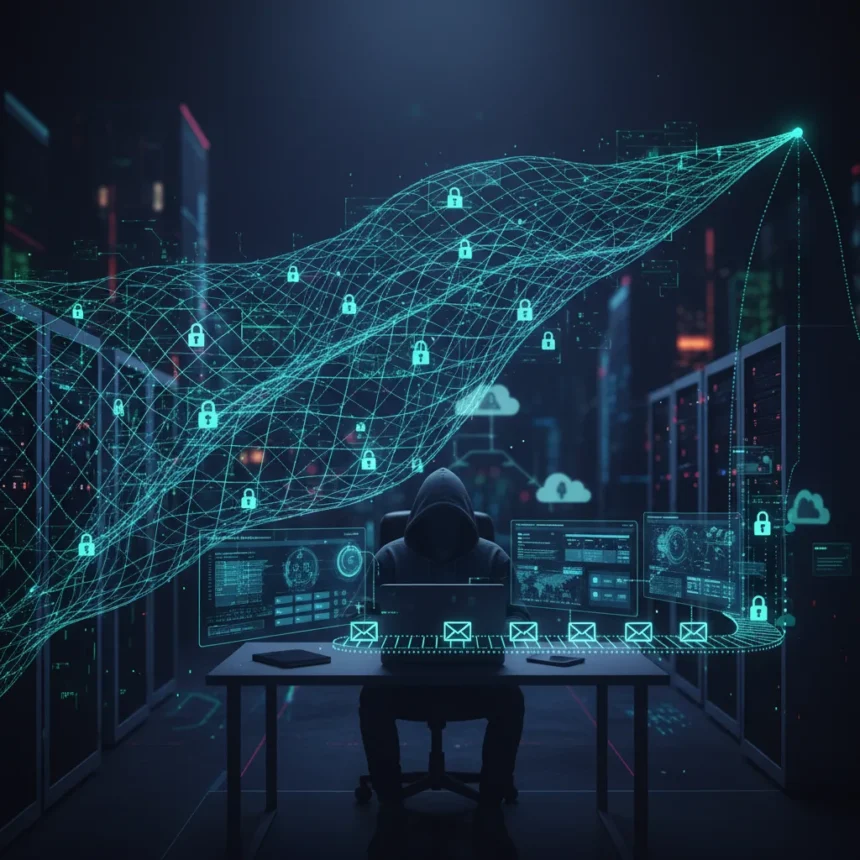
Phishing as a service refers to a cybercriminal business model where attackers sell phishing campaign tools, infrastructure, and services to other criminals, dramatically lowering the technical barrier for launching large-scale attacks. This emerging threat transforms phishing from a specialized skill into a commoditized service, meaning more actors with fewer technical skills can now orchestrate convincing email campaigns targeting your organization.
Key Takeaways
- Phishing as a service removes technical barriers, enabling less-skilled attackers to launch sophisticated campaigns
- The threat landscape has shifted from isolated attacks to organized criminal marketplaces offering turnkey phishing solutions
- Employee training remains the most cost-effective first line of defense against phishing threats
- Multi-factor authentication significantly reduces account compromise risk even when credentials are stolen
- Email security tools and monitoring systems must work together to catch both known and emerging phishing tactics
Understanding the Phishing as a Service Marketplace
The phishing as a service model operates like legitimate software-as-a-service platforms, but for criminal purposes. Threat actors purchase or rent phishing kits, email delivery infrastructure, credential harvesting pages, and even customer support from specialized vendors operating on dark web forums and encrypted messaging channels. This industrialization of phishing means attackers no longer need to build custom campaigns from scratch—they can buy pre-made templates, domain hosting, and email spoofing tools off the shelf.
What makes phishing as a service particularly dangerous is its accessibility. A cybercriminal with minimal technical knowledge can now execute phishing campaigns that rival those launched by sophisticated threat groups. The barrier to entry has collapsed. Instead of requiring expertise in email protocols, HTML coding, or infrastructure setup, attackers simply purchase a service, specify their target, and launch. The service provider handles the technical complexity.
Why Employees Remain Your First Defense Against Phishing as a Service
Security awareness training is not a luxury—it is the most practical defense against phishing as a service threats. When employees can identify suspicious emails, verify sender legitimacy, and report threats, they become your organization’s most effective security layer. Unlike technical controls that can be bypassed, human judgment applied consistently across thousands of employees creates friction that discourages attackers.

Effective training must go beyond generic awareness posters. It should include simulated phishing campaigns that test employees in realistic scenarios, immediate feedback when they fail tests, and regular refresher sessions that reinforce good habits. Organizations that conduct monthly or quarterly phishing simulations see measurable reductions in click-through rates. The goal is not perfection—it is making your organization a harder target than competitors, which encourages attackers to move on to easier prey.
Implementing Technical Controls to Stop Phishing as a Service Attacks
Email security tools form the backbone of technical defense. Advanced email filtering solutions can identify phishing attempts by analyzing sender reputation, message headers, attachment behavior, and content patterns. These systems catch many attacks before they reach inboxes, but they are not foolproof—sophisticated phishing as a service providers deliberately craft campaigns to evade detection.



Multi-factor authentication is non-negotiable. Even when attackers successfully steal credentials through phishing, MFA prevents them from accessing accounts without a second authentication factor. Organizations should enforce MFA across all critical systems, particularly email, VPN, and administrative accounts. This single control has prevented countless account compromises that would have otherwise led to data breaches or ransomware deployment.
Domain authentication protocols—SPF, DKIM, and DMARC—prevent attackers from spoofing your organization’s email domain. When properly configured, these protocols make it significantly harder for phishing as a service campaigns to masquerade as legitimate internal communications. Implementing DMARC with a reject policy is especially important, as it tells receiving mail servers to reject any email claiming to be from your domain that fails authentication checks.
Monitoring and Response: Catching What Gets Through
Not every phishing email will be caught by filters or stopped by employee training. Organizations need monitoring systems that detect suspicious activity after compromise attempts, such as unusual login patterns, rapid credential usage, or anomalous file access. Security information and event management (SIEM) systems and user behavior analytics tools can identify compromised accounts faster than waiting for users to report problems.
Incident response procedures must be in place before an attack succeeds. Define clear escalation paths, establish communication channels for reporting suspicious emails, and conduct regular tabletop exercises that test your team’s ability to respond under pressure. When phishing as a service attacks do penetrate your defenses, response speed determines whether the breach causes minimal damage or catastrophic data loss.



FAQ
What makes phishing as a service different from traditional phishing attacks?
Traditional phishing required attackers to possess technical skills and build campaigns individually. Phishing as a service removes this barrier by offering pre-built tools, infrastructure, and support as a service, enabling less-skilled criminals to launch sophisticated attacks at scale.
Can email filters alone stop phishing as a service campaigns?
Email filters catch many attacks, but not all. Sophisticated phishing as a service providers deliberately design campaigns to evade detection. Filters must be paired with employee training, MFA, and monitoring systems to create layered defense.
How often should organizations conduct phishing simulation training?
Monthly or quarterly phishing simulations are most effective. Regular testing keeps security awareness top of mind, identifies vulnerable employees who need additional training, and demonstrates measurable improvement in click-through rates over time.
Phishing as a service has industrialized cybercrime, but it has not made defense impossible. Organizations that combine employee training, technical controls, and monitoring create environments where attackers face significant friction. The attackers using phishing as a service are counting on your organization being unprepared—prove them wrong.
Edited by the All Things Geek team.
Source: TechRadar