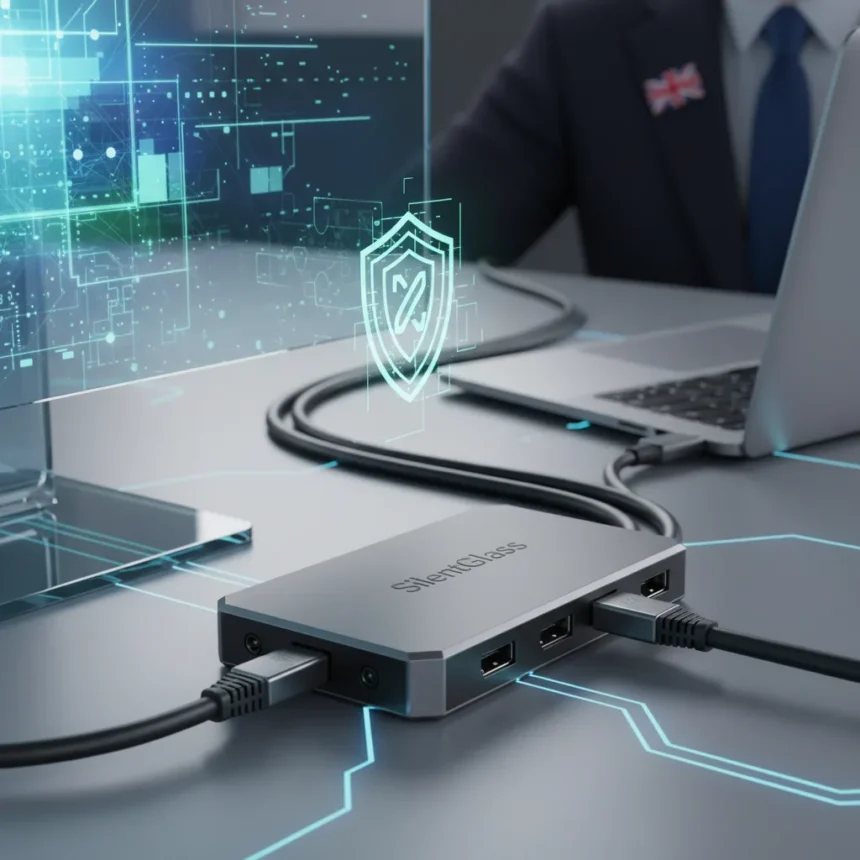
SilentGlass display security represents a fundamental shift in how governments and businesses protect overlooked vulnerabilities in their IT infrastructure. The UK’s National Cyber Security Centre (NCSC), part of GCHQ, has released its first branded commercial product—a plug-and-play hardware device that identifies and blocks malicious traffic traveling between computers and displays via HDMI and DisplayPort connections.
Key Takeaways
- SilentGlass is a threat-agnostic device that detects and blocks any kind of malicious activity in display data channels, not specific attack signatures.
- Already deployed across UK government estates for several years before public commercial release on April 22, 2026.
- Manufactured and sold globally by Goldilock Labs under an intellectual property license from the NCSC, in partnership with Sony UK Technology Centre.
- Treats hardware interfaces as security control points rather than assumed trust boundaries, marking a new approach to physical connectivity protection.
- Positioned as affordable and low-cost, addressing a security gap that has been widely overlooked in commercial and government environments.
Why Display Cables Have Become a Serious Security Risk
Monitors and display screens process sensitive data every single day in offices, data centers, and home offices worldwide. Yet the cables connecting them to computers have almost never been treated as security boundaries. That oversight has created a genuine risk. Displays are exposed through supply chains, third-party servicing, and direct physical access—making them prime targets for attackers seeking to intercept or manipulate what employees and users see on screen.
The threat is not theoretical. An attacker with access to a monitor or its cable could inject malicious data into the display stream, alter what appears on screen, or extract sensitive information. Because display interfaces have historically been trusted without question, few organizations deployed any protection at this layer. SilentGlass fills that gap by treating the display cable itself as a point where security controls should exist.
How SilentGlass Display Security Actually Works
SilentGlass operates as a hardware filter between your computer and display. You plug it into the HDMI or DisplayPort connection, and it monitors all traffic flowing through that link in real time. The device is threat-agnostic, meaning it does not rely on signature databases or threat intelligence feeds to identify attacks. Instead, it detects anomalous or malicious behavior in the data channel itself, blocking anything unexpected before it reaches your display.


The key advantage here is simplicity. Users do not need to configure rules, update threat definitions, or understand what specific attacks they are defending against. Ollie Whitehouse, NCSC Chief Technology Officer, emphasized this shift in thinking: “SilentGlass is the first step in a wider effort to enforce behaviour at hardware interfaces before it reaches complex software. It reflects a shift toward treating physical connectivity as a point of control rather than an assumed trust boundary”.
This is not a software-based solution running on your computer. It is a hardware device sitting passively in your cable run, requiring no drivers, no configuration, and no maintenance. Plug it in and it works.



From Classified to Commercial: The NCSC’s First Branded Product
The NCSC has been using SilentGlass internally across UK government estates for several years. The device has already been approved for the most high-threat environments within government, meaning it has been tested and validated under real-world security conditions. That operational track record is significant—this is not a new invention being released untested to the public.
The commercialization process itself is notable. Rather than manufacturing the device in-house, the NCSC licensed its intellectual property through a competitive process to Goldilock Labs, a UK-based company, with manufacturing partnership support from Sony UK Technology Centre. This model allows the NCSC to focus on security innovation while letting industry handle production and distribution at scale.
Stephen Kines, co-founder of Goldilock Labs, framed the release this way: “What was once confined to national security environments is now being applied with a low-cost, easy-to-deploy solution for CNI and businesses where the same risks exist”. Critical National Infrastructure (CNI) organizations—power grids, water systems, financial networks—face the same display-based threats that government agencies do. Now they can deploy the same protection.
Who Needs SilentGlass Display Security and Why
The obvious candidates are government agencies, financial institutions, and critical infrastructure operators. These organizations handle classified or highly sensitive data and already invest heavily in endpoint security. Adding hardware-level display protection closes a real gap in their defense strategy.


But the device also applies to any organization where supply chain security matters. If your displays come from third-party vendors, pass through multiple hands before reaching your office, or are serviced by external technicians, the risk exists. Healthcare organizations, law firms, and enterprises handling customer data all fit this profile.
For individual users, the calculus is different. Most consumer-grade malware does not target display cables. The threat model for SilentGlass is sophisticated—state-sponsored actors, organized crime with specific targets, or attackers with physical access to infrastructure. If you are a journalist, activist, or someone working with sensitive information in a high-threat environment, the device makes sense. For casual browsing and email, it is probably unnecessary.
What Sets SilentGlass Apart
No direct competitors exist in this space, which itself is telling. Hardware-level display security has been almost entirely absent from the commercial market. Traditional cybersecurity focuses on software endpoints, network perimeters, and data encryption. The physical interface between computer and monitor has been left unguarded.
SilentGlass is threat-agnostic, meaning it does not depend on knowing what attack you might face. It simply enforces expected behavior on the display data channel. This is fundamentally different from signature-based antimalware or rule-based intrusion detection systems that must know what they are looking for. A threat-agnostic approach is more resilient against novel or zero-day attacks targeting display interfaces.
The device is also designed for ease of deployment. Ollie Whitehouse noted that “Display screens and monitors are everywhere in modern business environments, and the SilentGlass device will help protect previously vulnerable IT infrastructure with unprecedented ease”. No software installation, no configuration, no training required. This simplicity matters enormously for scaling adoption across large organizations.
Availability and Pricing
SilentGlass was announced publicly on April 22, 2026, at the CYBERUK conference and is now commercially available globally. The device is described as affordable and low-cost, though specific pricing has not been disclosed. Orders are handled through Goldilock Labs, which manages manufacturing and distribution worldwide.
The global availability is important. This is not a UK-only product or a device available only through government channels. Businesses and organizations in any country can purchase and deploy it, subject to their own local regulations and procurement processes.
Is SilentGlass Worth Buying?
If you work in a high-security environment—government, finance, critical infrastructure, or sensitive research—and your organization has not yet addressed display-cable security, SilentGlass is worth evaluating immediately. It solves a real problem that has been overlooked for years, and it comes with the credibility of years of classified government use.
If you are a small business or individual user with standard cybersecurity practices in place, the urgency is lower. Your threat model probably does not include sophisticated attacks targeting display cables. But as supply chain attacks become more common and physical security becomes a larger part of overall risk management, this layer of protection will likely become standard practice.
The real value of SilentGlass is that it exists at all. For decades, the display interface was treated as a trust boundary by default. The NCSC has made the case—backed by years of government experience—that it should not be. That shift in thinking, now available in a commercial product, matters far more than the specific device itself.
Does SilentGlass work with all HDMI and DisplayPort cables?
SilentGlass is designed to work with standard HDMI and DisplayPort connections. It functions as a plug-and-play inline device, meaning it sits between your computer and display without requiring any special cables or adapters beyond what you already use. Compatibility with older or proprietary display standards has not been detailed in available information.
What happens if SilentGlass blocks traffic—will my display go blank?
When SilentGlass detects malicious or unexpected activity in the display data channel, it blocks that traffic. In theory, this could cause display issues if legitimate traffic is mistakenly flagged, but the device is designed to be threat-agnostic and permissive with normal display operations. The NCSC’s years of government deployment suggest false positives are minimal, but specific behavior in edge cases has not been publicly documented.
Can I use SilentGlass with a laptop or only desktop computers?
SilentGlass works with any device that outputs video via HDMI or DisplayPort—laptops, desktops, servers, and specialized equipment. The device itself is agnostic to the source; it only monitors and filters the display data stream. Laptop users with external displays can deploy it just as easily as desktop users.
SilentGlass represents a genuine first in commercial cybersecurity: government-validated hardware protection for an interface that has been overlooked for far too long. Whether it becomes a standard addition to security-conscious deployments or remains a niche tool for high-threat environments will depend on how quickly organizations recognize display-cable attacks as a real risk. For now, it fills a gap that should have been addressed years ago.
Edited by the All Things Geek team.
Source: Tom's Hardware